
A fair review of an employee adapting to new software asks whether they used the training and access provided, completed assigned tasks accurately, raised blockers through the approved channel, and applied feedback. It does not treat system defects, unavailable accounts, or unannounced workflow changes as personal failures. The hypothetical comments below help supervisors distinguish learning, actual use, and measurable work results. Check the documented timeline and standards in your own organization before assigning a rating or claiming a productivity gain.
Reconstruct the rollout timeline first
Before writing an appraisal, list when the new tool was introduced, which workflows changed, when the employee received access, and when formal training became available. A person who used a sandbox for one session cannot fairly be compared with someone who worked in the live system for the entire quarter. Record any outage or temporary process that affected the review period.
A useful manager note might distinguish initial orientation, supervised practice, live processing, and follow-up coaching. This sequence helps identify whether the employee struggled with learning the interface, understanding the revised policy, or waiting for permissions. Those differences require different support and should not be hidden under a generic label such as “resistant to change.”
Measure accuracy separately from navigation speed
Opening screens quickly is not the same as performing the work correctly. Evaluate whether the employee selected the correct records, checked required fields, used the approved workflow, and routed exceptions safely. For an HR system, the important behavior may be protecting personnel data; for inventory software, it may be checking a discrepancy before updating an item. The relevant standard is the job task, not familiarity with every menu.
Where your organization collects error or completion data, confirm that it measures comparable work and does not count training exercises as production. A numerical improvement should have a valid baseline. Without reliable figures, you can still describe documented actions: correctly using the new approval step, spotting a field mismatch, or requesting a review before submitting an uncertain record.
Write a positive adoption comment with proof
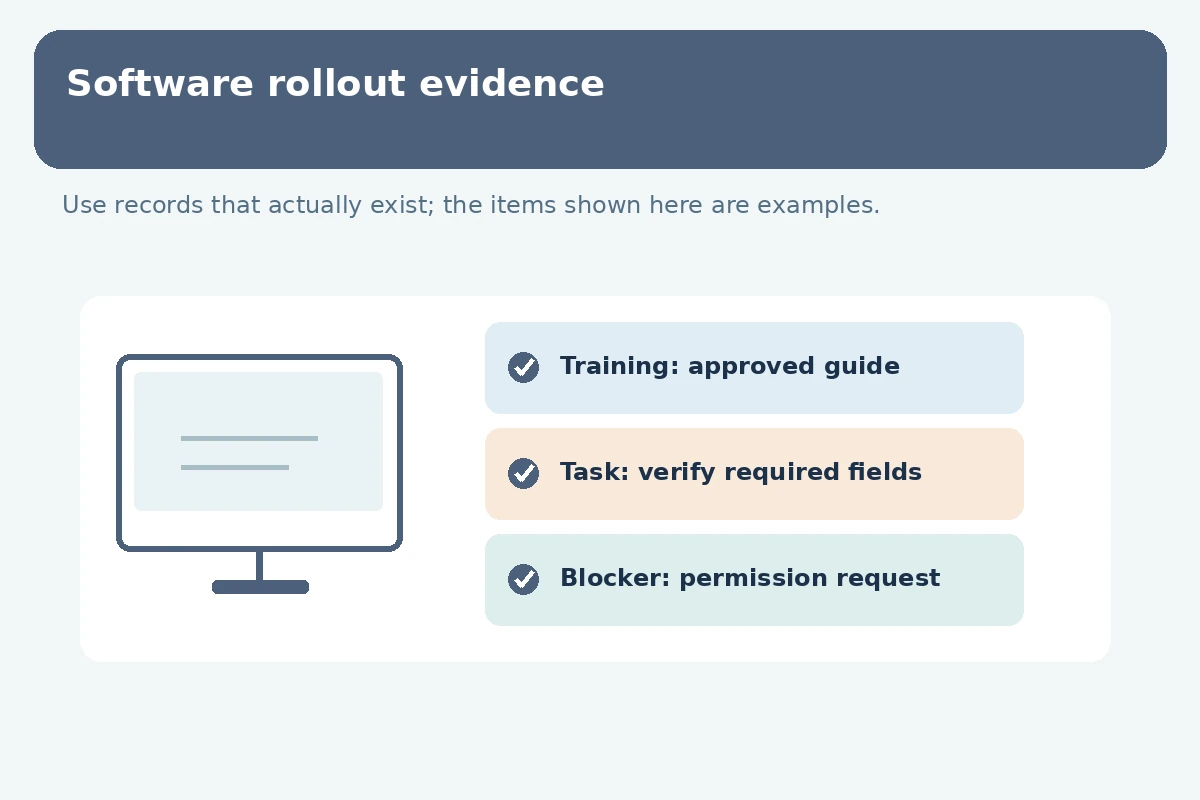
An illustrative recognition comment is: “After receiving training on the revised intake system, Casey used the approved checklist for new entries, flagged a missing account permission, and worked with the system owner to confirm the correct request route.” The employee’s contribution is clear even though the system owner changed the permission setting.
Another valid strength is helping colleagues understand a known procedure without claiming to be the administrator. If the employee shared the published guide and reported common questions, credit that collaboration. Do not infer that one helpful message proves the whole team adopted the tool successfully; different employees may have had different access and training.
Explain learning gaps without attaching a label
A constructive comment can focus on a repeatable behavior. Example: “Several draft records were submitted without the final verification step shown in the new checklist. We will review the field sequence together before the next processing cycle.” This is more actionable than “struggles with technology.” Verify that the checklist was current and accessible to the employee.
If an employee needed more practice, identify the specific part of the workflow that required support. Avoid guessing about age, aptitude, disability, or motivation. The EEOC emphasizes communicating and consistently applying expectations. A fair review does not penalize a person for a tool defect or unavailable training while describing that event as weak individual performance.
Differentiate employee actions from system defects
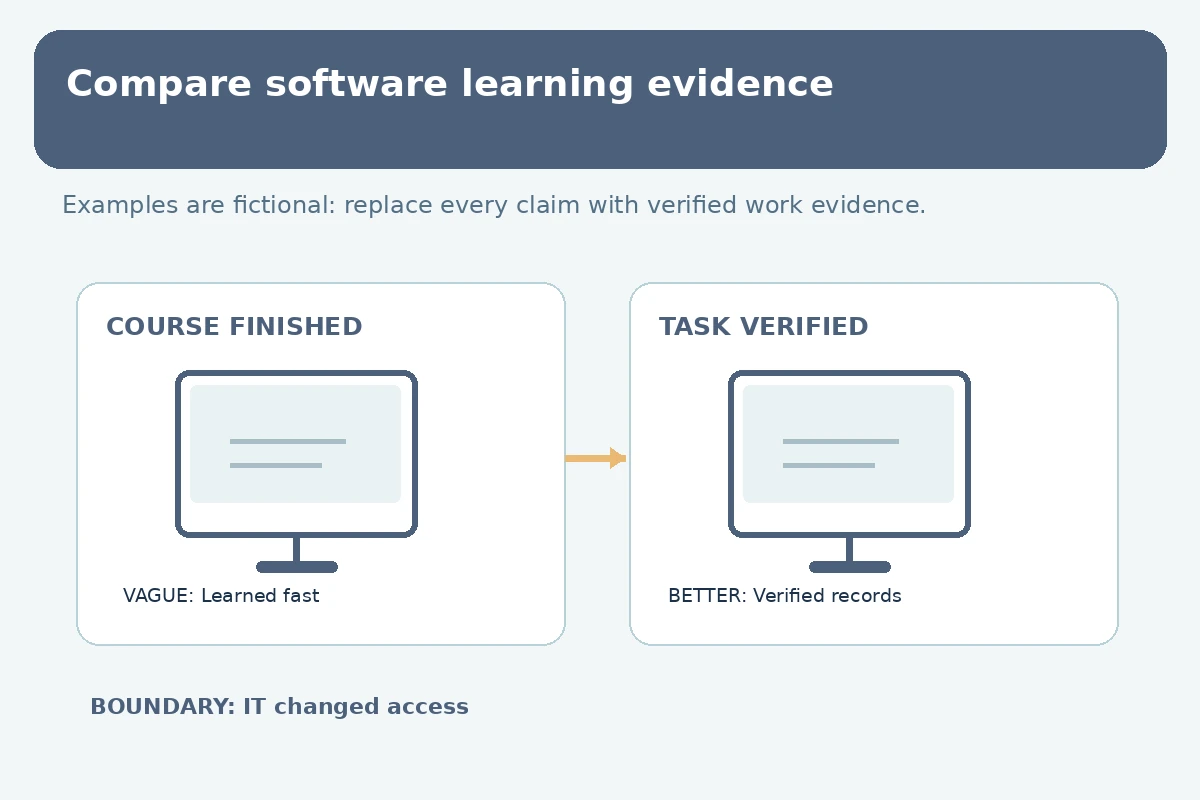
A software rollout can introduce confusing labels, unexpected validation rules, or slow integrations. Record those conditions as constraints rather than unexplained employee mistakes. A useful review might state that the employee documented the error screen, preserved the transaction status, and sent the issue to the help desk. That describes responsible problem reporting, even if a vendor had to fix the defect.
For unauthorized workarounds, be precise about the concern and the approved remedy. An employee should not bypass permissions or share passwords to keep work moving. If the system prevented the task, the safe action may be to stop, document the status, and ask the designated owner. Credit honest escalation rather than only quick throughput.
| Review focus | Example evidence | Important limit |
|---|---|---|
| Access and training | Role access and guide were available | Do not assume equal start dates |
| Task accuracy | Required checks completed | Speed alone is not quality |
| Problem escalation | Recorded error sent to owner | Do not reward bypassing controls |
Build one realistic next-cycle learning target
Choose a next step based on the identified gap: practice the approval sequence in a permitted environment, complete the role-specific training module, use a current job aid, or join a supervised review of exception cases. State how the employee and manager will know whether the skill was applied; a completed training session alone is not proof of accurate live work.
Management should specify the support it will supply. That might include account access, a current guide, scheduled coaching, or an escalation contact. If a new system changes responsibilities substantially, clarify revised performance expectations rather than silently judging past work against a later standard.

Read the final evaluation for accuracy and equity
Before submitting, check dates, system names, access status, and any figures. Remove screenshots containing private records or credentials. If you reference help desk tickets, use approved summaries rather than copying sensitive incidents into the appraisal. Describe what the employee actually did and distinguish their work from changes completed by IT or a vendor.
Ask whether the same review would be given to another employee with the same tasks, training time, and access. Include strengths and a clear improvement step when supported. The final comment should be a useful record of adaptation and business process quality, not an unsupported personality judgment or a promise that a tool will automatically improve performance.
How We Research Fair Performance Reviews
We compared the U.S. Office of Personnel Management’s guidance on clear, verifiable standards and continuous performance conversations with the EEOC’s advice on consistent, factual evaluations. University of Wisconsin–Madison’s HR writing guide provides a useful model for observable behavior and balanced comments; it is institutional guidance rather than a rule for every employer. Each scenario on this page is hypothetical and must be adapted to verified facts and applicable workplace policies. We do not claim any particular rating, pay result, promotion, or legal outcome. For our website disclosure see affiliate disclosure.
Research sources: OPM performance standards; OPM supervisor roadmap; EEOC evaluations; UW–Madison writing guide. Review employment standards, confidentiality rules, and the actual task ownership with your employer before reusing any example.
Frequently Asked Questions About This Review
Explore Related Career Guides
Check role expectations, actual access, training opportunity, workflow complexity, and evidence before drawing a conclusion.
No. Training completion and correct performance of assigned work are separate observations.
Document the system issue and the employee’s response separately. Avoid turning a verified defect into a personal appraisal claim.
Credit an observed explanation or use of approved materials, without claiming administrator authority or team-wide outcomes.
Only if permitted and appropriately redacted. A neutral description is often safer than attaching sensitive screens.