
When you write performance review comments about customer escalations, judge the employee’s handling of the issue within their authority: listening, recording accurate facts, using the approved route, and keeping the customer informed when appropriate. A frontline worker should not be evaluated as though they can waive company policy, disclose protected records, or make a supervisor’s decision. The sample comments in this guide are hypothetical; use actual documented cases, the review period, and your employer’s rules before assigning a formal rating.
Separate triage behavior from final resolution
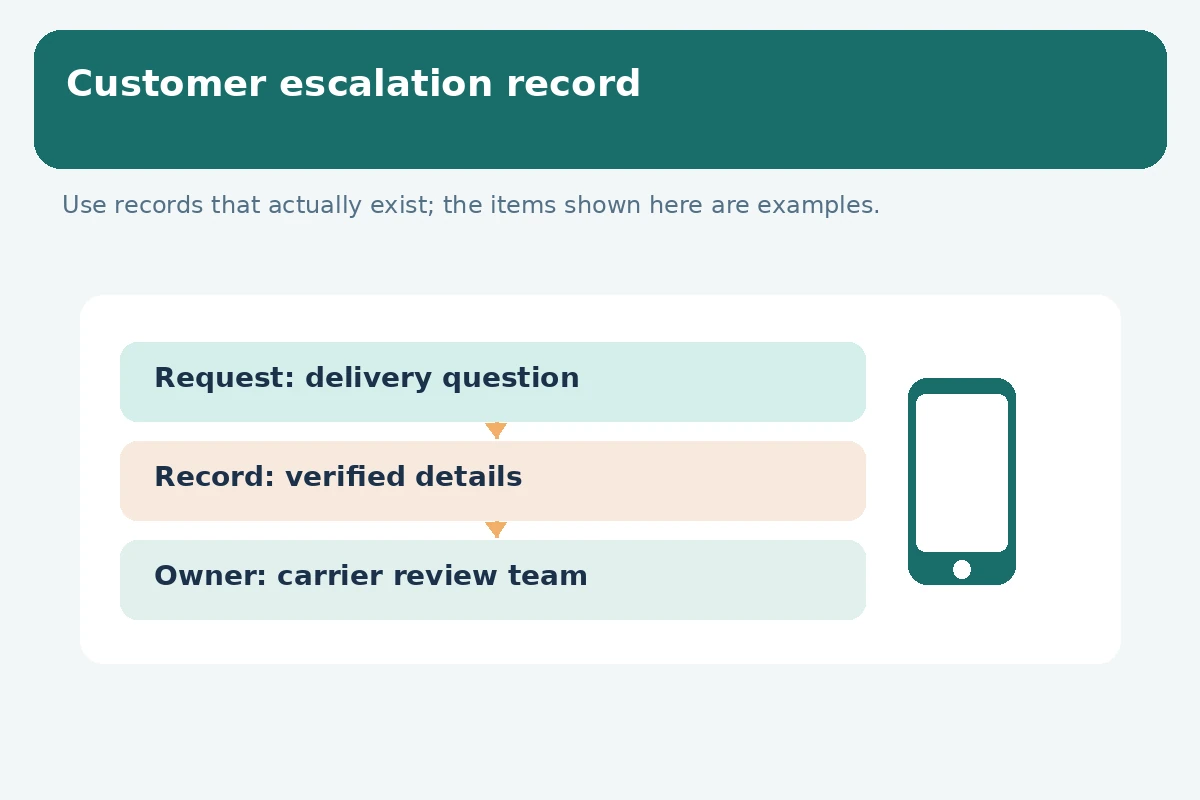
Customer cases often move through several people. An associate may listen to the customer, verify an order number through the approved system, record the request, and transfer it to a manager who can decide on a remedy. Those are different responsibilities. If the manager later approves a refund, do not describe that decision as the associate’s accomplishment unless the associate truly held that authority.
Good evaluation criteria reflect what the role controls: whether the employee identified the issue, used respectful language, captured the necessary facts, and escalated at the right point. A customer who remains dissatisfied does not automatically prove poor performance. Review the employee’s actions and the actual options available instead of judging only by a final survey score.
Use authorized records to confirm what happened
Review case notes or tickets only when the performance process permits it. Useful evidence may include the recorded issue category, the customer’s requested outcome, a handoff timestamp, and a documented response. A ticket title alone may not reveal how the employee handled the conversation, so check the available context before reaching a conclusion.
Protect personal details by summarizing the work rather than copying customers’ names, payment information, or private correspondence into the appraisal. If a complaint involved sensitive or regulated data, follow the organization’s escalation and privacy procedures. Do not introduce specific dollar losses or customer satisfaction numbers unless a verified record supports them.
Recognize effective listening and clear handoffs
A fictional positive comment is: “When a customer raised a delivery discrepancy, Alex confirmed the order details using the approved screen, summarized the unresolved question, and routed the case to the team responsible for carrier review. The receiving team could identify what still needed checking.” This comment credits careful triage without claiming a resolved delivery dispute.
Another strength is a timely update that matches known facts: the employee says what stage the case has reached and who will provide the next response, rather than promising a decision date they cannot control. If the review mentions courtesy or empathy, connect it to a specific observable behavior, not a guess about the employee’s personality.
Write constructive feedback around a specific gap
If the case record omitted a key detail, state what was missing and why it mattered. An illustrative comment: “The case notes did not include the promised callback channel, so the next agent had to confirm it again. Recording the preferred contact route before transfer would make the follow-up more consistent.” Check that the software had an accessible field for this information.
If an employee escalated late, ask whether the trigger was clear in the published procedures. Some cases require immediate safety, fraud, privacy, or supervisor review; staff should not improvise fixes to avoid an escalation metric. An appraisal should reward sound judgment and correct routing, not discourage necessary escalation.
Compare the service behaviors separately
Evaluate listening and clarification, record accuracy, response boundaries, and next-owner clarity as distinct dimensions. A person may be excellent at de-escalating an upset customer but inconsistent in documenting the next step. That leads to a focused coaching action rather than a vague low rating for “customer focus.”
Avoid rewarding unsupported promises. Saying “I guarantee this will be fixed today” may sound decisive yet mislead a customer when the employee has no authority to promise the outcome. A more credible behavior is stating what can be checked now and explaining the approved follow-up path. Match the review to the actual service standard.
| Review focus | Example evidence | Important limit |
|---|---|---|
| Listen and clarify | Issue summarized accurately | Do not infer customer motives |
| Record and route | Next team had required facts | No unsupported policy changes |
| Update customer | Accurate status and next step | No guaranteed remedy |
Choose an improvement that a reviewer can observe
A practical follow-up could involve using an approved case-note checklist for the next review period, rehearsing when to escalate policy exceptions, or asking a supervisor to review a sample of permitted de-identified records. Define who provides coaching and how improvement will be assessed. Avoid unrealistic promises that all future cases will end positively.
Employees also need support: current policy documents, functional access, clear decision thresholds, and enough time to document. The review should identify missing resources as well as employee actions. If policy responsibility sits with another department, the manager should record that dependency rather than making the frontline worker solely accountable.

Check fairness before submitting the comment
Compare equivalent cases under the same criteria, including whether customers had similar options and whether support resources were available. Do not judge an employee negatively because of a protected trait, medical leave, or a stereotype about speech or manner. The EEOC advises employers to use communicated standards consistently and document relevant facts.
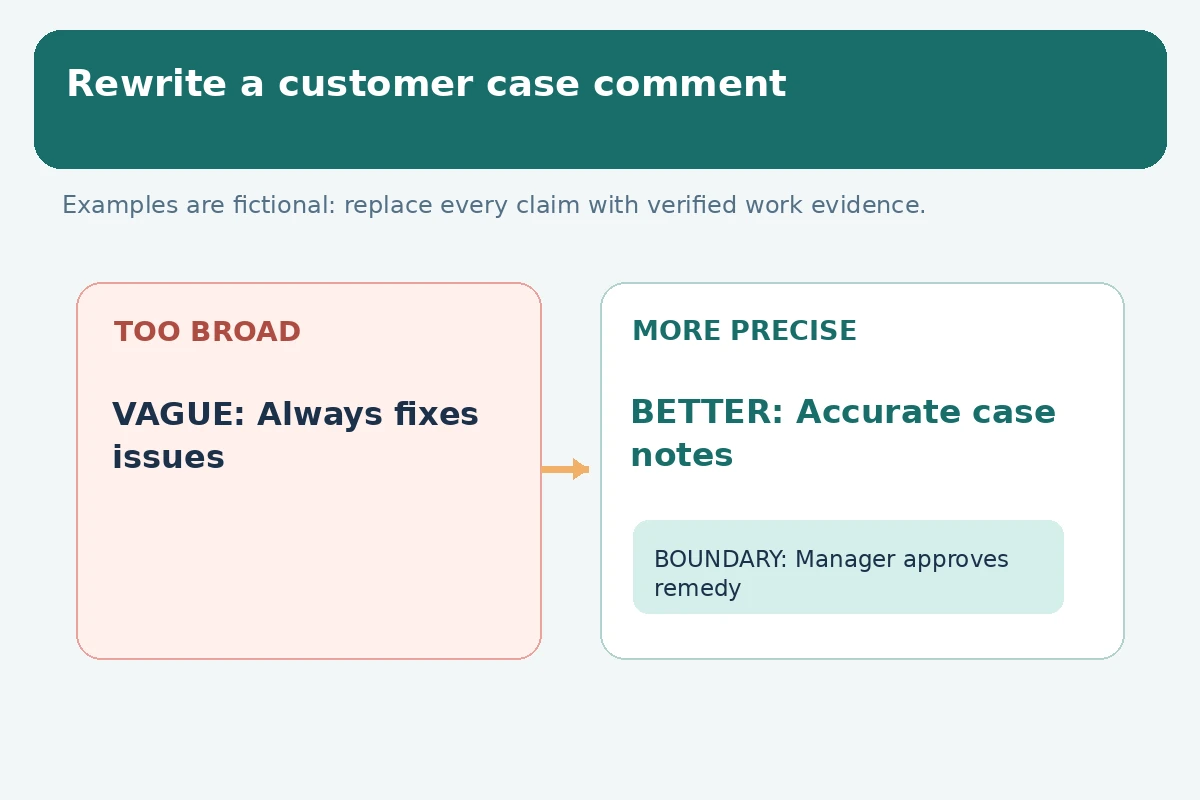
Read the completed review and remove broad statements such as “always makes customers angry” unless supported, appropriately scoped evidence justifies them. Use one or two specific observed examples and a clear next step. The goal is a reliable process for fair service feedback, not a dramatic retelling of a difficult encounter.
How We Research Fair Performance Reviews
We compared the U.S. Office of Personnel Management’s guidance on clear, verifiable standards and continuous performance conversations with the EEOC’s advice on consistent, factual evaluations. University of Wisconsin–Madison’s HR writing guide provides a useful model for observable behavior and balanced comments; it is institutional guidance rather than a rule for every employer. Each scenario on this page is hypothetical and must be adapted to verified facts and applicable workplace policies. We do not claim any particular rating, pay result, promotion, or legal outcome. For our website disclosure see affiliate disclosure.
Research sources: OPM performance standards; OPM supervisor roadmap; EEOC evaluations; UW–Madison writing guide. Review employment standards, confidentiality rules, and the actual task ownership with your employer before reusing any example.
Frequently Asked Questions About This Review
Explore Related Career Guides
A case may demonstrate sound triage and respectful communication even when the final outcome was outside the employee’s control.
Only where permitted and necessary. Usually a neutral summary with protected details removed is more appropriate.
Not necessarily. The trigger, policy limits, and appropriateness of each escalation matter more than raw counts alone.
Describe the missing information and how it affected the next owner, then specify the review or checklist that could help.
Describe the specific statement and clarify the approved communication boundary; do not invent a result or disciplinary finding.