
Nonprofit donor records experience can demonstrate careful data entry, document review and coordinated communication, even when you did not raise gifts personally. Name your actual role—donor services assistant, development office clerk, volunteer database helper or another verified title—and the dates and organization. Describe what you did with contribution information under approved procedures, such as recording updates, flagging mismatches or preparing acknowledgement drafts. Do not claim you secured donations, approved receipts or controlled donor relationships when those decisions belonged to fundraising staff.
Separate development support from gift solicitation
A nonprofit development team may contain fundraisers, program staff, finance staff, data specialists and volunteers. A records assistant often supports them rather than meeting with prospective donors or designing fundraising strategy. Keep your role distinct. For instance, “Maintained assigned donor contact records and prepared lists for supervisor review” conveys administrative value without claiming personal responsibility for donations. The BLS describes fundraising work as a wider occupation; sharing a department with fundraisers does not mean you personally performed every part of that occupation.
If you volunteer for a fundraising office, label the role Volunteer, Development Office Support, or the official title the organization uses. Paid and unpaid experience can both be relevant, but the nature of the relationship matters. State the true organization and working dates, not the title of a campaign sponsor whose staff did not employ or supervise you. If you rotated between clerical and event support, choose the tasks the next employer actually needs rather than inventing a single elevated title.
Turn data hygiene into concrete resume evidence
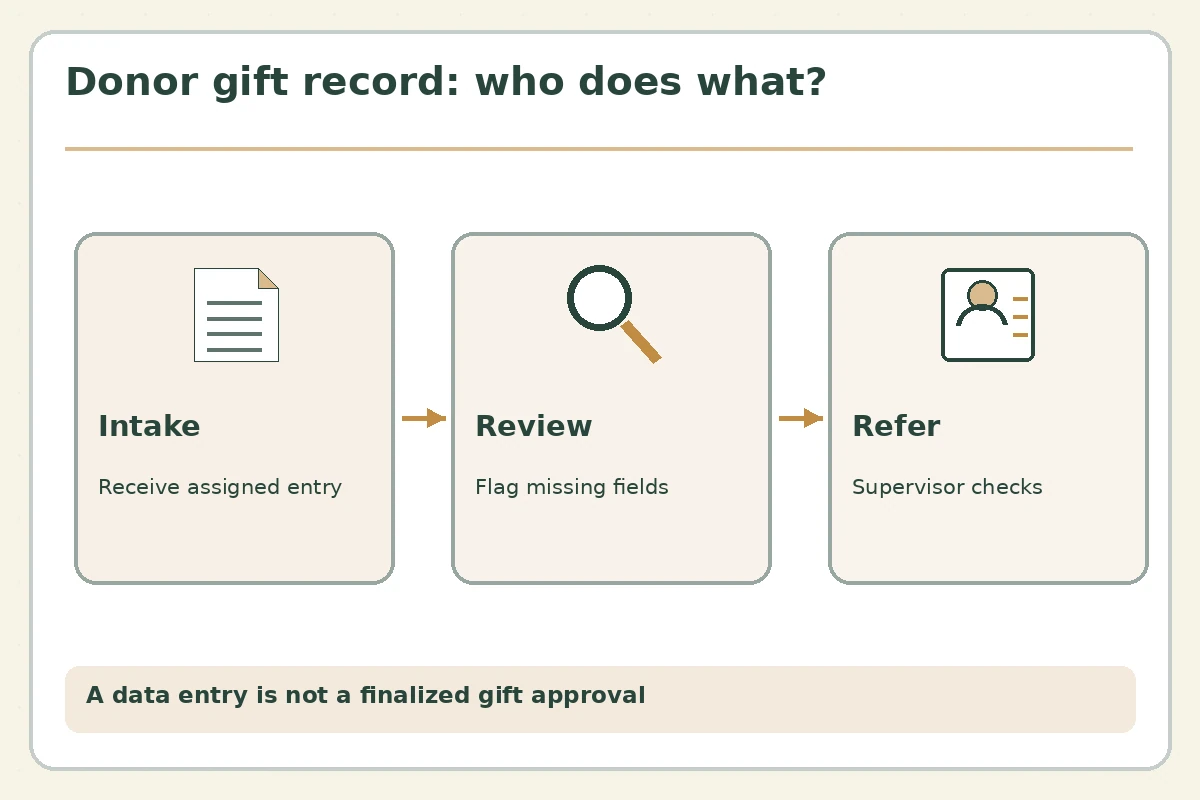
A reliable donor database depends on consistent fields, appropriate access and clear review of anomalies. You might have standardized phone formats, updated a mailing address after a verified request, compared two imported records or flagged a duplicate for someone to approve. Write only the activities you performed: “Reviewed assigned contact fields for missing information and flagged duplicate records for staff review.” This is stronger than the vague phrase “managed fundraising data” because the reader sees the actual checks and the approval boundary.
If a system automatically merges duplicate contacts, do not claim you designed the deduplication logic. If you manually changed records, identify whether you had permission and what kind of changes were in scope. Avoid donor names, gift histories, account numbers and screenshots in a public portfolio. A sample spreadsheet with invented entries can be marked fictional, but it must not be presented as a real donor database or as an employer’s official form.
Describe gift processing without inventing finance authority
Contribution records may move through intake, verification, acknowledgement, reconciliation and reporting. Your role may cover one stage. An illustrative bullet is “Prepared gift documentation for review and forwarded discrepancies to designated finance staff.” That does not claim you posted revenue, verified tax deductibility, issued legal receipts or approved a refund. Use the actual term from your process only if you understood and performed it. Sometimes “entered assigned gift records” is the most accurate and useful description.
Where a fundraising or finance professional signed off, preserve that chain of responsibility. Do not write “reconciled all donations” when you only assembled a report for someone else to compare. If the role required secure document storage, mention following approved access and retention procedures without explaining a real security configuration. The practical value of the work is disciplined records handling, careful communication about exceptions and the ability to distinguish a draft from an approved financial record.
Show acknowledgements as a coordinated workflow
Some organizations ask administrative staff to populate acknowledgement templates, check mailing addresses or assemble letters for signature. Describe the exact step. “Prepared acknowledgement drafts from approved templates and routed them for review” is appropriate when you had no authority to send or sign them. Avoid saying you “cultivated donors” or “secured repeat gifts” because an acknowledgement mailing does not establish those outcomes. A senior fundraiser or authorized staff member may own the relationship and final approval.
If you handled returned mail or corrected a preferred contact method, that can show record accuracy. You can explain how you checked an approved request, updated a permitted field and noted the follow-up. Do not include personal donor stories in a resume, even when the intention is to illustrate compassion. A hiring manager needs to understand the process and trust that you can protect sensitive information while keeping legitimate office work moving.

Choose experience evidence for the target vacancy
For a development assistant role, emphasize donor-record tasks and acknowledgement preparation. For an office clerk role, translate the experience into database maintenance, quality checks and file routing. For an entry-level finance position, mention only record-support work you actually did; do not imply bookkeeping, audit, accounting or tax expertise from exposure to donation forms. If you had authorization to work with basic exports, state which reports you prepared and who reviewed them rather than claiming full financial analysis.
A useful job-posting comparison asks whether the employer wants accurate record updates, relationship management or financial approvals. Those are different skill groups. Choose two or three bullets that match your honest experience. Do not stack every fundraising keyword into one line. If a task was performed as a one-off project, describe it as a project with its real dates instead of inventing ongoing responsibility for the donor management system.
Review a fictional before-and-after example
Weak: “Ran fundraising operations and increased revenue.” That usually overstates the authority of a donor-records helper and promises results without attributable data. Better, for someone who performed these tasks: “Checked contact entries for missing fields, prepared acknowledgement drafts, and flagged gift-record discrepancies for supervisor review.” The improved line names three concrete administrative actions. It remains hypothetical and must be trimmed to the particular worker’s duties before reuse.
Your final check is whether the job title, dates, tools and work samples are all defensible. Read each bullet and identify what document, checklist or routine memory could support it without sharing protected donor information. Confirm that a letter was a draft if you did not send it, and that a data correction was reviewed if you did not approve it. Clear attribution builds a more credible story than claiming that a support role independently produced campaign results.

How We Research and Check These Examples
We compared occupational duties and established resume-writing principles against the primary resources below on 2026-11-10. The role-specific bullets and process diagrams in this article are fictional teaching examples, not verified employment histories, proprietary forms, sample patients, customers, students, donors, or real outcomes. The sources support the boundaries and common tasks; they do not establish what any particular applicant was authorized to do. BLS — BLS describes donor record maintenance among fundraising activities but does not attribute strategic authority to clerical staff. O*NET — O*NET describes office clerk duties such as recordkeeping, communications and clerical support. CareerOneStop — CareerOneStop recommends accurate roles, dates, responsibility descriptions and relevant accomplishments in work experience. University of Colorado Boulder — University of Colorado Boulder discusses action, task and result statements, and nontraditional experience without title inflation. University of North Georgia — University of North Georgia recommends truthful titles, organization, dates, relevant work and reverse chronological presentation.
All examples are independent educational material, not employment verification or legal advice. Do not reuse personal records or protected workplace material in a portfolio. Review the JobAsk affiliate disclosure; this guide does not represent an approved paid partnership with the cited organizations.
More Resume and Cover Letter Guides
Yes, if the role was genuine and relevant. Clearly identify whether it was paid employment, an internship or volunteering.
Only with trustworthy attribution to your actual work and permission to share the evidence. Records support alone does not prove revenue impact.
It is a useful development-support process but does not establish donor solicitation or strategy ownership. Describe your actual step.
You may name a system you personally used, but do not reveal login details, actual donor information or screenshots of protected records.
Say that you identified discrepancies and referred them for authorized review. That is a clear and valuable contribution.