
An ongoing project can belong on a resume when it is relevant to the target role and you can point to work already performed. The entry should name the actual context, specify your contribution, and distinguish a completed milestone from work that is merely planned. A project title alone does not tell the reader whether you built, tested, drafted, or only proposed the work.
University of Pennsylvania Career Services recommends describing relevant projects and using action verbs that match your actual responsibility. Apply that idea to an unfinished project by writing about verified steps, not the hoped-for final outcome. If you have only brainstormed an idea, it may be too early for a resume entry. If you have an approved outline, reproducible analysis, functioning prototype, or documented user feedback, that can be concrete evidence.
Separate finished tasks from pending milestones
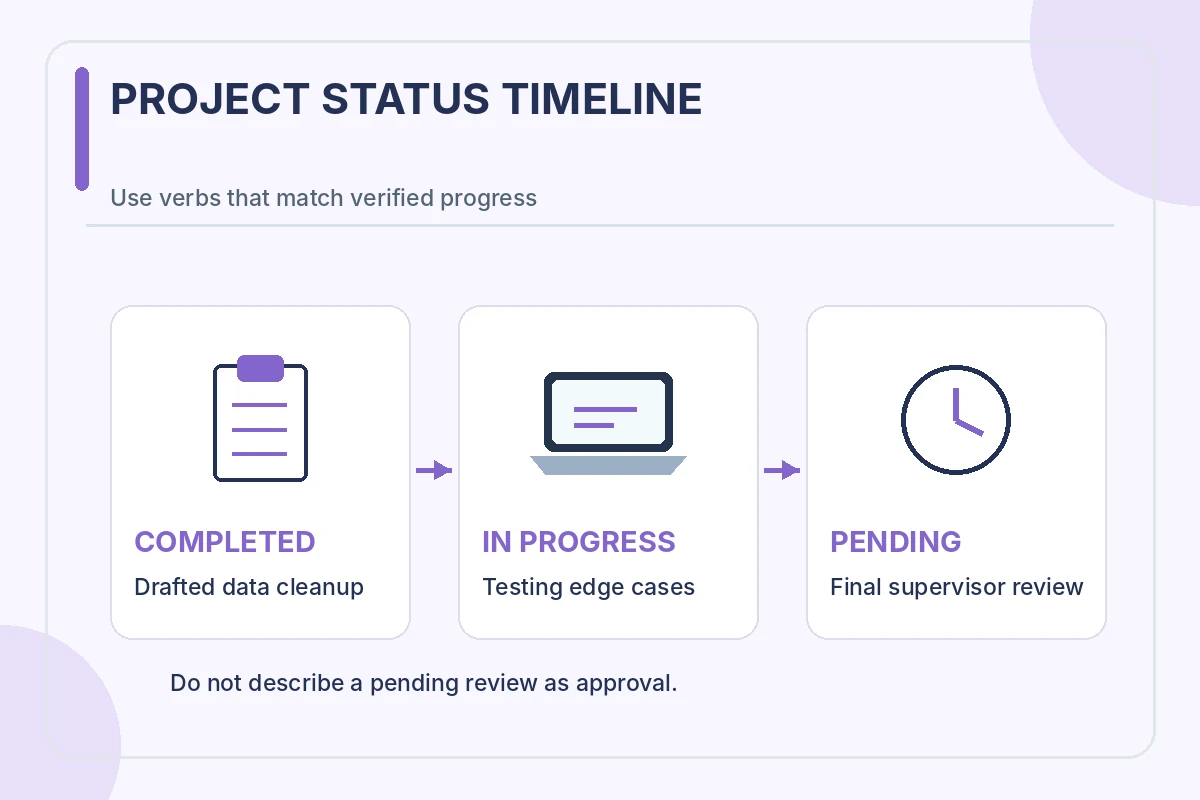
Create three private columns before writing: “Completed,” “In progress,” and “Not yet started.” Put only completed activities into past-tense accomplishments. Use present-tense wording or a clear status label for work you are still doing. Leave future claims out of the achievement bullet; a planned launch is not a successful launch, and a draft report is not a published study.
Consider a hypothetical student data project. The student has imported publicly available city records, documented missing values, and written a script that produces a preliminary chart. The student has not finished validation or shared a final report. A credible entry would mention importing, checking, and prototyping the chart; it would not say that the analysis “delivered recommendations adopted by the city.” The public records and draft visualization do not establish that result.
Avoid inventing completion percentages or deadlines to make a draft appear mature. If the program requires a presentation date, list the scheduled date only when verified and label it “planned” or “scheduled.” A hiring manager can understand precise progress without a fabricated milestone score.
Choose a location and title that reflect the context
Place a technical or class project under “Projects” or “Academic Projects” when that section helps explain qualifications not obvious from paid work. A research assistant assignment performed under a supervisor may fit under Research Experience. Volunteer projects should be identified by the actual nonprofit or program, not relabeled as an employer if no employment relationship existed.
For a group project, record the team size only if it is accurate and useful. Specify what part you owned and how someone reviewed it. For example, “Wrote the data cleaning notebook and documented unresolved records for team review” tells more than “Led a comprehensive analytics transformation.” If another student built the interface or a faculty adviser approved the method, do not quietly absorb that work into your own bullet.
A project that is only tangentially relevant should not crowd out paid experience or a stronger finished sample. Select entries by the skills the vacancy needs, the quality of evidence, and your ability to explain your decisions at an interview.
Build a bullet from action, artifact, and stage
Use a repeatable sentence structure: action you took; tool or process you actually used; artifact produced; current status or review boundary where necessary. For example, “Designed interview questions and completed a pilot with volunteer participants; revising the guide after instructor feedback.” This claims work already done and states the next activity without promising an outcome.
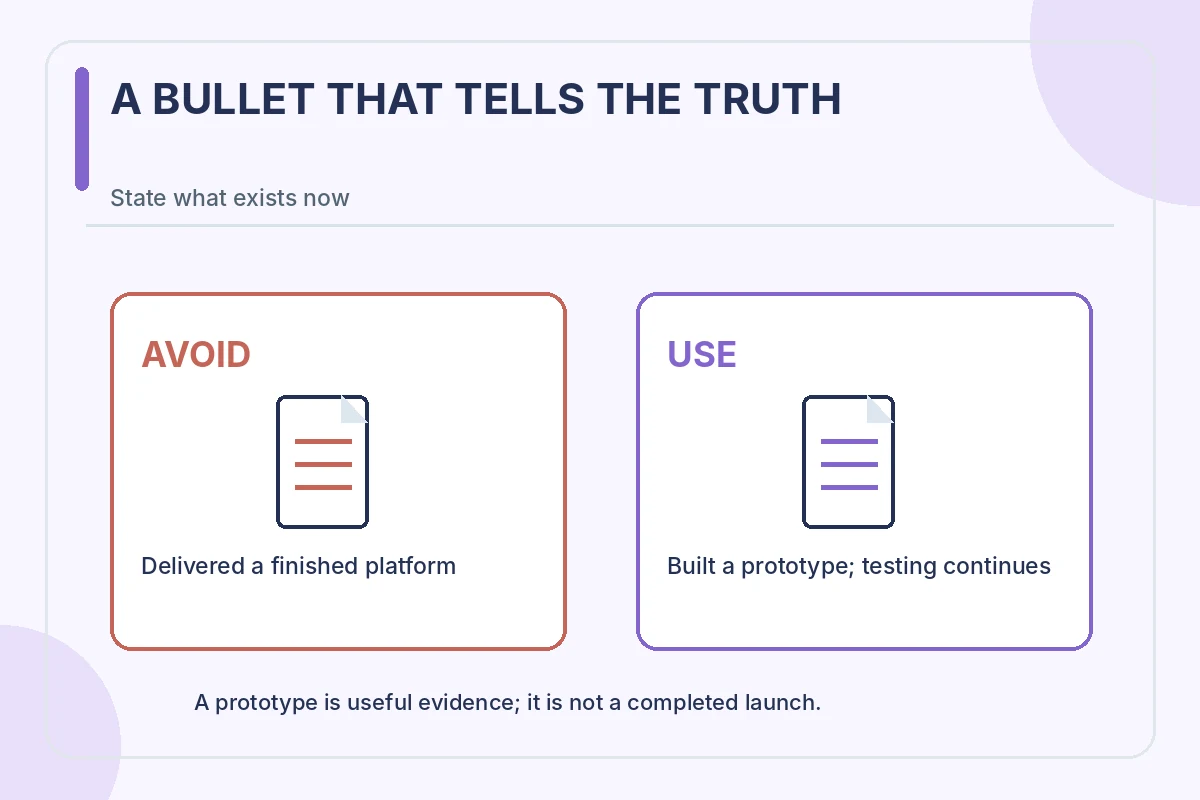
Compare this with “Conducted groundbreaking user research improving satisfaction.” If no validated satisfaction measure exists, the second statement invents impact. A more useful version names the recruiting method, consent procedure, sample or draft synthesis if those can be verified. Quantities are optional; when a number is missing, a concrete artifact can provide proof.
Do not upload a confidential customer file, internal repository, restricted class data set, or identifiable participant notes just to prove the project exists. A description, a redacted example with permission, or a new public demonstration may be enough. CareerOneStop recommends labeling work samples with your actual involvement and checking links before sharing.

Present technical uncertainty without hiding it
In engineering, programming, or research work, the unresolved portion often matters. A prototype may pass a local test yet fail on another device. A research notebook may run successfully while the source data remains incomplete. State such distinctions where they affect the reader’s interpretation. “Prototype tested with sample input; broader testing pending” is more credible than “Production-ready application” without deployment evidence.
If you have a public repository, check its latest commit, permissions, readme, and whether its code is yours to share. A broken link can distract from otherwise good work; a misleading repository description creates a more serious problem. If code or content belongs to a class team, credit contributors or describe only your part.
An employer may ask what you would change next. Prepare a short explanation of the trade-off, remaining question, and review checkpoint. Being able to explain limits is often stronger than insisting a project has no shortcomings.
Apply a milestone audit before the final resume export
Read every project bullet and underline verbs implying completion: launched, delivered, deployed, validated, published, increased, approved. For each verb, find the real artifact or outcome. Replace any unsupported term with the activity you can show: drafted, prototyped, tested with sample inputs, or submitted for review. This is an editing method, not a requirement to use timid wording when you actually completed something.
Finally, compare the project title and date range with the evidence. Mark “Present” only while work is active, and update the entry when the project ends. Save an updated resume copy rather than leaving an old “ongoing” label years after the work stopped. Your goal is a current record of real skills, not a prediction of future success.
How We Research and Verify This Guidance
This guide is based on documented career-service guidance and the actual limitations of the example scenarios, not promises about hiring outcomes. We checked the linked primary or specialist sources on November 2, 2026, and distinguish general resume recommendations from decisions that depend on a specific employer. We do not have confirmed affiliate relationships for these articles. Read our affiliate disclosure for the site policy.
University source reference: University of Pennsylvania guidance on describing projects, personal contribution and skills. The linked material informs the stated advice; it does not certify an individual applicant or guarantee employer acceptance.
CareerOneStop source reference: CareerOneStop guidance about relevant optional resume sections and their headings. The linked material informs the stated advice; it does not certify an individual applicant or guarantee employer acceptance.
CareerOneStop source reference: CareerOneStop guidance on describing personal contributions and choosing shareable portfolio samples. The linked material informs the stated advice; it does not certify an individual applicant or guarantee employer acceptance.
CareerOneStop source reference: CareerOneStop advice on honest work history, responsibilities and accomplishments. The linked material informs the stated advice; it does not certify an individual applicant or guarantee employer acceptance.
More Resume and Cover Letter Guides
Yes, if it is relevant and includes work you genuinely completed. Label its status clearly, show your own contribution, and avoid describing planned outcomes as achieved.
Use an accurate start date and “Present” if you are actively working on it. If your institution has a scheduled completion date, label it as planned rather than completed.
Usually not as an accomplishment. Once you have a tangible artifact, pilot, documented research, or other work product, an entry may offer stronger evidence.
Do not expose restricted code or client data. Share a link only when the material is yours to disclose and the intended viewer can access it.
Not unless it meets that description. A prototype, tested demo, or draft has value on its own; precise labeling helps the reader understand its limits.