
Running a real small business or side business can be valuable resume experience. You may have handled customer service, inventory, vendor coordination, basic records, marketing, or service delivery. The strongest entry identifies what you actually did, the business context, and the evidence of your contribution. The label “Founder” by itself does not prove that you managed employees, controlled a large budget, or built a profitable company.
A useful starting point is to write your real business name or a clear description such as “Independent Home Repair Service” when that is accurate. List the dates you actively operated it and choose a title that fits your responsibilities, such as Owner/Operator or Self-Employed Designer. Do not imply formal incorporation, business licensing, or a team structure you did not have. Local business requirements differ; the resume is not a certification of legal status.
Distinguish enterprise activities from personal duties
List every meaningful activity you personally carried out. Did you answer inquiries, prepare quotations, schedule jobs, review supplier invoices, deliver the product, or maintain accounting records? Then write down who else contributed. If a contractor built the website and a bookkeeper handled tax filings, do not claim you personally developed the site or managed all accounting compliance.
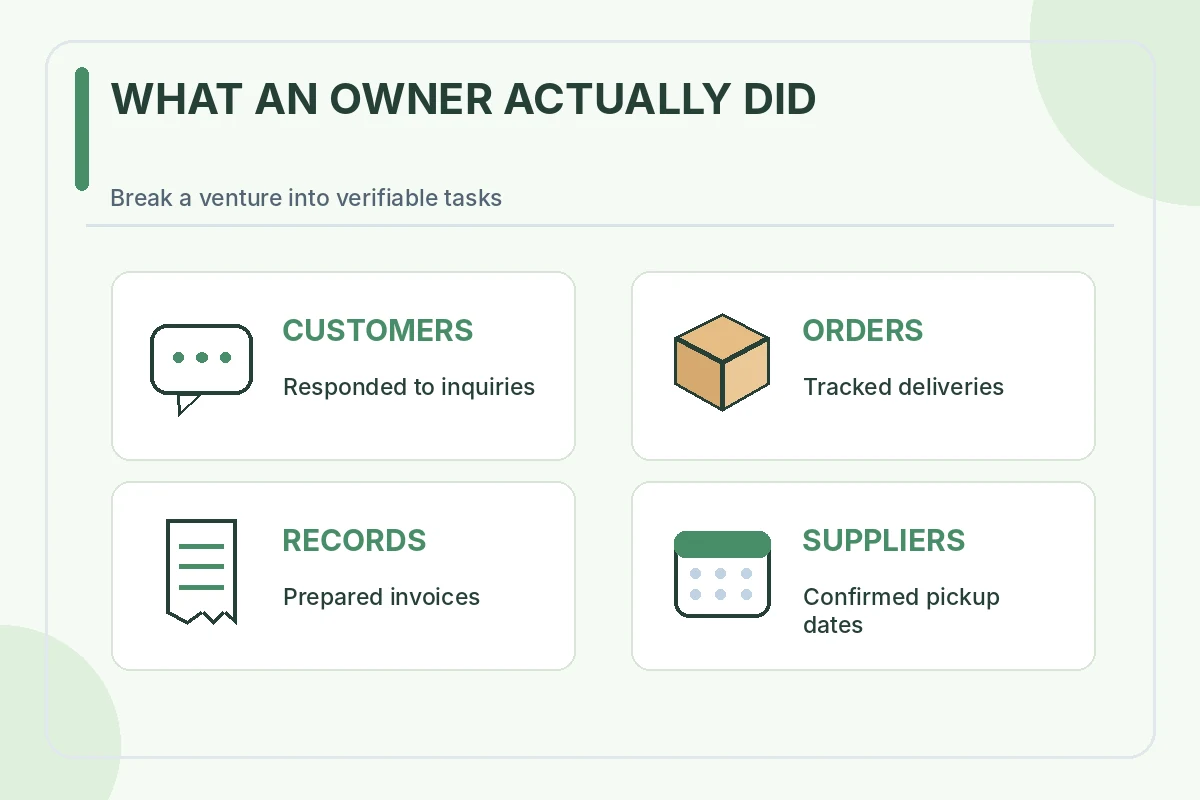
For example, a hypothetical owner of a weekend craft shop prepared product descriptions, organized approved vendor deliveries, and responded to customer questions. These are credible duties. If the shop had online sales, do not automatically describe the owner as a “growth strategist” or assign revenue increases to a marketing campaign without attribution evidence.
Make the distinction visible in each bullet: “Coordinated weekly supplier pickup times and maintained inventory notes” is more defensible than “Directed complex multinational supply-chain operations” for a small local shop. The size of the company is not a weakness; specificity helps the reader see the transferable skill.
Choose a truthful title and date range
Use a date range matching actual operation, not simply the month you thought of the business idea. If it began as a hobby, decide when it became an organized service or enterprise and describe the earlier work accurately. If the business remains active only occasionally, you can state that it is part-time or project-based if that clarifies the context. “Present” should not imply continuous full-time operations when work is sporadic.
A sole proprietor may have performed many functions at once, but that does not turn every function into a separate formal job. Avoid listing the same venture as five different employers to create the appearance of a lengthy work history. Choose an honest role heading and use bullets for diverse responsibilities.
If you left a business or closed it, use the real end date. The closure does not erase the skills gained, and you do not need to imply a successful sale or acquisition. If an interviewer asks why it ended, give a concise factual explanation and focus on the skills relevant to the new position.
Prove outcomes without disclosing private records
Strong bullets can include true, permitted measures such as order counts, recurring customer requests, project turnaround, or a process you introduced. Only use numbers that you can substantiate and that do not expose private customer information. “Prepared quotes and coordinated delivery dates for direct customer orders” is useful even without a revenue figure.
Distinguish company results from your own role. Business revenue may have come from several contributors or market conditions. If you cannot reasonably attribute growth to a particular action, describe the action and a verified outcome separately. Be equally careful with testimonials: do not manufacture a customer endorsement or copy a client’s private communication into a portfolio.
CareerOneStop recommends highlighting responsibilities and accomplishments that relate to the target job. A verified invoicing process or customer response workflow may be more compelling for an administrative vacancy than a headline about being a CEO. The reader needs evidence of your fit, not an inflated organizational chart.

Translate owner responsibilities to the target job
For a customer-support role, show how you handled inquiries, updated order status, clarified policies, and referred disputes that were outside your authority. For operations, show scheduling, supplier coordination, task tracking, and quality checks. For a creative role, link only to a portfolio you own and are allowed to share. Do not use a former client’s confidential design brief or unreleased product to prove your abilities.
University of Pennsylvania Career Services recommends writing impact-focused descriptions with verbs that match your contribution. The same rule applies to small-business owners: “built a simple product catalog” means you did the work; “oversaw catalog creation” may be better if someone else built it under your direction. Choose the verb based on what actually happened.
A concise experience block usually beats a long catalog of everything the business ever did. Select two or three work examples that connect directly to the new role and be ready to explain each one in plain language.

Review your business entry for credibility
Check the dates, company name, title, legal descriptions, certifications, and numbers against your own records. Remove claims of supervised workers, licensed work, taxes filed, contracts won, or client outcomes unless they are accurate and relevant. If you are uncertain about a number, use a factual process description instead of estimating it as fact.
Think about potential interview questions: What problem did the business solve? Which decisions did you make? Which tasks did another person approve? Which skills would you bring into an employee role? A truthful answer should follow from each resume bullet. Avoid uploading identity documents, tax returns, client lists, bank statements, or internal invoices through an unverified application link.
Finally, read the entry next to your past paid employment. It should use consistent formatting and make the nature of the business relationship clear. Self-employment is not something to hide; it is most persuasive when the actual work is easy to understand and verify.
How We Research and Verify This Guidance
This guide is based on documented career-service guidance and the actual limitations of the example scenarios, not promises about hiring outcomes. We checked the linked primary or specialist sources on November 2, 2026, and distinguish general resume recommendations from decisions that depend on a specific employer. We do not have confirmed affiliate relationships for these articles. Read our affiliate disclosure for the site policy.
CareerOneStop source reference: CareerOneStop advice on honest work history, responsibilities and accomplishments. The linked material informs the stated advice; it does not certify an individual applicant or guarantee employer acceptance.
University source reference: University of Pennsylvania guidance on describing projects, personal contribution and skills. The linked material informs the stated advice; it does not certify an individual applicant or guarantee employer acceptance.
CareerOneStop source reference: CareerOneStop guidance on describing personal contributions and choosing shareable portfolio samples. The linked material informs the stated advice; it does not certify an individual applicant or guarantee employer acceptance.
FTC source reference: FTC warning about sensitive personal information in fake job recruitment. The linked material informs the stated advice; it does not certify an individual applicant or guarantee employer acceptance.
More Resume and Cover Letter Guides
Yes, when it involved real work relevant to the target role. Identify the venture and your actual responsibilities, dates, and verifiable output.
Use the title only if it accurately describes the business and your role. “Owner/Operator” or “Self-Employed” may explain hands-on work more clearly.
You can label it part-time, seasonal, or project-based where that is accurate. Do not imply continuous full-time work if activity was occasional.
Only if the figures are accurate, appropriate to share, and clearly attributed. Concrete tasks and confirmed deliverables can be useful without confidential financial data.
Use the true end date. A closed business can still provide evidence of customer service, operations, planning, or other relevant skills.