
A team project belongs on your resume when it shows relevant work you actually did. Identify the team objective briefly, then make your personal contribution unmistakable: the analysis you completed, tests you wrote, agenda you organized, design you revised, or documentation you maintained. You can mention the shared result as context, but do not write as though you led or delivered the entire project if you owned only one part. The most useful project bullet lets an interviewer separate team achievement from your individual evidence in one reading.
Draw an ownership boundary before choosing verbs
Write the project goal on one side of a page and your own assigned tasks on the other. Add names of the outputs you personally produced: draft slides, cleaned records, test cases, interview notes, a prototype component, or a completed handoff. Between them, record who reviewed or approved each output. This distinction matters because proposing a feature, coding a component, signing off a release and owning a product roadmap are not interchangeable activities.
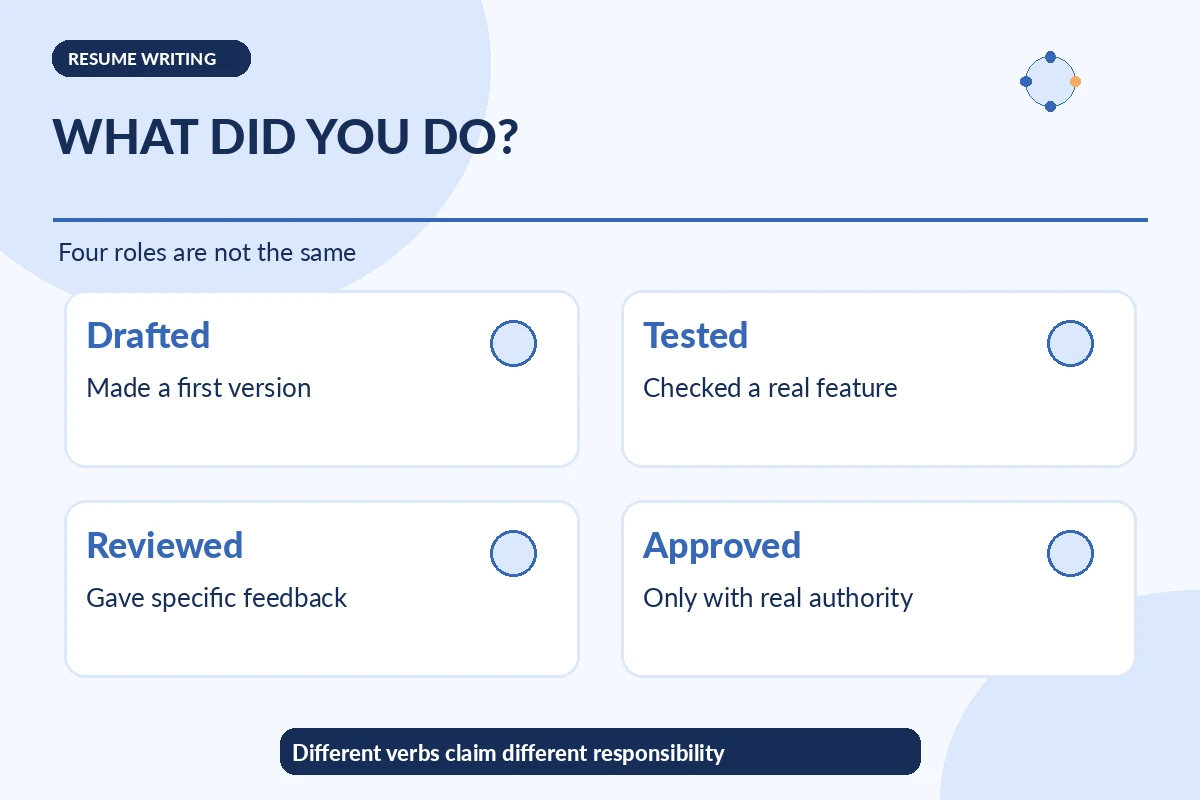
Use the ownership verb that fits the facts. ‘Contributed’ can be accurate but vague unless followed by an object. ‘Drafted,’ ‘tested,’ ‘organized,’ ‘analyzed,’ ‘presented’ and ‘coordinated’ say more; ‘led,’ ‘managed’ and ‘approved’ require actual authority. If you rotated leadership in a class team, label the period or task you led rather than implying a permanent role. The person hiring you wants to understand your real decisions.

Separate team achievement from the action you took
Consider a fictional student group that built a campus event website. ‘Launched a campus event platform’ sounds like individual ownership. A narrower hypothetical line might say, ‘Developed the RSVP form and checked mobile layout for a four-person class website project.’ This leaves room to discuss the overall website later without claiming all coding, design, outreach or deployment decisions. The project description may state that it was a team assignment.
If the group actually launched a product or completed an event, you can connect your contribution to that shared milestone, but use careful syntax. ‘Prepared participant sign-in materials for the team-run campus event’ is not equivalent to ‘Directed campus event operations.’ Team size, schedule and tools can add useful context if they are accurate. Do not invent audience counts, performance improvements or employer endorsements merely to make collective work sound more dramatic.
Write team projects differently for different settings
In a class project, name the course or academic context where that prevents the item from looking like paid employment. An example might say, ‘Collected survey responses and summarized themes for a supervised course research project.’ In a volunteer team, specify the organization and the type of contribution rather than suggesting a job title you never held. In paid work, retain your actual job title and employer and identify a cross-functional project underneath it.
The labels protect clarity. ‘Course Project,’ ‘Volunteer Project’ and ‘Work Project’ are not decorative; they tell the reader how to interpret your authority and the project’s status. If work was simulated or a proof of concept, say so. A mock dashboard is not a live production analytics system. If a partner organization gave real feedback, describe what you received and how you used it without implying the partner hired or endorsed you.
Build the bullet around a handoff you can show
Team projects often have a clear handoff: one person finishes analysis and another makes a decision, or a tester reports a defect and a developer fixes it. Name the artifact you passed along and the people or role that received it. A hypothetical bullet could say, ‘Documented checkout test findings and reviewed reproduction steps with the development team.’ This expresses useful work without claiming to have personally repaired the entire checkout.
For event planning, a similar line could read, ‘Compiled attendee questions and prepared a volunteer briefing for the event coordinator.’ In both cases, the point is concrete responsibility and communication. Do not claim an approved policy, certified report or final acceptance when you only prepared a draft. If the project involved regulated work, specify supervision and keep activity claims within the tasks you were authorized to do.
| Project element | Illustrative work | Ownership boundary |
|---|---|---|
| Team goal | Launch a class website | Context only |
| My work | Built the RSVP form and tested mobile layout | Personal scope |
| Claim to avoid | Owned the entire platform launch | Unverified ownership |
Explain collaboration without burying your own role
Teamwork as an adjective is weak evidence. Instead show the exchange: coordinated a review, incorporated feedback, resolved a scheduling conflict, documented unresolved decisions, or passed a tested file to the next group. These actions help a reviewer picture how the team functioned and how you contributed. Use ‘with’ to identify collaborators, not as a substitute for explaining your own action.
For example, ‘Worked with designers and engineers’ says very little. An illustrative rewrite is, ‘Reviewed navigation mockups with designers and recorded accessibility questions for engineering follow-up.’ That identifies a specific role and an appropriate boundary: recording concerns is not the same as certifying an accessibility standard. Remove contributions you cannot explain when asked what you changed and why.

Keep one clear project entry instead of repeated credit
A resume does not need five bullets all saying that your team collaborated, presented, built, researched and succeeded. Choose the two or three contributions that best match the job you want, with at most one sentence of project context. If your personal role changed across stages, show the sequence: researched requirements, created a draft, tested it, then handed it off. Use the stages you actually completed.
Before submitting, ask a teammate or instructor to sanity-check the scope if appropriate, but do not share private records merely to verify wording. You should be ready to explain the project in an interview from your perspective: what you were assigned, what decisions you made, what the team decided, and where your responsibility ended. The most credible statement may be less grand but much clearer.
How We Research This Resume Advice
We reviewed practical resume guidance from UC San Diego Career Center, University of Pennsylvania Career Services, USC Career Center and Penn resume-writing guidance. We used those sources for the principles of task specificity, honest ownership, reader clarity and relevance. The worked examples here are hypothetical: use only facts you can personally verify, and follow the specific employer’s application instructions. We do not claim a particular format guarantees interviews or passes an applicant tracking system. Read our affiliate disclosure for the site’s relationship policy.
More Resume and Cover Letter Guides
Describe the particular phase or deliverable you led and its dates or context; avoid suggesting a formal project-lead appointment if none existed.
You may mention an accurate team size when it explains collaboration, but it does not replace saying what you personally contributed.
Yes, when relevant and honestly labeled as coursework or a class project rather than paid or professional employment.
Describe the prototype, research, tests or recommendations you actually completed. Do not say the product shipped.
Use a permitted general description of the task and handoff, leaving out confidential clients, restricted data, and undisclosed results.