
A payroll specialist resume summary should explain what records you verify, how you handle discrepancies, and where your authority stops. Employers may use payroll specialist, payroll clerk, or timekeeping coordinator differently, so follow the particular posting. A good opening names actual timesheet, adjustment, or reporting work and adds a concrete accuracy control. It does not claim that you authorized pay changes, interpreted law for the employer, or guaranteed perfect payroll when those decisions belonged to someone else.
Read the payroll workflow behind the title
The same title can cover entry of approved hours, exception review, payroll-system exports, employee inquiries, and end-of-cycle reporting. Begin by identifying which portions you actually performed. Did you inspect timesheets, reconcile a schedule against approved hours, or only forward records for processing? Use verbs that reflect that distinction. A posting that expects full payroll ownership may require stronger experience than a support position. Your summary must not suggest that you made decisions about wages, deductions, or employee classification if you merely prepared a report for review.

Identify a record check you can explain
“Detail oriented” becomes meaningful when connected to a specific control. You might have verified missing punches against the documented approval workflow, noted differences between time entries and schedules, or reconciled reports under supervision. State how exceptions were tracked and who could correct them. There is no need to disclose employee names or actual pay data in an example. In fact, using confidential records would undermine a supposed privacy strength. A fictional, clearly labeled sample table can show the format of your review process without pretending that it is a historical company result.
Draft a summary with an approval boundary
A fictional candidate might say: “Payroll support specialist with experience reviewing submitted hours, tracking incomplete approvals, and escalating pay-entry discrepancies through documented procedures. Focused on accurate records and confidential communication.” This is a usable model only if those tasks match the candidate’s history. Someone with actual end-to-end payroll duties can name them, but should distinguish preparation, verification, and authorization. Avoid a statement that you ensured legal compliance across jurisdictions unless that claim is real, specific, and within your responsibility. Keep the opening brief and support every clause below.

Look at the verbs in the example: reviewing, tracking, and escalating are different from approving or changing payment data. If the candidate actually entered hours but never reviewed exceptions, the first verb should be ‘entered’ and the second can refer to the validation they performed. A summary should not conceal that final signoff belonged to payroll management. Check the wording against an actual job description and your access permissions. When asked about a discrepancy in an interview, explain how you documented it without displaying sensitive employee information. The example uses no real payroll records and provides no financial or legal advice.
Describe exceptions without implying you changed pay
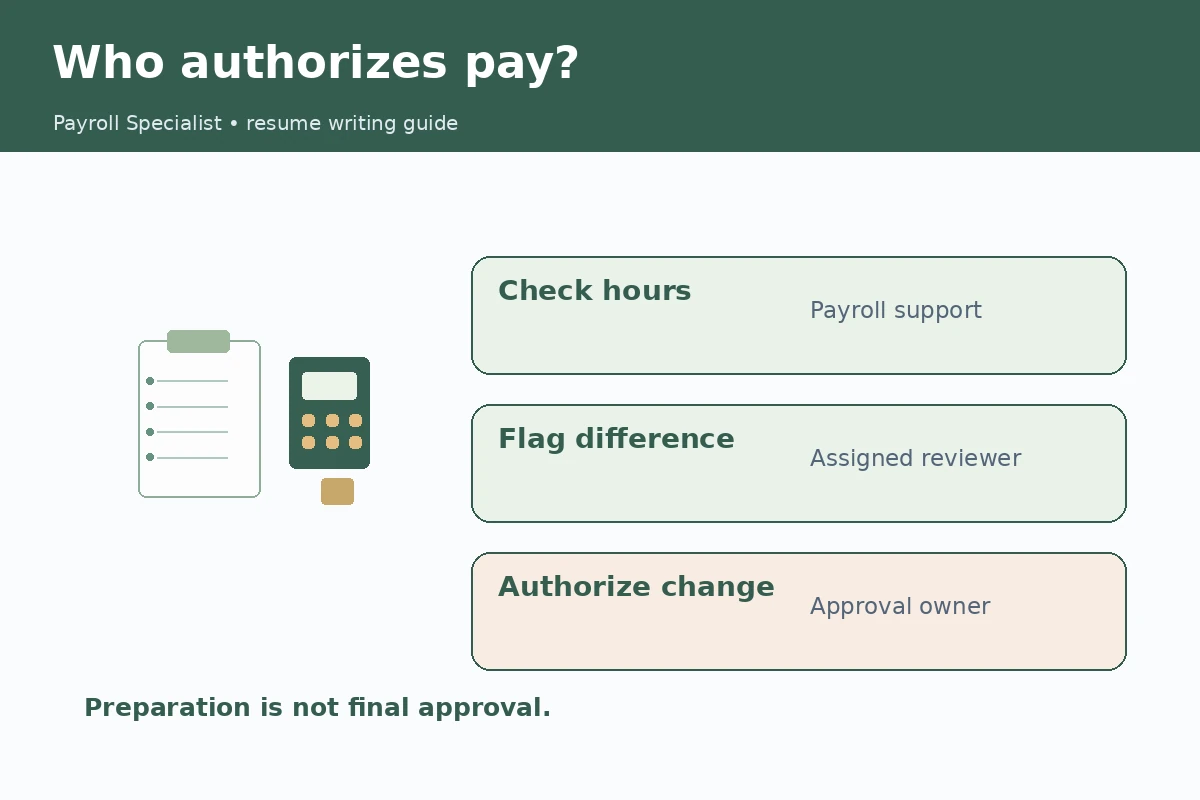
Suppose a timesheet is missing a manager approval. A trained clerk may flag it in the allowed system and ask the designated reviewer for confirmation. That is not the same as changing an employee’s recorded hours. Summaries should reflect the actual workflow: “Documented exceptions for supervisor review” is safer than “Resolved payroll errors” when another person approved the correction. A reviewer should understand how you communicate discrepancies and preserve a traceable record. Do not present hypothetical company policies as universal rules; payroll processes depend on employer systems and applicable obligations.
Use payroll software names sparingly and honestly
Payroll products vary, as do the permissions each role has within them. If you used a platform only to view time submissions, do not say that you configured its tax engine or ran the final payroll. Name spreadsheet skills only where the record supports formulas, comparisons, exports, or data checks you actually completed. In the experience section, show the system function and task; reserve the summary for the most relevant capabilities. A recognizable brand name can help a reviewer, but it is not a substitute for demonstrating how you noticed and routed a discrepancy.
Keep privacy as a concrete work habit
Employee payroll records can contain sensitive identifying and financial data. A credible summary mentions confidential record handling only when you followed specific approved practices, such as access controls and limited distribution of review reports. Do not include actual employee information in a portfolio or writing sample. If you wish to demonstrate a process, create synthetic sample entries and label them as fictional. Your summary should not claim compliance certification simply because you handled private files. Strong privacy language describes how you restricted access, followed the employer procedure, and avoided forwarding more information than necessary.
Adapt the opening to the payroll job level
For a first payroll clerk role, emphasize accurate time entry, document completeness, and supervised exception resolution. For a more experienced specialist, identify the payroll cycle, systems and reconciliation tasks you actually managed, alongside verified scale where appropriate. Do not inflate a department-wide pay-run count into your personal workload. If your background is accounting or HR support, make the transferable link explicit and name what you still need to learn. A resume summary is an introduction to relevant evidence, not a declaration that every payroll title is interchangeable.
Audit dates, outcomes, and decision rights
Read the summary and confirm the systems, employment dates, and approvals it describes against your experience records. A statement about meeting deadlines should be supportable by a real cycle, not a guessed percentage. If a correction was made by another team, credit their decision. Ask whether a reviewer could misunderstand “processed payroll” as authorization rather than data preparation. Rewrite ambiguous wording before submission. Compare the final text to the vacancy and your experience bullets, and keep the file accessible in the format requested by the employer.
How We Research Professional Resume Summaries
We reviewed BLS occupational guidance; BLS occupational guidance; Penn Career Services resume guidance; Berkeley Career Engagement resume guidance to separate the tasks typical of this field from what any particular applicant actually did. Occupational descriptions inform which terms to explain, but they are not proof that a named person has the listed credentials. The resume resources emphasize targeted, specific evidence. Examples on this page are hypothetical; they must be rewritten to match your records, permissions, and the job posting. We do not invent employment, project outcomes, certifications, test scores, salary, or hiring assurances. Check your current employer requirements and refer to our affiliate disclosure before relying on any linked recommendations.
More Resume and Cover Letter Guides
Yes, if you identify the actual time-entry or record-review tasks and label the internship accurately.
No. Describe observational exposure separately if relevant; do not claim independent use or configuration.
Only when you truly had that authorization. Preparation and escalation are different responsibilities.
Avoid real employee data. Use synthetic, clearly marked practice records and obtain permission for any workplace materials.
No. Only use a rate if the underlying data and attribution can be documented.