
Academic Advisor situational interview questions test what you would do when a realistic problem has incomplete information and more than one person involved. In this guide, the central hypothetical is: “How would you help a student whose degree plan conflicts with the current course schedule?” A strong answer asks what must be checked, describes a responsible action within the role, and explains who makes decisions outside your authority. The examples are invented for rehearsal, not accounts of employer experiences or guaranteed interview questions. State your limits before naming a confident next step.
Identify the decision hidden in the hypothetical
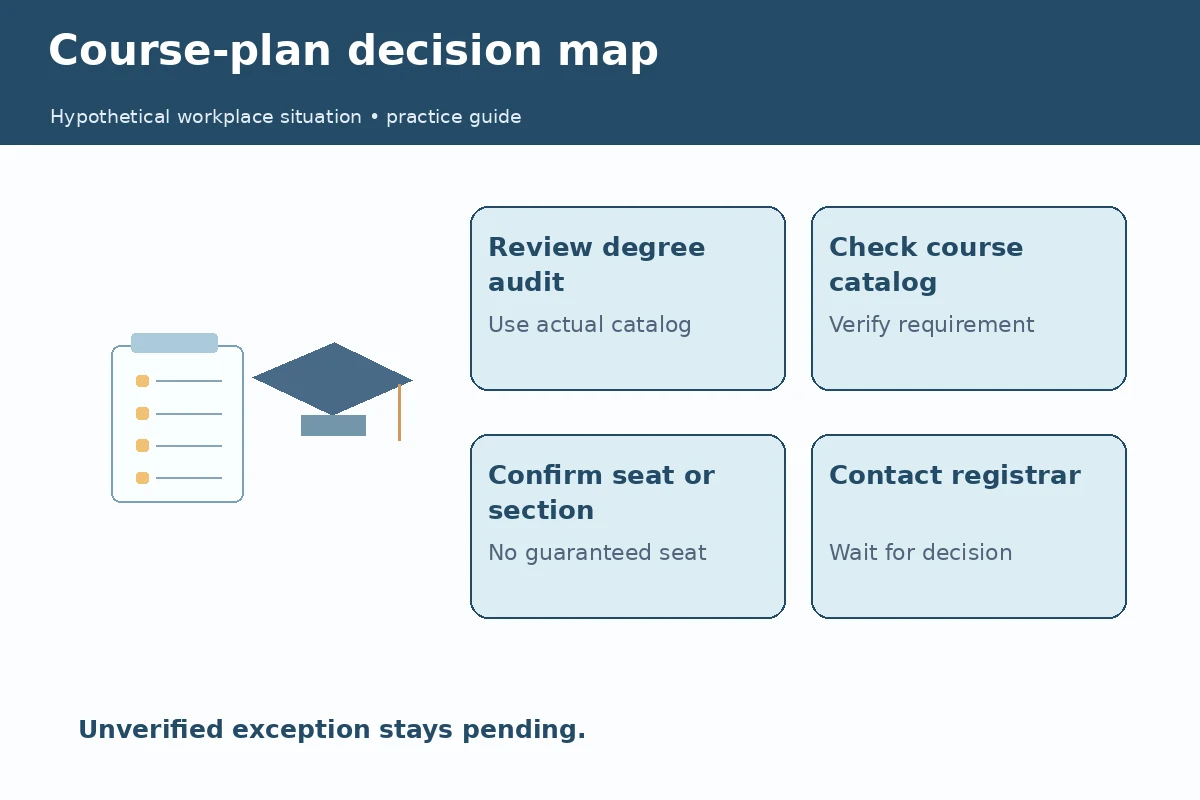
A situational prompt about an unavailable course is usually not a test of whether you can recite every catalog number. The interviewer is looking for how you distinguish a rule from an assumption, how you protect the student from a premature promise, and how you coordinate an answer across offices. Before speaking, state the information you would check: the student’s actual catalog year, completed prerequisites, any approved substitutions, the schedule of classes, and the relevant registration deadline. A sample story about advising should not imply that all universities operate with identical requirements. Say plainly that you would consult the institution’s current policy and designated authority.
Clarify what the student needs before suggesting courses
The student may be worried about graduation, financial aid, a course conflict, or understanding an academic hold. Ask a short question that makes their objective explicit. If graduation timing is central, identify which requirement is a dependency and which course might be an elective. If the problem is access to a full course, check actual waitlist and substitution procedures rather than inventing a section or guaranteed seat. An effective answer separates the student’s preference from catalog constraints. Explain choices in plain language and ask the student to repeat the next action so that a long advising conversation produces a usable plan.
Use the registrar referral rather than a fictional override
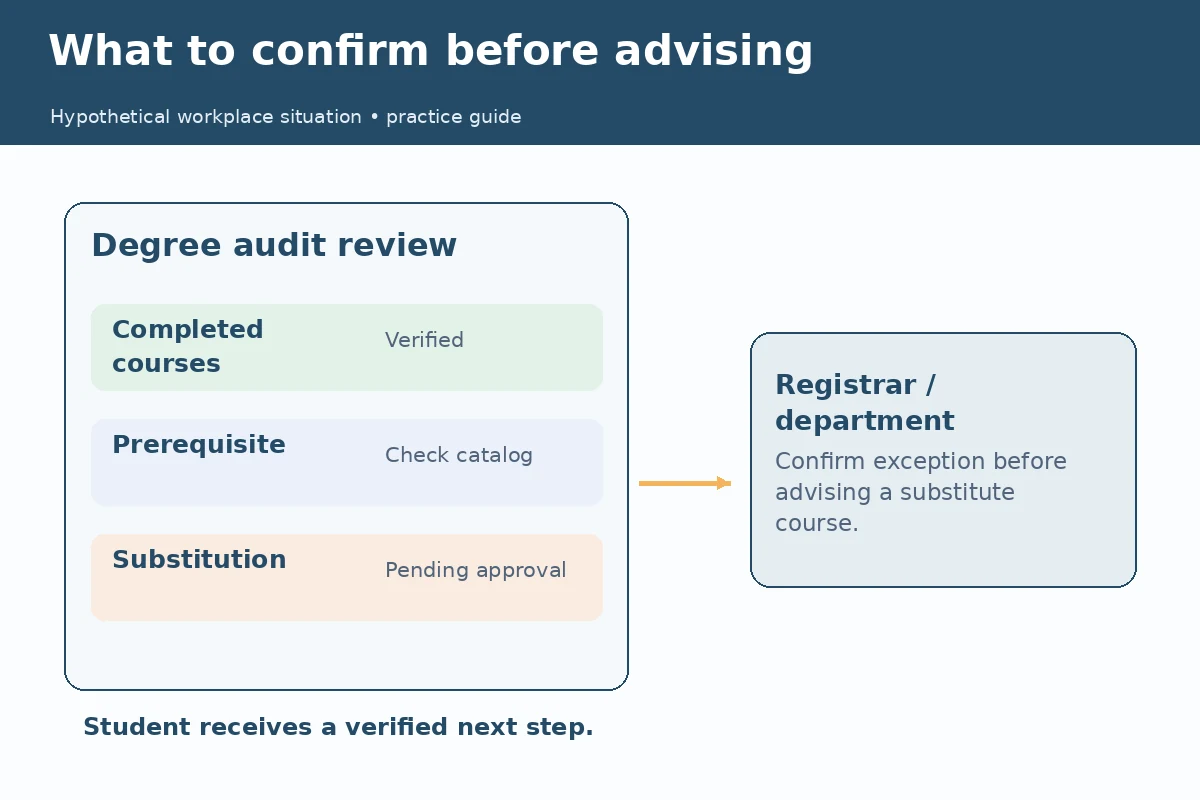
An advisor can identify and document a record discrepancy without having authority to change a degree audit or approve a prerequisite waiver. Name the office that can confirm a substitution or correction, and describe exactly what you would send: a factual record reference, the requirement needing clarification, and the registration deadline. Do not send unnecessary personal details. A credible hypothetical answer does not say, “I would waive the prerequisite to help.” It says, “I would explain which part is pending, ask the authorized office for a decision, and update the student when the answer is verified.” That answer demonstrates ownership of follow-up without claiming someone else’s decision.
For this role, avoid the easy but weak answer: “Promise an override.” Instead, identify whether the information is verified, who is affected, and who has the authority to decide. The distinction between a hypothetical situation and a real past event matters: in a hypothetical you describe a responsible plan; in a behavioral question you must tell the truth about what actually occurred. The following sample uses a fictional situation and makes no claim about a past employer.
Give a full hypothetical answer without invented outcomes
An interviewer may ask for the steps you would take, not a result that has already happened. Start with a brief clarification, then explain record checks, reasonable options, the referral, and how you would close the loop. The worked answer below is a fictional practice response, not evidence of the reader’s prior advising employment. If the interviewer instead says “Tell me about a time,” switch to a real example from student services, peer mentoring, admissions, or another relevant setting. Use the actual outcome, including unresolved questions. Do not convert a proposed course plan into a completed graduation outcome.
Illustrative answer to the central question
Hypothetical interview answer: “I would ask which graduation or registration deadline concerns the student most, then compare the degree audit with the current catalog and actual course schedule. I would distinguish confirmed alternatives from a prerequisite exception that needs approval. I would contact the designated registrar or department office, explain the unresolved point to the student without promising an override, record the referral in the approved system, and agree on a follow-up date. I would check that the student can explain the next step in their own words.” This is a model of reasoning, not a script to memorize verbatim. Replace its workflow with the organization’s actual rules and explain the scope you would have in the advertised position. The interviewer may interrupt to ask who owns the next decision. Use that interruption to make the authorization boundary explicit rather than inventing a result.

Compare three distinct advising scenarios
Practice a record error, a student who missed appointments, and a concern that belongs with another support office. Each calls for a different next step: verify documentation, attempt neutral outreach, or refer respectfully. Avoid a universal answer such as “I would fix the problem immediately.” With a missed appointment, say what information you would include in a short message and where the outreach would be recorded. With a sensitive personal concern, do not ask the student to reveal details they have no reason to share in the advising setting. Clarify the campus contact path and avoid improvising counseling or clinical guidance.
Three follow-up questions to practice
What if the degree audit looks incorrect? Compare the audit and catalog, mark the disputed entry as unverified, and ask the records office to resolve the discrepancy before treating it as approved. A student misses registration repeatedly. What do you do? Use neutral outreach, verify the actual deadline and hold, offer a practical contact route, and document the attempts without guessing why appointments were missed. What if a student asks for help beyond your training? Explain the scope of academic advising and make a concrete, supportive referral to the designated campus resource.
Show accurate notes and an accountable handoff
Explain how you would document an advising session in the institution’s approved system: the student’s stated academic objective, verified requirements, options discussed, authorized referrals, and date of next contact. Do not create unofficial spreadsheets of private academic records or promise to disclose the student’s situation to anyone who asks. A note saying only “course problem solved” is not helpful if a registration action is still pending. Your answer becomes stronger when another advisor could understand what remains open without relying on private speculation. If a decision is pending with the registrar, identify it as pending rather than copying the student’s request into a completed field.
Rehearse the answer against the job posting
Look for the advising model in the posting: assigned caseloads, drop-in appointments, degree audits, transfer credits, or first-year orientation. Adapt which facts you would verify, but keep the underlying reasoning stable. Say which student systems you have actually used and which you would need to learn. Practice aloud with a timer, then remove unnecessary jargon. A strong answer ends with the student knowing what is verified, what remains uncertain, and who owns the next communication. Ask the interview panel which campus offices handle exceptions and how advisors coordinate peak-registration work.
Build a short scoring rubric for rehearsal
After a practice response, evaluate it against five observable questions: Did I identify the first missing fact? Did I state the safest immediate action? Did I name the relevant person or office that approves the next decision? Did I describe a usable handoff or status update? Did I avoid claiming a result I cannot know? For the academic advisor example, this means assessing whether you treated “advising scenario” as a bounded role decision instead of a personal rescue mission. Have a peer ask “What would you do if that information were unavailable?” A convincing answer acknowledges uncertainty, asks for clarification, and keeps the process accountable without turning the interview into a speech about perfect outcomes.
How We Research These Situational Answers
We reviewed NACADA advising competencies; Northeastern career guidance; Princeton interview guidance to distinguish the typical responsibilities of the role from decisions that require a supervisor or designated professional. The career-center sources distinguish hypothetical situational reasoning from real behavioral examples. Role-specific sources inform the examples, but no source can confirm what a particular hiring manager will ask. This article does not claim that a fictional outcome happened, or that a reader has a credential or authority they did not earn. We avoid private employee, client, or student information in practice cases. Before relying on any recommendations or sponsored links, see our affiliate disclosure.
More Interview Preparation Guides
No. Demonstrate how you verify the correct catalog year and current institutional rules before suggesting an academic option.
No. Describe referring the request to the office authorized to approve exceptions and communicating the pending status.
Use a truthful student-support, tutoring, or administrative example and explain how you would learn this institution’s procedures.
Yes, but describe approved access, relevant factual notes, and privacy-conscious handoffs rather than disclosing sensitive details.
The student objective, verified facts, a bounded decision or referral, clear follow-up, and a check that the student understands the next action.