
For a pharmacy technician interview, choose strengths you can prove through accurate intake, careful stock handling, and timely referral to a pharmacist. Describe a weakness as a limited, genuine habit you have worked to improve—not as a patient-safety failure you would ignore. The best answer connects a specific workflow to the role you actually held. Never say you made medication decisions reserved for a pharmacist or imply one employer’s procedures apply everywhere.
Match each strength to a pharmacy workflow
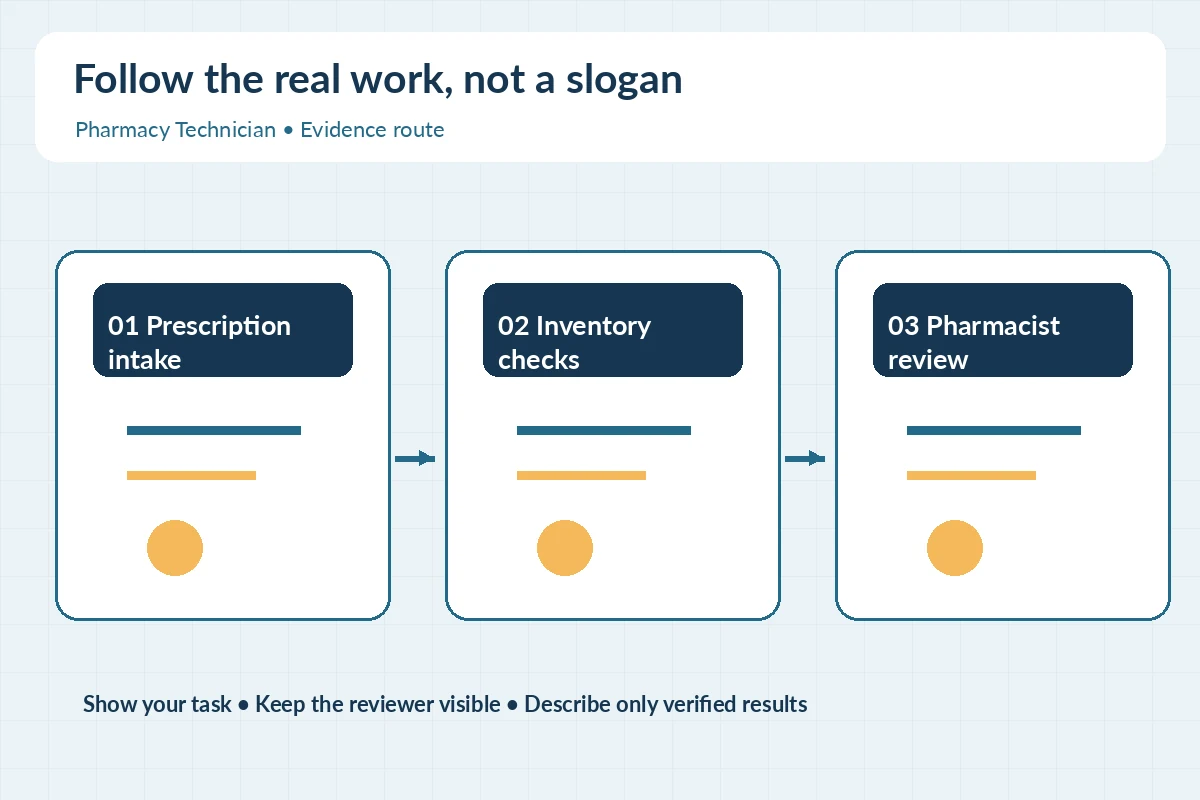
A convincing strength describes the part of prescription intake you handled, how you checked it, and when the pharmacist became involved. If you performed only inventory or retail counter duties, use those examples instead of claiming prescription-processing experience. The distinction matters more than impressive vocabulary. Prepare one story about careful information entry, another about stock or shelf checks, and a third about speaking clearly with customers when a question exceeds your authority.
For example, noticing that a product label does not match the inventory record shows attention to detail when you explain who reviewed the discrepancy. “I am meticulous” alone does not tell an interviewer whether you worked with real orders, training materials, or a retail shelf. State the setting and the approval point. Your example should show a repeatable check, not an unsupported claim of perfect accuracy.
Describe a weakness without minimizing safety
A workable weakness is a real skill you are improving, such as organizing a busy counter queue, making concise handoff notes, or asking for clarification earlier. Avoid a story in which you hid a medication discrepancy or ignored instructions. Such an incident is not made harmless by calling it a learning opportunity. If a serious event happened, do not invent a neat resolution; talk about verified corrective actions and follow applicable reporting duties.
Suppose you initially spent too long checking a confusing item before telling the pharmacist. A better answer acknowledges the delay, explains how you learned the escalation rule, and says how you confirm the handoff is complete. You cannot promise that errors will never occur. You can demonstrate that you recognize limits, use the approved verification process, and report uncertainty before it becomes an assumption.
Build a truthful example from training
Applicants entering pharmacy work may use approved coursework, simulation, inventory practice, or supervised externships as evidence. Identify the setting explicitly: “During a classroom simulation” is different from “While working at a pharmacy.” Show the task and a supervisor or instructor’s feedback without implying that a training exercise involved actual patients. Do not disclose names, prescription details, or identifiable health information in an interview portfolio.
If you counted sample stock, report the check you used, not an invented number of avoided errors. If you have only customer-service experience, explain how you sought clarification on policy-based requests and handed specialized questions to the right person. O*NET describes pharmacy work broadly; hiring managers still need your particular level of preparation. A modest accurate example is stronger than a fictional clinical achievement.
Answer the follow-up about speed and precision
Interviewers may ask how you work when the counter is busy. Avoid treating speed as a reason to skip checks. Explain how you identify which tasks you can complete independently, what information you keep ready for the pharmacist, and how you respond when instructions conflict. A good answer emphasizes an orderly queue, explicit priorities, and the expected review points instead of claiming to process the most prescriptions.
Practice a follow-up in which the interviewer challenges your claim of accuracy: “How would someone verify that?” Your response can mention documented training feedback, a standard double-check step, or a clearly labeled simulation. If no numerical metric exists, do not manufacture one. Where an employer has a different workflow, say you would learn and follow that procedure rather than import a personal rule.

Compare stronger and weaker interview answers
Weak: “I never make mistakes and I know which medication is right.” That response is unverifiable and confuses a technician’s responsibilities with clinical judgment. Stronger: “I carefully compare entries to the source and bring unclear directions to the pharmacist.” The second statement names a behavior and an appropriate boundary. Add a real instance only if it happened. Interview examples on this page are hypothetical prompts for preparing your own account.
Another weak answer is “My only weakness is I care too much.” It avoids a real development need. A stronger version might describe slow escalation of unclear administrative information, the feedback received, and the new habit of flagging the precise question early. A weakness answer does not need to be dramatic. It needs to be believable, connected to the work, and supported by an observable improvement.
Practice a concise answer and an honest follow-up
Prepare a roughly one-minute version containing one strength, a brief situation, your action, and a concrete outcome or supervisor feedback. Prepare a similarly concise weakness answer: what was difficult, why it mattered, what you changed, and what remains a learning goal. Avoid reciting a script if the interviewer asks for another setting. Adapt the example to community, hospital, or specialty workflow only when you have corresponding experience.
Before the interview, review the job advertisement for training, certification, system familiarity, and scheduling requirements. If asked about tasks you have not performed, say so and explain related preparation. If a question asks you to override an approval step, describe your obligation to follow the employer’s procedures and involve the authorized pharmacist. That answer demonstrates professional judgment without exaggerating independence.

Build your personal evidence checklist
Before using a strength claim, write down the setting, your exact task, who reviewed it, and one observation you can defend in a follow-up question. For a weakness, choose a real, bounded development area and prepare the feedback or changed habit that demonstrates progress. Your examples must come from experience, not from the hypothetical scripts on this page. If a story involves a customer, colleague, patient, or employer confidential information, describe the work pattern without identifying anyone. Interview preparation is not permission to disclose restricted details.
Illustrative strength answer (not a personal testimonial): “One strength I would bring is careful prescription-data entry. In a training exercise, I compared entered directions against the source document, flagged a mismatch, and asked the supervising pharmacist to review it before the record moved forward.” This wording is a model; replace the situation with your own facts. Illustrative weakness answer: “I have worked on hesitating to escalate an unclear order. Early in training, I spent too long rechecking ambiguous information alone. I now mark the exact field in question and promptly refer it to the pharmacist instead of guessing.” Never memorize these examples as achievements you did not perform.
How We Research and review interview advice
This guide uses O*NET’s description of the occupation to anchor the kinds of tasks an employer may assess and the U.S. Office of Personnel Management’s structured interview guidance for the principle that answers should provide evidence relevant to job competencies. O*NET describes occupations, not your personal work history or a universal license. OPM guidance informs interview assessment, not a guaranteed hiring outcome. All sample answers here are illustrative and must be adapted to the applicant’s actual experience.
We also consider the EEOC’s limits on pre-offer disability-related inquiries: job-relevant strength and weakness preparation should not pressure applicants to disclose medical diagnoses or other protected personal information. Verify the particular employer’s job description, authorization rules and interview instructions. Links or recommendations do not represent a paid endorsement. Read our affiliate disclosure.
More Interview Preparation Guides
Yes. Label it as a simulation or supervised exercise and explain what you actually checked; do not present it as patient-facing employment.
It is generic until you attach an actual check, a clear discrepancy, and the correct reviewer or escalation point.
Do not treat a serious safety issue as a casual talking point. Be truthful about incidents and required reporting; choose a focused skill-development example where possible.
Only describe the questions your role permits. Referral to a pharmacist is the appropriate example when clinical advice is outside your scope.
Use accurate retail, office, inventory, or supervised training examples, clearly labeled, and explain how the habits transfer.