
Map clinical support routes before enrolling
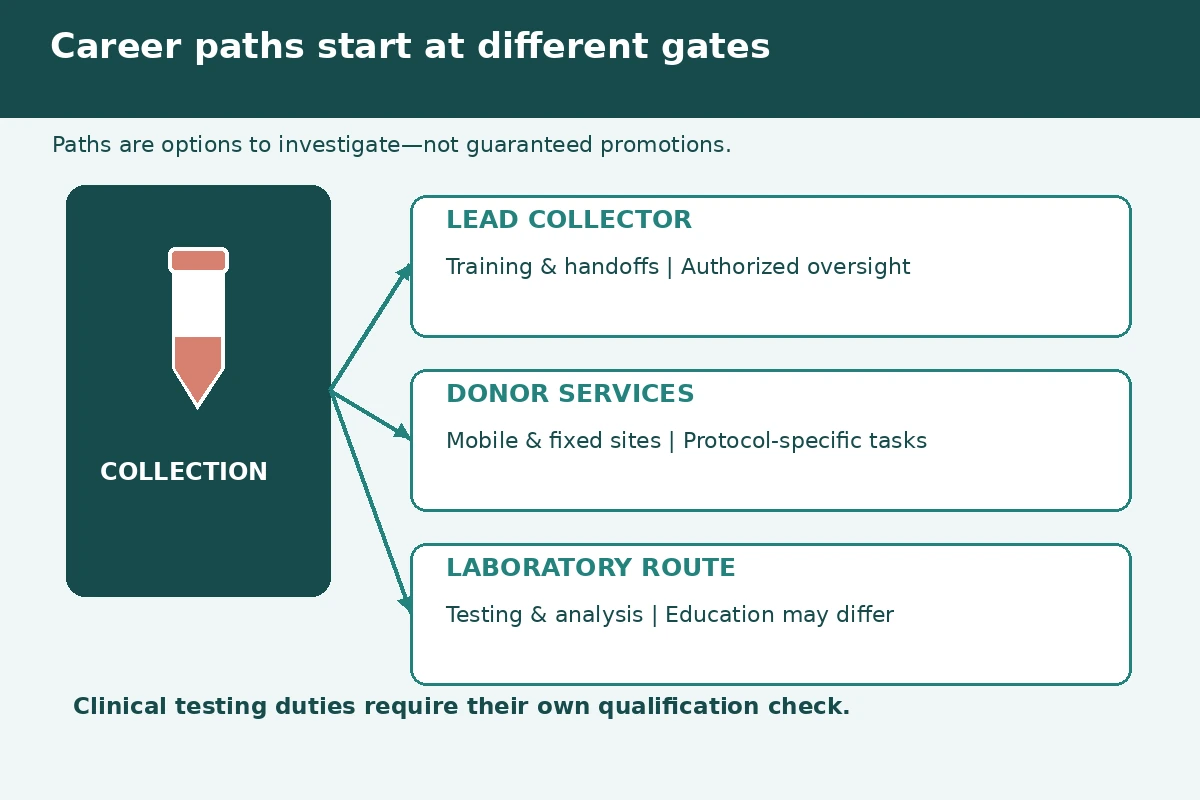
Phlebotomist career advancement can lead toward a lead collector position, donor-center operations, approved training support or a separate pathway into laboratory work. These options involve different responsibilities and prerequisites. Phlebotomists collect blood, confirm patient or donor identity, label specimens and support safe handling. A person who performs collections well is not automatically qualified to analyze specimens or make clinical interpretations. Start with the tasks of the next job and match them to your verified training, employer authorization and local credential requirements.
A lead collector may coordinate, not diagnose
A lead phlebotomist or experienced collector may help schedule collection coverage, coach new employees on an approved procedure and flag labeling or transport problems. The specific title is an employer choice, not a nationally guaranteed rung on a career ladder. Focus on specimen-quality habits: identity verification, accurate timing and labeling, clear handoffs and prompt reporting of problems. If a supervisor signs off on trainees, do not claim that you independently certified their competence unless the organization actually delegated that authority.
Donor centers have their own procedures
Blood donation centers may use fixed sites or mobile events, with different equipment, donor interactions and collection processes from an outpatient laboratory. A phlebotomist interested in donor services should compare posted expectations about schedules, donor communication, adverse-reaction escalation and site setup. Experience calming anxious donors is useful; it is not evidence that you may evaluate eligibility outside established rules. Ask for approved observation or cross-training before representing a new procedure as a skill you can perform independently.
Laboratory testing is a separate qualification question
BLS describes clinical laboratory technicians and technologists as testing and analyzing body fluids or other specimens, often with different education pathways from phlebotomy. If you want that kind of career change, identify whether the role calls for an associate’s degree, bachelor’s degree, certification, licensure or clinical placement. Do not assume a collection certificate qualifies you for analytic testing or result reporting. Discuss prerequisites with an accredited program and a prospective employer, and check state requirements before paying for an additional course.
Build evidence around specimen integrity
Your strongest advancement record may be a structured description of how you maintained identification, labeling, tracking and secure specimen handoff during busy sessions. Use a private checklist or authorized quality summary rather than patient-facing documents. Describe the procedure you followed, a discrepancy you correctly escalated and the qualified person who reviewed it. Avoid invented “zero-error” statistics unless an official, appropriate data source supports them. Employers may value consistent adherence to steps more than an unverified number of blood draws.
Safety remains non-negotiable as duties expand
OSHA’s bloodborne pathogens standard addresses workplace exposure controls, training and protective measures. Learning to lead does not authorize bypassing safe collection, sharps handling or incident reporting. Ask your employer which training and competency reviews are required for each new task. Do not write or teach a new medical procedure from a generic career article. Use facility-specific protocols, required professional supervision and assigned protective equipment. A safe advancement example can center on spotting a process exception and promptly involving the appropriate lead.
| Evidence area | Proof you can describe | Boundary to check |
|---|---|---|
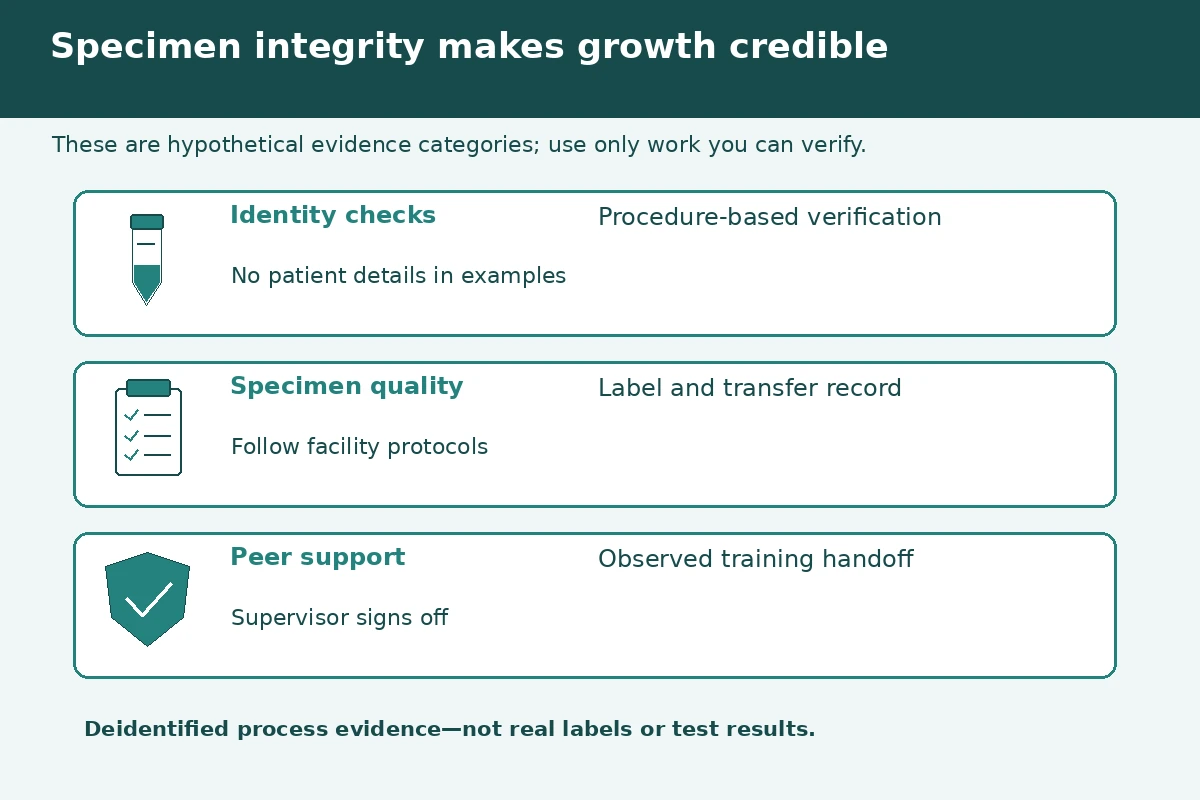
| Identity checks | Procedure-based verification | No patient details in examples |
| Specimen quality | Label and transfer record | Follow facility protocols |
| Peer support | Observed training handoff | Supervisor signs off |
Compare credentials with the exact job
BLS notes that phlebotomy entry and credential rules differ, including among states and employers. A current certification, local license, training completion and college course are different kinds of evidence. List the issuing organization, status and expiry where appropriate. If a vacancy requires specimen processing or lab equipment tasks, ask whether they fall within your present scope or require further competency assessment. Do not claim that every employer recognizes the same credential or that collecting specimens grants independent laboratory authority.
Request a measured training opportunity
Ask your lead: “Could I assist with the approved onboarding checklist or observe specimen transport coordination, with you reviewing my work?” Define a small permitted task, the materials you can see, and the evidence that can be documented without exposing protected records. At the end, ask what you performed well and what remains outside your scope. Helping a trainee understand the workflow is useful evidence only if you were instructed and authorized to do so.
Have the promotion conversation with a pathway chart
Bring two or three potential target roles and the published prerequisites. Discuss whether a lead assignment exists internally, whether a donor-center route fits your schedule, or whether lab education is a longer plan. Ask who signs off on competence and how feedback will be recorded. Do not present tenure alone as sufficient evidence for a role that requires new clinical responsibilities. If an education program is necessary, compare the cost, schedule, credential recognition and supervised practice expectations before committing.
Protect privacy in every work sample
A patient label, collection tube photograph or laboratory information system screenshot may contain personal or facility-sensitive data. Keep such material out of résumés, personal websites and interview take-home assignments. Use a synthetic diagram that shows labeling and handoff checks without a real patient identifier. A reliable applicant can explain what would trigger an escalation without revealing a particular person’s results. If you cannot share an example safely, describe a general approved process and the feedback you received instead.

Questions to ask before paying for more training
Before enrolling in a program advertised as a promotion route, ask which occupation and credential it actually prepares you for. Compare that answer with a local employer’s job description, relevant state rules and required supervised practical experience. Check whether the curriculum addresses laboratory testing or only specimen collection; these are not equivalent career outcomes. Ask who can verify a completed competency and whether credits transfer if you later pursue a degree. A certificate may be valuable for your own goal without guaranteeing a position, employer recognition or permission to perform a clinical task. Keep the distinction clear when updating applications.
Use a staged advancement plan
First choose a target track. Second compare entry requirements and identify a missing competency. Third seek supervised access to a permitted task, gathering process-level evidence. Fourth assess whether a formal credential or degree is needed for the next role. Fifth review your progress with a supervisor or an admissions advisor. A lateral move that builds skills may be more appropriate than an immediate promotion. The goal is wider responsibility supported by verified training, not a title that implies clinical authority you do not have.
How We Research and Check Career Advancement Guidance
We reviewed these occupational and professional sources on November 16, 2026: BLS describes collection, patient verification, specimen labeling, work settings and state credential differences. BLS outlines clinical laboratory technician and technologist education and testing duties. OSHA sets bloodborne-pathogen protections for occupational exposure. Roles, approvals and qualifications depend on the employer and jurisdiction. Illustrative scenarios are not reports of real candidates. Read our affiliate disclosure.
Explore Related Career Guides
Some employers use lead or training assignments. Requirements vary, so compare job duties, approved coaching experience and any credential requirements.
Not by itself. Clinical laboratory testing roles can have different education, training and credential requirements.
Use deidentified process descriptions and authorized quality records; do not disclose patient names, images, identifiers or sensitive results.
No. Workplace safety training and professional certification have different purposes and should be described accurately.
Explore donor-service operations, training-support assignments or education toward another healthcare role after checking requirements and costs.