
A phlebotomist resume summary should establish your actual credential status, practice setting and safe specimen-handling responsibilities. If you have performed blood collections, be clear about whether the experience came from supervised training or authorized employment. A training certificate, a professional certification and a state license are not interchangeable; requirements vary by state and employer.
The Bureau of Labor Statistics describes identity checks, blood collection, specimen labeling, data entry and hygiene as common duties. You can convey these skills without reporting patient information or inventing successful draw counts. The best summary is specific enough to show safety-conscious judgment and honest about what you were permitted to do.
Put earned credentials and actual status first
Check the precise name of your credential, issuer, expiration date and current standing before drafting. A completed training program does not always mean you hold a national certification, and certification does not necessarily satisfy every state requirement. Where a license is required, the state board is the appropriate place to verify rules.
If a credential is pending, write “exam scheduled” or “application pending” only when true and do not abbreviate it as earned. If you completed clinical training but are applying for your first job, describe yourself as a trained applicant or newly qualified candidate only in the way your actual status allows.
Separate supervised clinical hours from paid experience
Practical training can include patient identification, supervised specimen collection, labeling and transport procedures. It is useful on a resume, but the reader must be able to tell where the training occurred and who supervised your work. Do not present a classroom simulation as work with real patients.
A summary may say “completed supervised collection training in an outpatient setting” when your records support it. Under Experience or Clinical Training, identify the approved site, relevant dates, procedures you were trained to perform and the scope of supervision. Never invent a number of successful sticks.

Describe patient identification and label accuracy
Specimen identity is central to laboratory quality. The job may involve following approved identification protocols, confirming orders, labeling tubes and entering sample details. State that you followed employer procedures rather than claiming you designed or audited those protocols unless you had that responsibility.
A careful sentence might read, “Trained in verifying patient identifiers and labeling collected specimens according to site procedures.” Do not share patient names, dates of birth, accession numbers or actual medical records. A resume is not a place to display protected health information.
Show patient communication within the assigned role
Phlebotomists explain the collection process, respond to routine questions within their scope and help patients remain calm. What to do after an adverse reaction depends on training and local protocols, so do not make yourself sound like the clinician who diagnoses or prescribes treatment.
Instead of “provided comprehensive clinical care,” use “explained collection steps and alerted clinical staff when a patient reported discomfort” if that matches your experience. The wording communicates professionalism without implying medical duties beyond collection and approved support.

Rewrite a generic phlebotomy profile safely
Weak sample: “Expert phlebotomist with perfect first-stick success and guaranteed no sample errors.” Such figures are unverified unless supported by a reliable personal record, and “guaranteed” is not appropriate for clinical performance. A useful revision focuses on verifiable preparation, workflow and supervision.
Illustrative revision: “Phlebotomy training graduate with supervised outpatient collection practice, patient identification, tube labeling, and specimen documentation. Follows site infection-prevention procedures and seeks timely clinical guidance when needed.” Do not copy “outpatient” or “graduate” if they do not match your record.
Tailor to the collection setting and shift
A blood donor center, outpatient laboratory and hospital inpatient unit may differ in patient population, scheduling and procedures. Read the employer’s requirements and name relevant duties that you have genuinely performed. Do not claim pediatric collections, difficult draws, special handling or mobile drives simply because the employer mentions them.
If your experience is narrower than the advertised role, lead with transferable verification and specimen-handling skills; follow with training needs that you can discuss in an interview. The summary should not imply you can practice independently in a state where you have not verified requirements.
Verify every count and protect medical privacy
Counts of collections, shift volume, hours or specimens are only useful when they are trustworthy and appropriate to share. A training log may support a supervised-hours claim; do not create percentages from memory or claim to have caused a laboratory-wide quality improvement without evidence.
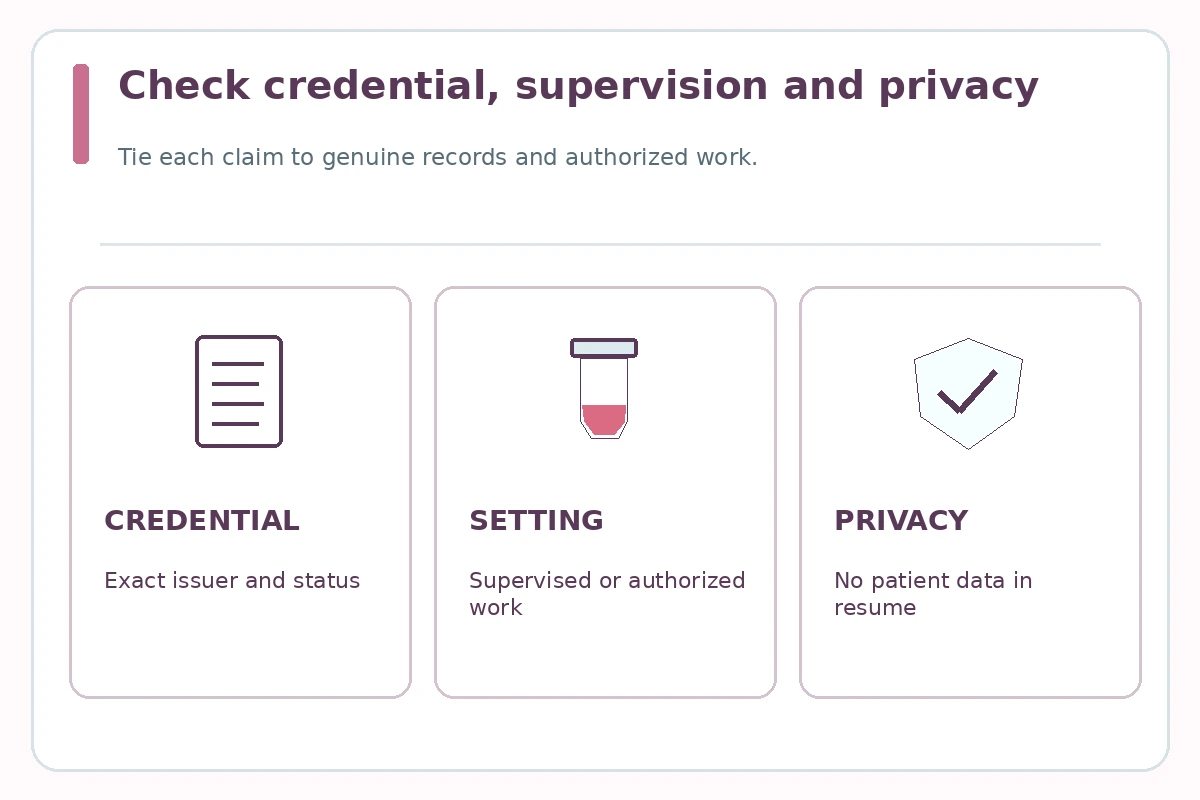
Before exporting, check that credential abbreviations, training dates and role titles match official documents. Remove all patient identifiers, internal sample numbers and clinical records. Ask whether the summary clearly separates “trained to” from “authorized to perform.”
Worked Example: A Summary You Can Defend
Illustrative scenario: A trainee completed a documented clinical placement with supervised blood collections and specimen labeling. The first draft calls the trainee a “licensed senior phlebotomist with a perfect safety record,” although the individual has neither a license nor an employment history in that role. A corrected summary reads: “Phlebotomy program graduate with supervised clinical collection experience, patient identity checks, specimen labeling, and careful documentation. Follows training-site infection-control and escalation procedures.” The training section then identifies the actual program and dates. Do not claim a credential unless the person has obtained it.
This example is hypothetical, not a genuine employer testimonial or a measured hiring outcome. Keep the sentence structure if helpful, but replace every noun, title, tool, credential and claimed contribution with your own verified information. A useful test is whether you could explain the sentence to a hiring manager without adding a qualification that is missing from your resume.
Final Resume Summary Audit Before You Apply
Read the first three lines as a hiring manager would. Can you tell the occupation and work setting? Are the skills tied to observable tasks? Is an employer likely to mistake training for paid tenure, team participation for individual ownership, or a recommended action for final approval? Verify every date, credential, product name and numerical claim against your records.
Compare the summary with the target job advertisement and the evidence in your work-history or projects sections. Do not fabricate percentages, promote yourself to a higher title, or include confidential organizational details to sound impressive. Read the exported resume on a phone and computer so the summary does not become a clipped block of jargon.
How We Research This Guide
We checked official CareerOneStop resume guidance and the applicable Bureau of Labor Statistics occupation description on November 2, 2026, then compared the proposed topic with the supplied JobAsk WordPress list and previous local article batches. Occupational descriptions summarize typical duties; they do not certify any applicant’s skills or guarantee that every employer uses the same responsibilities. All example sentences in this guide are hypothetical. See our affiliate disclosure for site policies.
CareerOneStop resume guide: CareerOneStop explains when a brief 3–4-sentence professional summary helps and recommends relevant accomplishments rather than inflated claims. Reviewed November 2, 2026.
BLS occupational reference: BLS explains patient identification, blood collection, labeling and sanitation, and notes that state requirements vary. Reviewed November 2, 2026.
More Resume and Cover Letter Guides
Yes, when applicable. Use each credential’s exact name, issuing body, current status and expiry as appropriate; the terms do not mean the same thing.
Yes, when labeled as supervised clinical training and backed by an accurate training entry. Do not present it as paid professional tenure.
No. Include verified counts only when they are accurate, permitted and relevant. Identification, labeling and careful documentation also demonstrate value.
No. Only name the settings and patient groups in which you actually have training or experience.
No. State and employer requirements differ. Check the relevant state licensing authority and the employer’s specific qualifications.