
A librarian professional development plan should start with a service the library actually provides, not a list of conferences or credentials collected for their own sake. Choose one user need, identify the related skill, practice it within your role, and gather non-identifying evidence for a review. Reference assistance, instruction, collection work and outreach need different proof of competence. The American Library Association’s competency resources can help frame growth, but they do not replace your library’s policies or your supervisor’s decisions about assignments.
Identify the service context before naming a skill
Start with the kind of library and the people served. In a public library, the need might be clearer technology help for walk-in patrons. In an academic library, it could be an introductory search lesson for students. A school librarian may coordinate differently with teachers, while a special library may handle restricted research requests. A goal that sounds useful in one setting may be irrelevant or unauthorized in another.
Ask the service team what recurring problems they already observe: inconsistent referral notes, users who cannot find a database, confusing program sign-ups, or inaccessible handouts. Use aggregated, appropriately approved feedback rather than collecting names and personal search histories. Define the problem in operational terms before selecting training. ‘Improve reference interviews for broad questions’ is more actionable than ‘be more knowledgeable.’
Choose one competency and a realistic starting level
Review an applicable ALA or RUSA competency area and decide what you can already demonstrate. Can you explain the existing reference workflow, conduct it with guidance, or help a colleague use it consistently? The answer should reflect actual practice, not simply years of employment. Do not mark yourself an expert because you attended a workshop, nor assume that every competency applies to your position.
For an example, a librarian who regularly answers routine questions might choose more effective clarifying questions when patrons arrive with complex research needs. A specific development goal could be to draft an approved set of neutral opening questions and use it during supervised practice. The manager determines whether any workflow change is appropriate; the goal does not grant authority to revise library policy.

Connect training to a patron-centered activity
Possible learning methods include a relevant webinar, observation of a colleague, reading current professional guidance, reviewing an existing tutorial or joining an approved practice session. Match the method to the skill. An instruction goal needs rehearsal and user-friendly materials; a cataloging goal needs accurate standards and review; a program-planning goal needs accessibility, scheduling and community input.
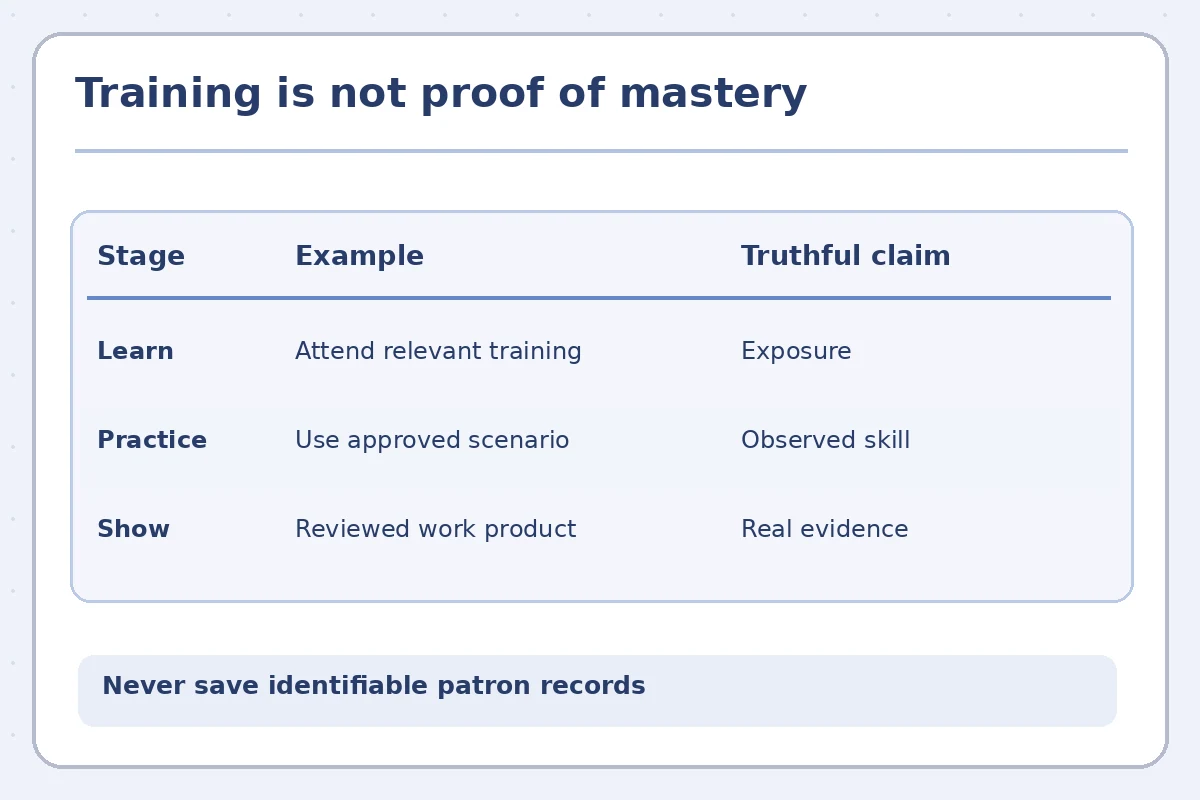
Reserve time for practice after the training. A calendar entry labeled ‘course completed’ is not evidence that users benefited. Build a small exercise: revise a draft handout for readability, rehearse a database search explanation with a colleague, or test whether a referral script sends a patron to the correct authorized service. Use sample requests, not identifiable patron records.
Collect evidence without recording patron identities
Evidence can include an approved before-and-after instruction handout, supervisor observation, an internal checklist or anonymous aggregated feedback collected under policy. Do not publish circulation records, search topics linked to people, screenshots of accounts or notes from private patron conversations in a career portfolio. If your library has a formal evaluation process, use its approved documentation practices.
A useful evidence statement may be ‘Revised a search-orientation handout after staff review; the new version has explicit steps and a clear accessibility check.’ That proves a tangible contribution. It does not prove an improvement in all patron outcomes unless you collected appropriate evidence. Keep observations separate from claims of causation, especially when many services change at once.
Differentiate service quality from activity volume
Counting classes or transactions may help describe workload, but quantity alone does not establish quality. Ask whether the patron received an understandable next step, whether information was accurate, and whether the service complied with privacy and access rules. Any success measure should reflect the particular goal. A one-off workshop may need a different evaluation from ongoing reference desk work.
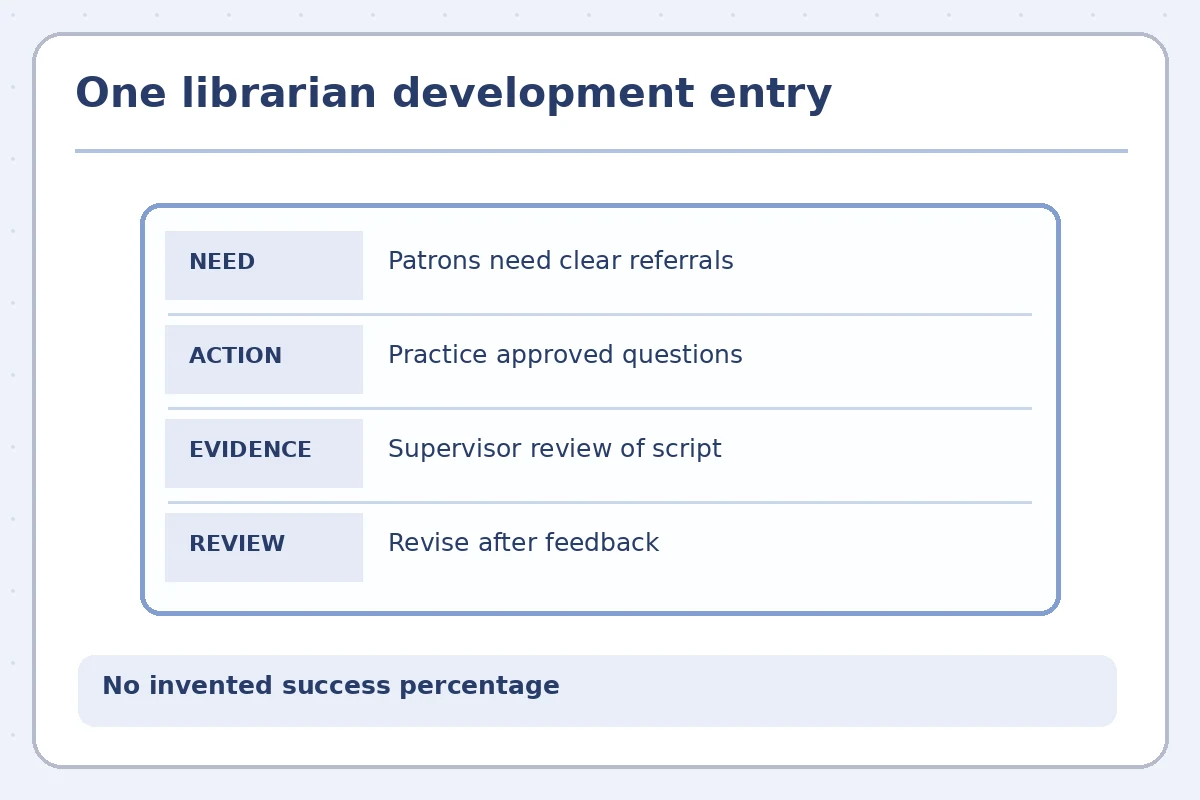
For example, if your aim is to make library orientations accessible, check the reading order, labeling and alternative access routes of the materials, then seek approved feedback. Do not promise that changing a handout will raise usage by an invented percentage. If your library cannot measure an outcome, record the process improvement you actually verified.
Review resources, workload and permission limits
Library staff have different authority over collections, instruction, vendor contracts and budgets. A reference librarian planning professional growth should not presume permission to purchase software or change a catalog record. If training requires money, schedule coverage or access to a restricted system, request approval before beginning. Include an alternative learning activity that fits within current resources.
Review the plan with the person who actually supervises the relevant service. A goal can be valuable without creating a new title or a guaranteed promotion. If the role has a professional degree or certification requirement, check the employer and relevant jurisdiction rather than relying on an informal skills checklist. The plan should distinguish continued learning from formal qualification.
Write the review note around real work
A concise development note includes the service need, the skill, the activity, the evidence and the next review. Example: ‘Patrons sometimes need a clearer handoff between general questions and research support; I will practice the approved referral script with a colleague and collect staff feedback on its clarity.’ This is a hypothetical example, not a claim about any library’s measured performance.
At the review, decide whether the technique is ready for normal use, requires revision or does not fit the service. Invite feedback from appropriate colleagues, not an unrestricted mailing list containing patron details. Over time you may build a small portfolio of approved materials and reflections showing how your professional judgment developed in the context of your library.
How We Research and Verify the Guidance
We reviewed role-specific source guidance, compared the intended reader decision with previously prepared JobAsk topics, and distinguish illustrative scenarios from official employer or institutional policy. Source references checked on 2026-11-10: ALA: Core Competencies (ALA identifies continuing professional development and core competencies for librarianship.) ALA/RUSA: Reference Competencies (RUSA competencies describe context-sensitive reference and user-service skills and distinct levels of proficiency.) BLS: Librarians (BLS distinguishes librarian duties across libraries, including user services, research instruction, collections, programs, and staff oversight.) BLS: Teacher Assistants (BLS describes teacher assistants as reinforcing lessons under teacher direction and helping with materials and records.) We do not imply that training completion guarantees authority, hiring or a workplace benefit.
This page is independent informational guidance, not a statement of any employer’s policy or a paid endorsement. Review the affiliate disclosure and verify local policies, job qualifications, and any individual benefit or licensing details before acting.
Explore Related Career Guides
No. Public, school, academic and special libraries differ in user needs, roles and permissions. Select competencies relevant to your actual setting.
It documents learning participation. Demonstrated competence usually needs practice, feedback or an approved work product tied to the skill.
Avoid identifiable patron requests or records. Use fictional examples or approved, non-identifying work products consistent with library privacy policies.
Follow your library’s governance and supervision arrangements. A development goal does not authorize changing policies, budgets or access rules.
Set an interval appropriate to the activity and your library’s review process. Revisit after practice or feedback, not only at the end of a course.