
A procurement specialist resume summary should say what you actually sourced, compared, documented, or purchased and identify the level of approval you held. A useful opening might mention purchase orders, supplier quotes, contract administration support, or delivery exceptions—but only when your work history confirms those activities. Avoid starting with “strategic negotiator” if you only collected quotes for a buyer. Read the job posting for whether the role is requisition support, sourcing analysis, supplier management, or independent purchasing. Then choose two or three defensible strengths for a compact summary that the experience section can prove.
Identify whether the role is support, sourcing, or authorized buying
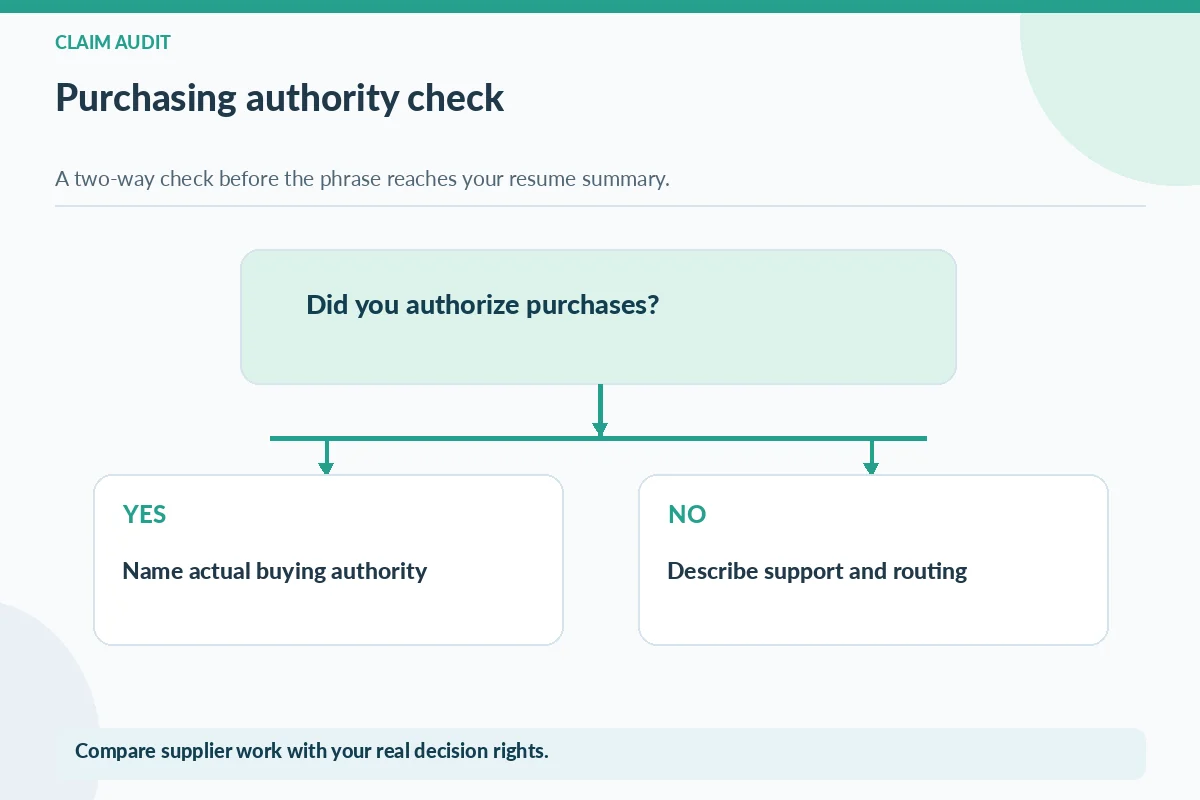
The word procurement covers materially different jobs. An assistant may receive requests, check that fields are complete, request standard quotes, create draft purchase orders, and update delivery records. A purchasing agent may evaluate vendors, compare terms, negotiate within policy, or release approved orders. A contract specialist may administer milestones and coordinate change requests. O*NET lists several of these task families for purchasing agents, but it does not mean every applicant performs all of them. Choose the slice of work that matches your own records before naming a specialty in the summary.
Make a three-column evidence sheet: task, document or witness that could confirm it, and decision owner. For example, “compared three supplier quotes” could be supported by a sanitized comparison worksheet; “approved vendor selection” requires actual delegated authority. An applicant who routed requests to finance should say so rather than claiming to have controlled a department budget. This distinction matters because a one-line summary is often read as a claim about the scope of your past role. If the vacancy asks for contract negotiation and you have only issued standard purchase orders, state the adjacent experience without inventing negotiation responsibility.
Write a summary that fits your actual procurement level
Illustrative support-level example: “Procurement support professional experienced in checking requisitions, comparing supplier quote details, and tracking purchase-order status for internal teams. Documents exceptions and routes approvals to the assigned buyer.” This wording is specific about inputs, outputs, and limits. Use it only if those activities are real. If your experience comes from an office coordinator role, name that background in the summary and show the purchasing-related tasks in its bullets rather than relabeling your former job as procurement specialist.
Illustrative experienced example: “Procurement specialist with experience evaluating suppliers, maintaining purchasing records, and coordinating approved orders across operating teams. Uses documented comparisons to clarify delivery and specification trade-offs; escalates contract or spending decisions outside delegated authority.” Replace broad phrases with real categories, systems, and outcomes if you can substantiate them. If you independently managed a sourcing cycle, you can describe it directly. If you participated in one part of the cycle, describe the part. Neither example supplies a fictitious tenure, savings percentage, or budget amount.

Pick evidence that proves the exact sourcing contribution
Your strongest summary detail may be an activity rather than a number. Perhaps you built a standard quote comparison, maintained a supplier contact log, followed up on late materials, or checked item specifications against requisitions. For each item, ask whether the purchasing team could recognize the artifact or workflow. A real purchase order, approved requisition, supplier issue log, or inventory handoff is stronger evidence than a list of unsupported adjectives such as “cost-effective,” “innovative,” and “results-driven.” Never share confidential supplier pricing or contract terms publicly; explain the workflow without exposing restricted data.
Be careful with system names. Familiarity with an enterprise procurement platform, spreadsheet, or ticket queue is useful only when you used it. If you created test purchase orders in a course, say “practice purchase-order workflow” rather than “managed enterprise procurement.” Describe supporting activities in a separate experience bullet, such as checking requested item codes against the approved catalog, recording missing documentation, and asking the authorized purchaser to resolve exceptions. The summary can then reference requisition accuracy or supplier follow-up without falsely implying independent procurement leadership.
Use purchasing results without claiming invented savings
A common temptation is to lead with a cost-saving percentage. Only cite savings if you have a credible baseline, approved calculation, and a clear explanation of your personal contribution. Comparing two quotations does not automatically save the price difference; the quoted products, delivery terms, quantities, and service obligations might not be equivalent. Likewise, reducing late deliveries requires actual tracking rather than remembering that the team became faster. If a result cannot be substantiated, state the method and scope: “Maintained a supplier exception register and escalated overdue confirmations to buyers.”
A metric can be simple and still useful. If your records show that you processed a defined volume of requisitions or monitored deliveries across certain locations, and sharing that figure is permitted, you can name it. Do not claim you “owned a $5 million budget” merely because you viewed the budget file, nor imply you signed contracts when you prepared draft exhibits. Add a second proof point that reflects care: reconciled item codes, checked supplier onboarding documents, or documented approvals. The combination of role, activity, and verifiable result generally communicates more than a crowded string of purchasing buzzwords.
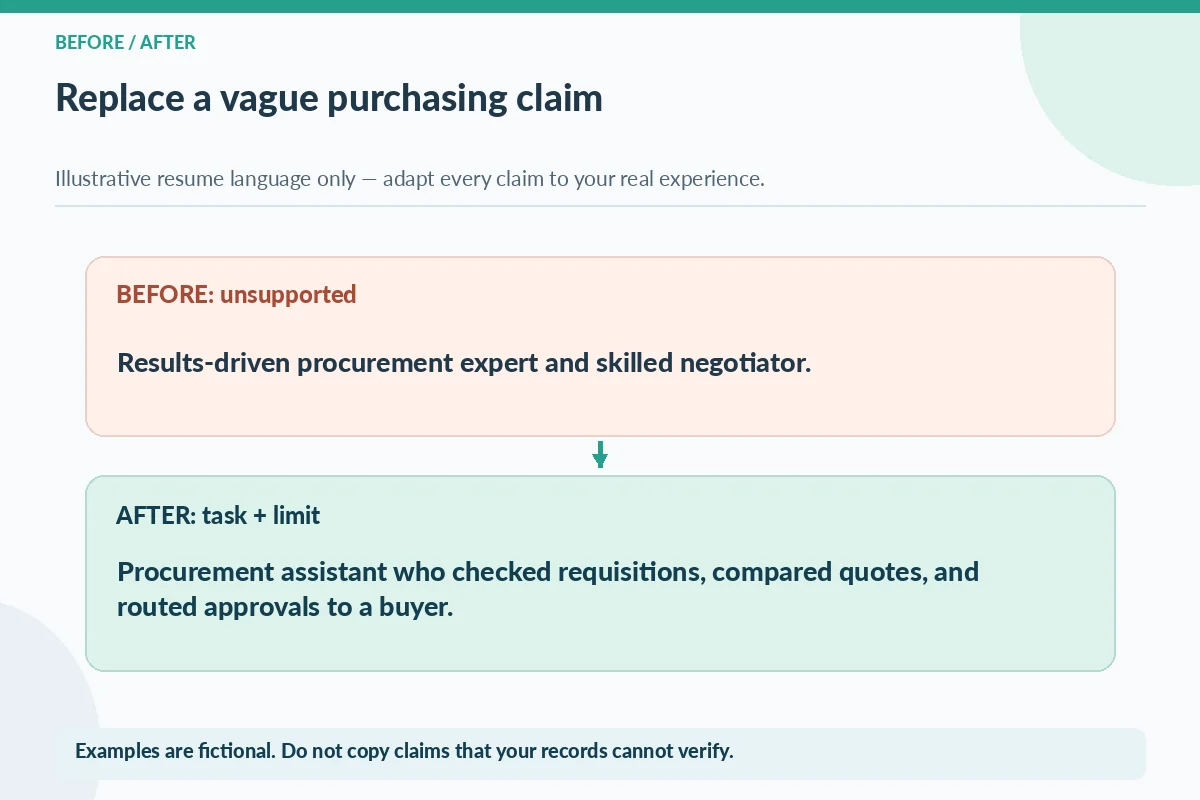
Translate operations experience into procurement language carefully
People enter procurement from inventory control, accounts payable, administrative support, logistics, and customer operations. A warehouse clerk who checked receipts against purchase-order lines may have relevant purchasing-adjacent evidence, but not necessarily supplier-selection experience. An accounts payable specialist who researched invoice discrepancies may understand three-way matching but may not have ordered goods. An office coordinator who obtained quotes may have experience gathering bids without making the purchasing decision. Name the transferable action and explicitly identify what the next role would add.
A career-change example could read: “Operations coordinator experienced in vendor communication, delivery tracking, and discrepancy documentation; seeking a procurement support role that uses careful requisition and supplier records.” It is a truthful transition when the underlying tasks are real. Move any training into a separate education or skills section instead of packing certificates into a summary without context. Do not label a private course an accredited procurement credential or promise a prospective employer that routine operations work qualifies you for regulated government contracting.
Audit the final three lines against the job description
Highlight the vacancy’s required outputs: supplier comparisons, sourcing events, purchase order processing, contract tracking, or exception resolution. Put a check beside each phrase in your summary that a former supervisor, work sample, or dated record could confirm. Remove unsupported claims, then read the remaining wording aloud. If the summary merely repeats the employer’s requirements, it does not show why you fit; replace one copied phrase with a task you performed. Keep employer-specific product names and contract information confidential unless disclosure is authorized.
Finish by matching the summary to the work-history bullets. If the summary says you monitored supplier delivery, at least one bullet should explain which records you checked and how you handled a delay. If it says you evaluated vendors, explain the factors you compared and whether you recommended or approved a choice. Check that you did not simultaneously call yourself a purchasing assistant and a procurement director without explaining the actual role progression. A summary is a preview of proof, not a substitute for that proof or for the employer’s minimum qualifications.
How We Research Role-Specific Resume Summaries
We reviewed occupational profiles, official career guidance, and relevant professional or safety sources from onetonline.org; bls.gov; cloudfront.careeronestop.org on November 4, 2026. Each sample summary here is fictional and must be adapted to actual skills, official role titles, and the employer’s requirements. No source endorses a particular candidate, and no hiring outcome, credential, metric, or ATS result is guaranteed. We do not claim a paid relationship with the sources. Read our affiliate disclosure.
More Resume and Cover Letter Guides
Use the actual title or a clear description such as procurement support unless the specialist label accurately reflects your work. A functional description should not conceal the official job title in your experience section.
Yes when you actually used the platform and it is relevant to the vacancy. Separate live work experience from training environments, simulations, or observation.
Describe the category, purchasing workflow, and your responsibility at a nonconfidential level. Do not disclose restricted prices, contract terms, vendor information, or private contact details.
Only when the savings method, baseline, and your contribution are verifiable and appropriate to disclose. Comparing two non-equivalent prices does not prove savings.
Usually two or three focused sentences are easier to scan than a long paragraph. Prioritize role, two verified strengths, and the kind of procurement position you are targeting.