
List inventory management skills on your resume only when you can connect each one to a task you actually performed: receiving goods, verifying quantities, labeling stock, recording locations, checking cycle counts, or reporting discrepancies. A software name alone tells a hiring manager little about accuracy. Show the item or record you handled, the check you performed, and whether someone else approved an adjustment. That distinction matters for stockroom, retail, and warehouse applications.
Start with the inventory task you can defend
Inventory management can describe different levels of responsibility. A receiving associate may compare cartons with a packing list, while an inventory analyst may investigate patterns across locations. A stockroom assistant may enter counts without being allowed to change the official balance. Select terms that fit your actual work, such as receiving verification, stock location updates, cycle counting, barcode scanning, or discrepancy reporting. Do not borrow a managerial title because you handled stock occasionally.
O*NET describes stockers and order fillers as workers who receive and count items, enter data, maintain storage locations, examine defects, and support orders. It also lists broader tasks that not every individual performs. Use that occupational profile as a vocabulary reference, not permission to claim every listed responsibility. Put the most relevant genuine skills in a short Skills section, then substantiate the important ones under Experience.
Connect receiving records to a visible control
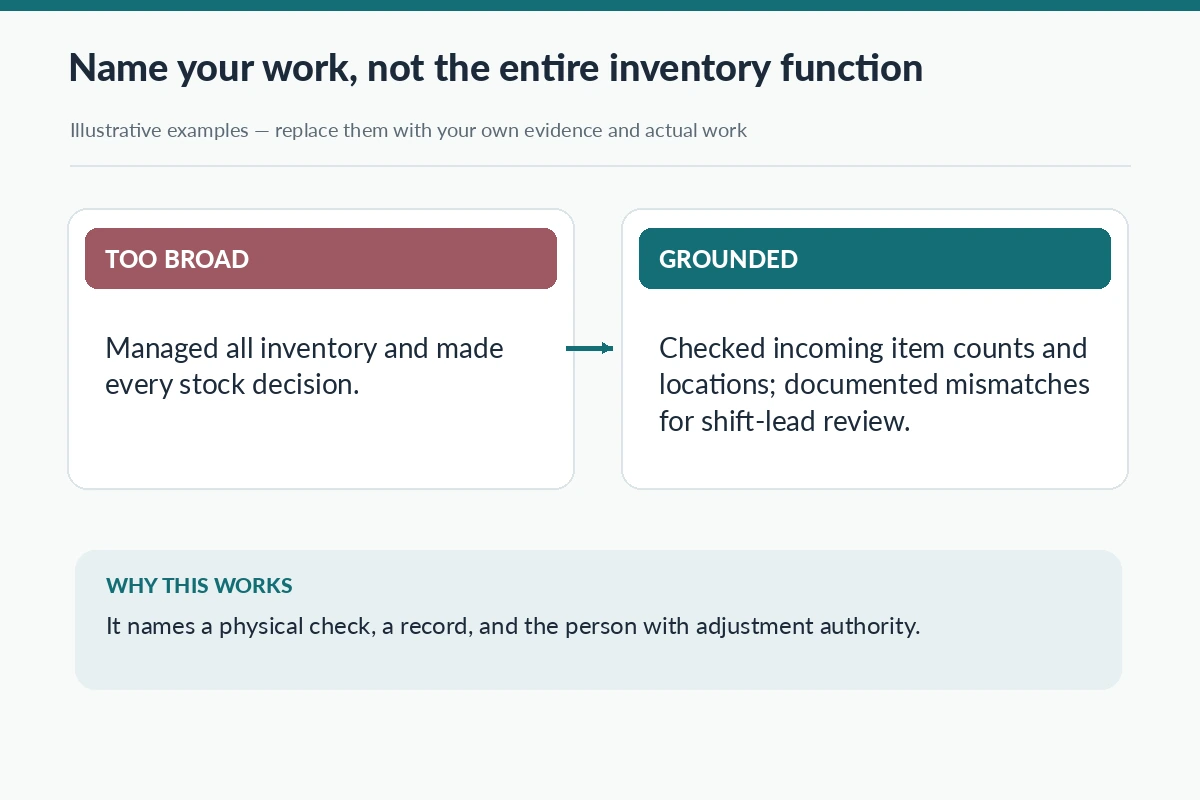
If you received merchandise, identify the document and check rather than writing “managed inventory.” You may have compared item identifiers, quantities, condition, and assigned locations to the delivery documentation. Explain how you recorded mismatches: in a receiving log, an inventory system, or a supervisor notification. A description such as “Checked incoming cartons against packing lists and flagged quantity differences for review” is useful without pretending that you approved supplier disputes.

Separate receiving from purchasing. Scanning a shipment or updating a shelf location does not necessarily mean selecting vendors, placing purchase orders, determining reorder levels, or authorizing invoices. If a posting requests procurement experience and you have only handled receipts, state the receiving evidence. A hiring manager can assess its transferability more accurately than a misleading claim about end-to-end supply-chain ownership.
Explain cycle counts and mismatches without magic numbers
A cycle count is more informative on a resume when the work is described precisely. Did you count a defined section, rescan a questionable label, compare quantities against a record, or document an exception? Mention the location or type of inventory if confidentiality permits. Do not claim a percentage accuracy improvement unless you have an actual baseline, reliable measurement, and permission to disclose the result.
Try “Performed scheduled shelf counts and documented differences for lead review” instead of “Achieved perfect inventory.” If you personally resolved a data-entry error according to an approved procedure, describe that narrower action. If discrepancies went to a supervisor, say so. Realistic limits create confidence because inventory systems often preserve an audit trail and assign correction rights to specific employees.
Name systems only to the depth you used them
You can list a warehouse management system, POS stock module, handheld scanner, or spreadsheet when you used it for a real operation. Add the function: “barcode scanning for location verification” or “spreadsheet reconciliation of physical counts.” Avoid claiming an enterprise system module just because you could view its dashboard, and distinguish data entry from configuring or administering the system.
If you do not remember an exact proprietary product name, a truthful task description is better than guessing. “Entered receipts and transfers in an inventory system” is credible if that is what happened. If a job posting requires a specific system you have not used, explain your experience with a comparable workflow and treat the unfamiliar platform as something to learn, not as a listed skill you already possess.
Turn a vague bullet into an auditable example
Weak: “Responsible for all inventory operations.” Better: “Recorded incoming items, verified shelf locations, and reported count exceptions to the shift lead.” The improved version names three observable actions and keeps authorization limits clear. If you have an authentic result such as fewer unmatched items in a particular reporting period, you may include the measured result only after confirming who calculated it and how.
For school projects, simulate a small stock ledger using fictional products and clearly label it a project. Explain the method, not fictional company savings: “Built a sample inventory log with receipt, issue, and balance fields; tested mismatched counts.” For volunteer work, describe the real donated supplies or event materials you tracked. Do not convert a classroom simulation into paid warehouse experience.
Match the role before selecting skill keywords
A grocery stocker posting may emphasize replenishment, shelf rotation, and product condition. A parts clerk may need item codes and accurate issuing records. A warehouse inventory-control role may emphasize count reconciliation, location records, and exception logs. Read the duties before placing broad phrases such as “inventory optimization” or “demand forecasting” on the page. Those are different skill sets and should require separate evidence.
You do not need a ten-line skills bank. Choose a few role-specific terms supported by your work history, then show one carefully selected example beneath the relevant job. CareerOneStop recommends a Skills section centered on job-relevant capabilities and explains that the section is optional. Relevance and proof beat copying every phrase in the employer listing.
Protect safety boundaries in equipment examples
Operating powered industrial trucks, accessing restricted areas, or handling hazardous stock are not ordinary extensions of being able to scan a barcode. Include equipment or controlled-material experience only when it was authorized, trained, and appropriate to the role. Do not label yourself forklift-certified unless you have valid employer-relevant evidence and the wording is accurate for the location.
Safer resume language could be “Prepared pick tickets and confirmed item locations; powered-equipment moves were handled by authorized operators.” If you reported damaged packaging or a blocked aisle, state the observation and the reporting channel. This shows attention to safe processes without implying a license, inspection authority, or responsibility you did not have.
| Experience | What you did | Proof to describe | Limit to respect |
|---|---|---|---|
| Receiving check | Compared items with packing list | Record count differences | Do not claim supplier approval |
| Cycle count | Recounted assigned bins | Escalated mismatch | Do not invent accuracy gains |
| System use | Scanned locations | Logged item movement | Do not claim configuration |
Make the evidence easy to verify during interviews
Prepare one concise story about a discrepancy: what the record showed, what you physically found, what you checked next, and who made the adjustment. Remove customer names, proprietary stock values, and screenshots of private systems. You can tell the story using categories and actions instead of disclosing restricted data. An interviewer should understand both your contribution and the point at which authority passed to someone else.

Before submitting, check that dates, shifts, employer names, and tool descriptions match what you can substantiate. Where responsibilities varied by location or supervisor, avoid sweeping statements that make it sound as if you owned the entire inventory process. A focused, verifiable description supports more hiring decisions than a claim to have controlled everything.
How We Research and Verify Resume Examples
This article uses publicly available occupational and career guidance to distinguish a task a worker might perform from a claim a particular applicant can honestly make. All sample resume statements are illustrative, not biographies or verified employer results. The sources listed below were reviewed on 2026-11-05. Skills, authority, training, and credential requirements depend on the actual job and organization. For the site’s relationship policy, read the affiliate disclosure.
Source basis: CareerOneStop Resume Guide — Skills sections should list relevant capabilities and can be positioned according to importance.; O*NET OnLine occupational profile — Receiving, item counts, stock records, location storage, and damage reporting are recognized occupational tasks.. Review original requirements before making legal, licensing, financial, or other consequential claims about your own scope of work.
More Resume and Cover Letter Guides
Receiving verification, stock location updates, barcode scanning, cycle counts, discrepancy documentation, and authorized record reconciliation are strong when backed by real tasks.
Use narrower wording such as replenishment, shelf organization, and stock checks unless you genuinely handled inventory records or controls.
Yes when you personally used that system. Include the function you performed, not an unfamiliar module or guessed proficiency level.
State the count or record check you completed, how you documented the difference, and who was responsible for correction approval.
It can support a Projects section when honestly labeled as a sample or class exercise; it must not be presented as paid warehouse results.