
In a contract-job interview, ask who directs the work, what outcome the assignment must produce, who reviews it, and what determines the end of the engagement. Do not treat a project title or a verbal estimate as a confirmed contract term. These questions help US applicants compare a fixed project, an employee assignment, and another arrangement without assuming the worker classification or legal obligations from the word “contract.”
Separate the hiring entity from the client contact
Start by establishing the working relationship: “Which organization would employ or engage me, and who would assign my work each day?” A recruiter may coordinate interviews, a client may set priorities, and another person may approve a timesheet or deliverable. Those functions need not sit with one contact. Write down the actual names and responsibilities, rather than guessing from email signatures.
Follow with: “Who can change task priorities, and who resolves a disagreement about scope?” Consider a hypothetical analytics contractor who receives requests from three departments. Without one named approver, each team can assume its request is urgent. Ask whether there is a regular check-in, a task queue or a documented escalation route. The useful answer identifies a decision-maker, not merely “we collaborate.”

Ask what successful completion looks like
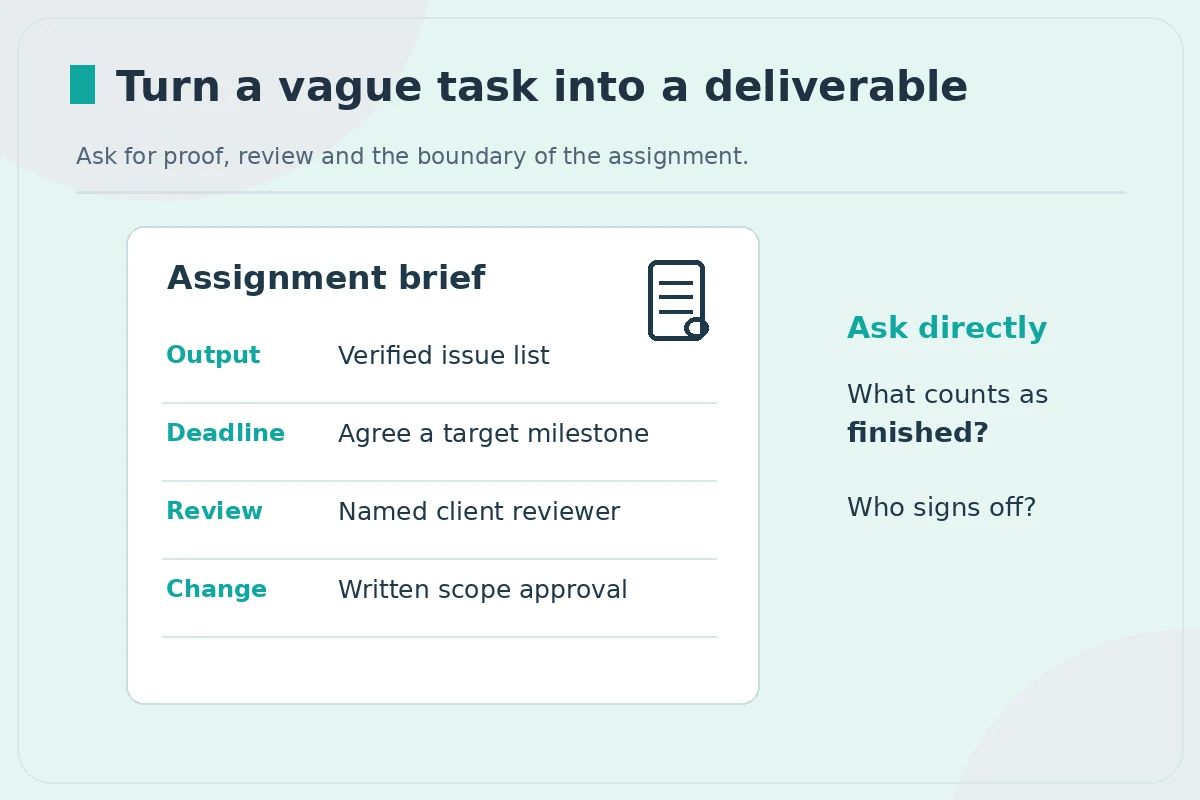
Move from job title to deliverable: “What concrete output is expected in the first month, and how will it be accepted or reviewed?” A project support assignment might involve a verified records inventory, a reconciled issue list or an agreed handoff document. Ask which quality checks a supervisor performs and whether the candidate will receive the tools and access needed for the task.
An answer such as “help wherever needed” may be reasonable for some support roles, but it does not clarify scope. Try: “Which two tasks would take priority if the team has more requests than capacity?” If work depends on private client records, ask how permission is granted and which data may be used in samples. Do not offer to copy client files into personal software to prove initiative.
Pin down duration without inventing a renewal promise
Ask: “Is there a target start date, an estimated end date, a milestone-based end, or an ongoing need?” These are different answers. An assignment may end when a deliverable is accepted rather than on a calendar date. Ask who communicates extensions, which document would record a changed date, and how far ahead the team normally knows that more work is needed.
Do not phrase an interview question as “Will you guarantee six more months?” unless the employer has already raised a specific written commitment. A better version is “If the work expands, what is your process for proposing and approving a change?” Treat extension possibilities and conversion to direct employment as possibilities only, not benefits you already have.
Clarify workload, approval and the normal workflow
A realistic question is: “Where are tasks requested, reviewed and closed?” Follow with whether a weekly status report, ticket system or client meeting is used. The answers reveal how progress is visible and who can verify your work. Ask about reasonable response windows and which changes require sign-off instead of assuming unlimited availability.
For a hypothetical website migration assignment, one team might supply content while another controls deployment. The contractor may test and report defects but not approve a release. Ask whether approvals are documented and who owns production changes. This is more informative than simply asking whether the workplace is “fast-paced.”
What a useful answer should actually establish
| Question topic | Useful confirmation | Answer to clarify |
|---|---|---|
| Who directs the work? | Named task owner and escalation route | “Everyone will tell you what to do” |
| What will be accepted? | Deliverables and designated reviewer | “Whatever comes up” |
| When might it end? | Date or milestone plus change procedure | Unqualified promise of renewal |
| Who confirms the terms? | Identified written-offer contact | Only verbal assurances |
Choose questions about access and workplace safety
If the engagement involves a client site, ask which organization provides site orientation, specialized training and protective equipment when relevant. OSHA explains that coordination between host employers and contractors matters for safe work. Do not treat this as proof that all engagements have the same employment status or that all office contractors require particular safety equipment.
A well-formed interview question is: “Before I use client systems or visit the worksite, who explains the authorized access and safety procedures?” If sensitive information is involved, ask about approved devices, data retention and reporting of mistakes. The answer should identify a process, not encourage work before approval.
Match each question to the person who can answer it
A recruiter may know the advertised assignment length, location and interview stages. A project manager usually explains priorities and acceptance criteria. HR, procurement or the party issuing the written offer may be better placed to confirm pay documentation, classification and contractual terms. Use the interview to identify the right contact rather than forcing an interviewer to make promises outside their authority.
A concise closing question: “What parts of this arrangement are still being finalized, and who will send the confirmed details?” Record the answer in a private note. Do not send financial documents or identification to an unverified contact; independently confirm the organization and formal application channel if the approach was unsolicited.

After the interview, write a four-line verification note
A practical follow-up email can say: “Thank you for discussing the reporting structure and deliverables. My understanding is that the team lead will assign priorities, a designated reviewer will approve deliverables, and the projected schedule remains subject to the written engagement terms. Please correct anything I have misunderstood.” This asks for precision without pretending that a conversation is a signed agreement.
Compare what you heard with the written position description and any offer. If two sources conflict, request clarification before making a commitment. Keep interview notes factual and avoid storing confidential client details in a personal portfolio. The goal is to decide whether the work is realistic, supervised appropriately and accurately described.
Rehearse the two answers that would change your decision
Before an interview, rank the unknowns rather than trying to ask every possible question. For a contract position, the most consequential gaps are often who can change your work and what event ends the engagement. Practice follow-up language: “If the deliverable needs another review, who approves that change?” and “If the expected end date moves, how will I learn that?” Specificity is courteous because it gives the interviewer a clear way to answer.
For a second hypothetical applicant, location and access may matter more than duration. That person might ask whether client-site visits are scheduled in advance and whether the organization provides approved devices. There is no universal best question list. The best questions reveal the exact uncertainties that affect your acceptance decision, and they can be prioritized without implying mistrust.
How We Research Interview Questions
We reviewed the following authoritative US resources on November 7, 2026: cloudfront.careeronestop.org (Interview preparation and asking about responsibilities and performance). www.osha.gov (Coordination between host employers, contractors, and staffing agencies). consumer.ftc.gov (Verification of unfamiliar employers and avoiding fraudulent recruiting requests). We use the sources to distinguish actual public guidance from interview preparation suggestions; example questions and situations are illustrative, not quotes from recruiters. Company policies, public hiring procedures and the terms of each role can differ. Confirm details with the organization authorized to make the decision.
We do not rank employers for payment and do not claim an affiliation or assured hiring outcome. Read the JobAsk affiliate disclosure. Keep private records and job-application credentials secure; interviews and informal comments do not replace written employer decisions.
More Interview Preparation Guides
Yes. Ask if a formal conversion pathway exists, who decides, and whether it has been used for this role. Do not assume conversion or a particular timeline.
Yes. Clarify the paying or contracting entity and request written terms from the responsible team. An interviewer may not be authorized to confirm them.
Treat the discrepancy as unresolved. Request a single written clarification from the organization issuing the agreement before relying on either date.
Only samples you are authorized to share. Use fictional or sanitized examples where permitted, and never expose confidential customer information.
Prepare several and prioritize two or three that address the biggest uncertainties. Ask permission to send remaining administrative questions afterward.