
If you are leaving a restaurant role, give a clear notice with your proposed final date, then handle the role-specific work separately. Your supervisor should confirm the employment date and decide who accepts unfinished responsibilities. This guide shows what to check, what to document, and which decisions belong to managers or specialist teams—not the departing employee. It is written for US readers; your employer policy, agreements, state rules and actual duties can change the correct process.
Start with a documented notice and a precise final day
A resignation letter should establish your decision; it does not need to settle every task, financial question, or equipment issue. Check the notice terms you actually agreed to and ask HR or your supervisor how the end date is recorded. There is no universal federal rule requiring every employee to give two weeks of advance notice; contracts, organizational policies, and state requirements may differ. Keep the message factual and preserve your own permitted record of the confirmation.
Separate your notice date from your final shift
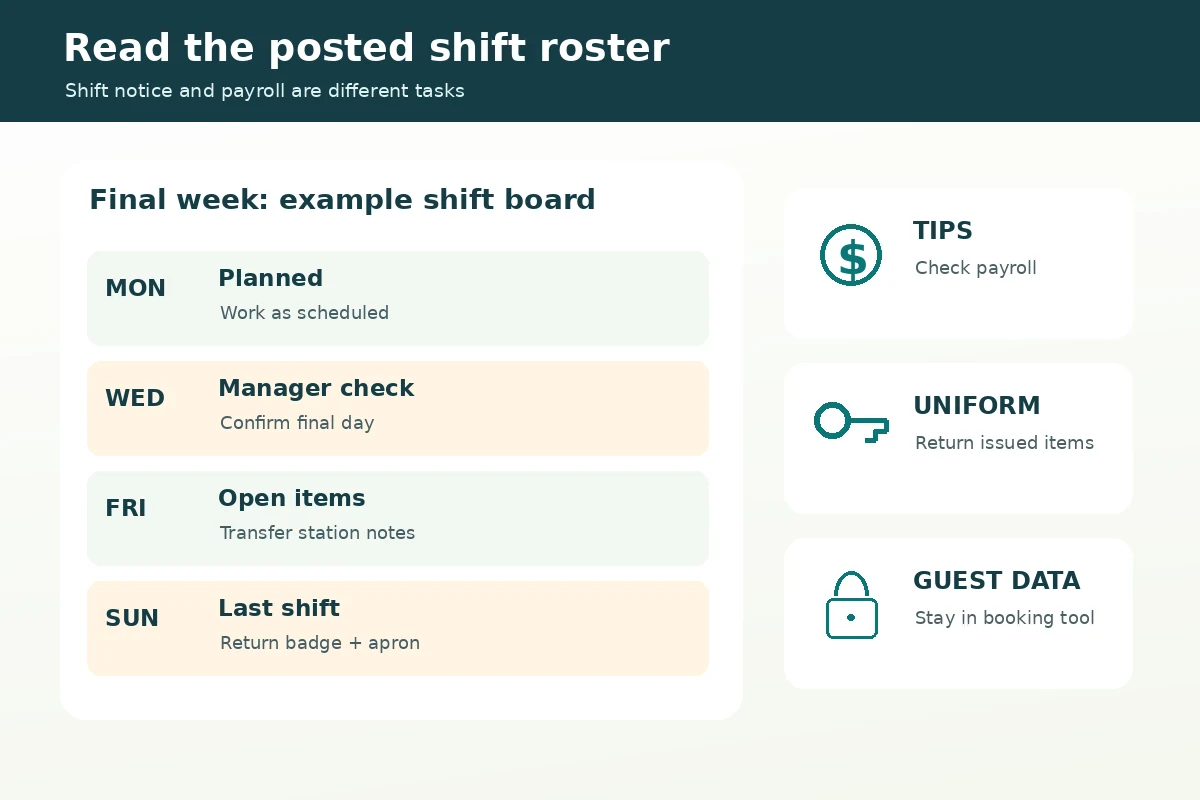
The date you tell a manager you are leaving, your last scheduled shift, and your official final employment date can be different. Look at the posted schedule and any written notice policy before proposing a date. Name both the calendar date and the shift, especially when an evening shift ends after midnight. Do not count on a coworker to adjust the roster without management approval.
For example, a server scheduled Thursday through Sunday might write: “I am resigning, and my proposed last shift is Sunday, November 22, closing service.” The dates are illustrative, not a promise that this notice is sufficient. Ask the manager to confirm the end date and any assigned duties in writing. If the rota changes while you are leaving, check the revised version rather than assuming the old copy governs.
Tell the appropriate supervisor before telling the crew
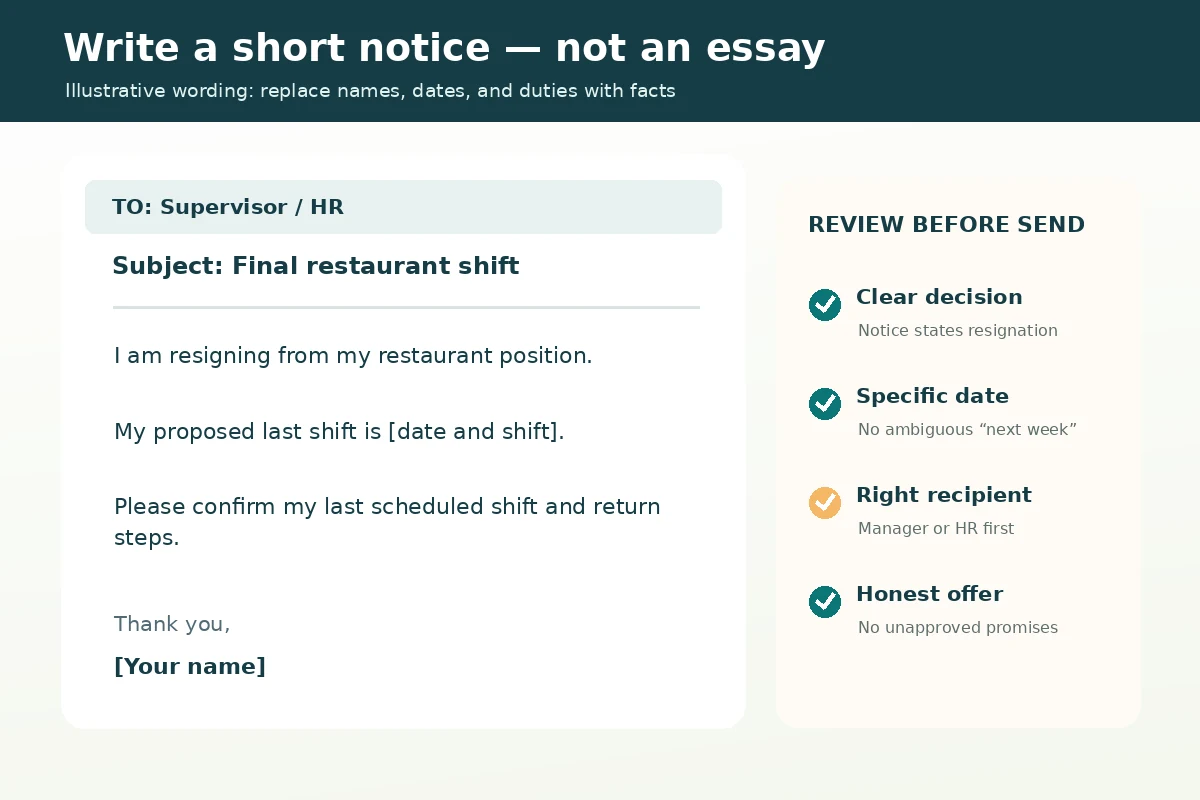
Restaurant teams may have a floor manager, general manager, owner, and scheduling coordinator. Find the person authorized to receive employment notices; a group chat to all servers is not a reliable substitute. Briefly tell that person first, then send a simple dated confirmation. Avoid a lengthy critique of coworkers or customers in the notice. A resignation is a clear employment decision, not an invitation to debate every past shift.
A concise email can say: “I am resigning from my host position at Example Bistro. My proposed last shift is Friday, November 20, from 4 p.m. to close. Please confirm the schedule and where I should return my entry card and apron. Thank you for the opportunity.” Replace every detail with what is true. Do not claim you can train a replacement unless a manager agrees and schedules it.
Use the posted roster to prioritize the remaining work
Mark your confirmed shifts, planned days off, and any time-off request that overlaps the notice period. Ask who will update the schedule if service hours change. If your role involves opening or closing, leave clear station-specific notes on routine setup and where approved checklists live. Keep ordinary food-handling and customer-service procedures intact through the end. Do not independently change lockup, cash, or food-safety steps to simplify the departure.
A kitchen helper could identify prep handoff times and which lead is responsible for cleaning sign-off. A host might flag an existing reservation workflow and leave the authorized manager to reassign the account. The useful record names the task, next owner, and location of the approved instructions. It does not reproduce guest phone numbers or export private reservations to a personal device.
Ask payroll about hours, tips, and reimbursements
Before your last shift, verify that time entries, punch corrections, and any tips reporting are accurate in the employer system. Federal law regulates tip ownership and wage obligations, but the timing of final wages and some deductions depends on state rules. The U.S. Department of Labor says federal law does not generally require immediate final payment; state law may provide more protection. Avoid asserting that all workplaces must pay the same day.
Make a private list of dates you worked and the hours shown on your pay records; use lawful employee access rather than copying employer payroll databases. Ask payroll how remaining tips or tip-pool amounts are processed and how you will receive a pay statement after access ends. The restaurant FLSA guidance also limits deductions for required uniforms when they reduce pay below applicable standards. For disputed amounts, request a written explanation rather than calculating an unsupported figure.
Keep return items distinct from payroll questions
Inventory the apron, name tag, locker key, handheld device, parking pass, access card, or other items actually issued to you. Ask a manager where to return them and request acknowledgment. Do not leave keys in an unattended drawer without permission. Property return and final pay may be handled by different departments; keep both questions visible without implying wages can automatically be withheld over a missing shirt.
A simple last-day record can have columns for item, location returned, date, and person receiving it. Record only necessary details. If uniform cleaning or replacement charges are raised, ask for the written policy and applicable state guidance. Do not accept a broad claim that any alleged equipment cost cancels wages owed; specific legal rules and facts matter.
| Item or deadline | Who decides or receives it | What to record |
|---|---|---|
| SHIFT ROSTER | Supervisor or designated owner | Status and confirmed end date |
| TIPS & PAY | Authorized specialist or manager | Approval needed and next step |
| HANDOFF NOTE | Receiving team or successor | Where approved records live |
| Personal employment record | HR or payroll contact | Permitted copy of notice or pay record |
Prepare a shift-level handoff, not a management takeover
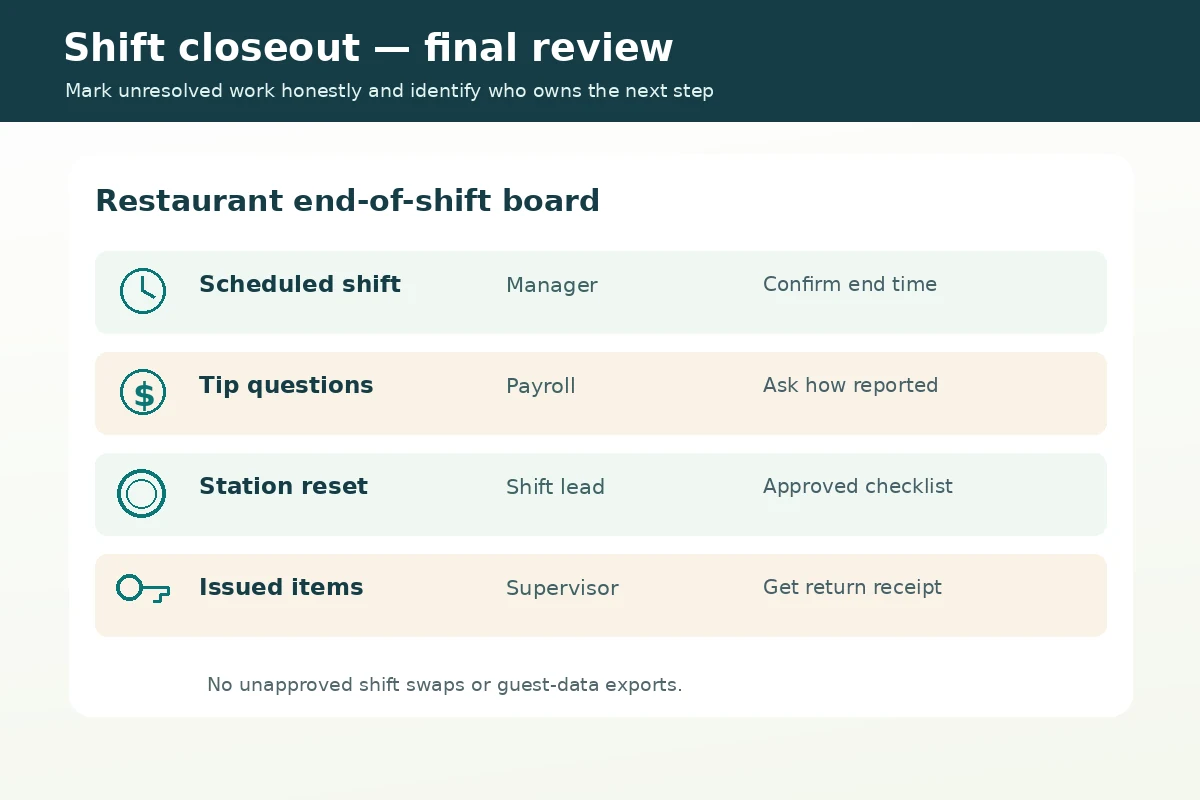
Your task is to communicate what you know and complete assigned duties—not to approve schedule changes, distribute tips, or decide who takes your role. Leave a short status note on unfinished reservations, restocking, point-of-sale issues, and closing assignments that affect the next shift. Direct colleagues to the existing authorized system. Ask a supervisor to own any changes that touch cash handling, refunds, or guest information.
A hypothetical line might read: “Saturday dinner reservation modifications are in the approved booking system; night manager to review before service.” That is more useful than an informal text with customer contact details. If a disagreement arises, state the current status and who needs to decide. Clear boundaries protect customers, the restaurant, and the departing worker.
Send a short confirmation after the conversation
After giving notice, send a concise record of the proposed end date and any agreed next steps. Use a neutral subject such as “Resignation and final shift confirmation.” If the supervisor changes your last shift, ask for the revised date in writing rather than rewriting the past. Keep your personal copy of the notice, your own pay statements, and relevant correspondence through permitted channels.
Example: “Thanks for speaking today. This confirms my resignation and our discussion of my final scheduled shift on [date]. I will complete assigned duties and return my access card to [manager]. Please confirm the final employment date and payroll contact.” The sample is for illustration and should be adapted to your actual policy, schedule, and local requirements.
Run a final-shift check before leaving
At the end of your final shift, complete the normal cash, cleaning, and station procedures you are authorized to perform. Confirm which open items are assigned to someone else. Record employer property handover and ask how to reach HR or payroll afterward. Do not keep customer data, recipes marked confidential, transaction histories, or coworker schedules as future “proof.” A clean exit means no abandoned work and no unauthorized copying.
A final checklist is: confirm actual end date; finish assigned station tasks; pass along urgent items in approved tools; return property; verify timesheet entry; retain the approved payroll contact. If the employer asks you to stay available after departure, discuss a separate arrangement rather than silently agreeing to unpaid on-call work. Your resignation is complete without guaranteeing a substitute worker.
How We Research Resignation and Handoff Guidance
We reviewed the following primary or authoritative US sources on November 7, 2026: www.dol.gov (Federal wage, uniform, tip and restaurant practices). www.dol.gov (Federal rules about employee tips and tip pools). www.dol.gov (Federal final paycheck rule and state variation). These sources address specific employment, security, tax, or organizational practices, not a universal resignation form. Where policy or legal obligations differ, consult the actual employer terms and current state guidance. Illustrative examples are not real employee records or professional legal or tax advice.
This article contains no paid ranking of templates or confirmed commercial relationship. Read our affiliate disclosure. Do not expect a particular reference, paycheck date, or rehire outcome merely because you use this format. Accurate records and respectful communication are more useful than unsupported promises.
Explore Related Career Guides
Check your employer agreement, school or workplace handbook and applicable state rules. A two-week custom is not a universal federal requirement; obtain date confirmation from the appropriate office.
A concise dated email is often useful as a written record, but follow your employer’s actual notice process. Keep a permitted copy and ask the receiving manager to confirm the effective date.
No. Inform the designated supervisor or HR first. Let management decide who needs a role handoff and which external contacts should receive an approved notice.
Document the status, urgency, location of authorized records, and receiving owner. Do not mark unapproved or incomplete work as finished or keep personal access to complete it later.
Keep only employment records you are entitled to retain. Do not copy protected customer, donor, student, credential, or business information to personal accounts for reference or portfolio use.