
Recruiting experience can be a bridge into HR operations when your work has included scheduling, accurate candidate records, process explanations and careful handoffs. HR operations may add employee files, onboarding documentation, benefits support and ongoing personnel administration. Those tasks are not automatically the same as managing an applicant pipeline. The most credible transition identifies the records you already handled, the privacy boundaries you respected and the employment processes you still need to learn.
Distinguish recruiting activity from employee administration
A recruiting coordinator may organize interviews, communicate with applicants, update status fields and collect permitted hiring paperwork. HR operations staff may verify personnel documents, record employee changes, prepare orientations and retrieve files for authorized requests. Both require accurate records, but the information and access rules can differ substantially. Review three HR assistant or operations coordinator postings to see whether the requested tasks are clerical, specialist-level or policy-driven.
Create a two-part skills map. On one side list the recruiting tasks you truly performed: calendar coordination, confirmation messages, applicant-system updates and approved status notices. On the other, list target HR tasks: maintaining employee files, processing changes, responding to procedural questions and routing benefits issues. Draw a line only where you can explain an actual shared method, such as accurate record matching or controlled handoff.
Turn candidate coordination into credible proof
A transferable achievement is an observable process improvement, not a claim that you made hiring decisions. For example, if true, you might say, ‘Coordinated interview schedules across teams and verified candidate status updates before sending approved notices.’ Mention only real systems, counts and outcomes you can support. If a recruiter decided which candidates advanced, identify that decision owner instead of writing that you independently selected applicants.
Create a sanitized exercise showing how a fictional candidate moves from interview scheduling to the employer’s authorized offer workflow and, once hired, to the onboarding team. Use made-up names and neutral status fields. Do not include real candidate résumés, private contact details, salary information or internal hiring notes. The point is to demonstrate a reliable transfer of necessary information, not to claim ownership of the entire employment lifecycle.

Understand who can access personnel records
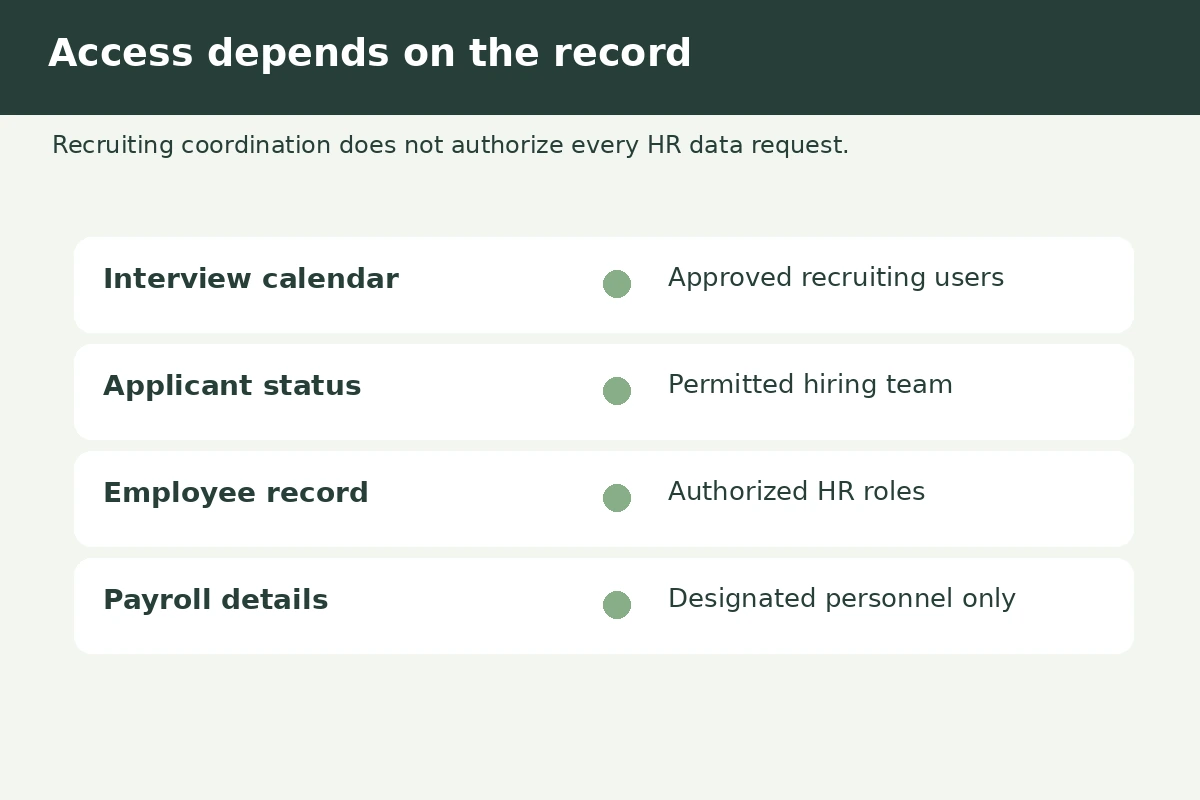
Recruiting systems and HR records systems can expose different information to different staff. A person may be permitted to arrange an interview but not view an employee’s medical, payroll or disciplinary record. An HR assistant often supplies records only to authorized people. In an interview, describe how you would check access procedures and refer an unclear request rather than relying on a person’s title or informal urgency.
If you have never processed a specific type of employee document, say so. You can demonstrate comparable discretion through restricted calendar links, secure file transfer or careful handling of personal data in an approved process. Never invent a general legal rule for every record category; employer policies and applicable requirements vary. What matters for a support role is that you do not bypass the controls you are being trained to use.
Map an onboarding handoff without inventing approval
A fictional onboarding checklist can show an approved offer notification, required paperwork request, orientation scheduling, completion-status tracking and an escalation when an item is missing. Put the person responsible for each action on the page: recruiter, HR operations representative, manager or designated specialist. Mark items as received or pending, not legally valid or approved, unless the authorized reviewer made that determination.
Try a simple scenario: a new hire has not submitted an expected document by an internal checkpoint. The coordinator records the status, sends an approved reminder through the designated channel and refers the unresolved matter to the HR owner. The coordinator should not alter the effective date, make a payroll promise or declare the new hire ineligible without authority. This is a work process, not a universal compliance script.
Select learning based on the actual HR system
HR operations jobs may request employee record platforms, spreadsheets, document-control tools and ticket systems. Listing a familiar applicant tracking system can support your computer skills, but it should not be presented as experience with payroll or a human resources information system that you have never used. Learn terminology and the boundaries between recruiting, benefits, payroll and employee relations before buying a training program.
Ask employers whether an HR assistant learns through documented procedures, shadowing or formal training and which decisions stay with specialists. If a role expects independent investigation of employee complaints or benefits administration, find out the qualifications required. You may be ready for a coordinator job while still needing substantial preparation for a broader HR generalist opening.
Write a targeted transition summary and cover letter
An honest summary could read, ‘Recruiting coordinator with experience in scheduling, applicant record accuracy and controlled communications, seeking HR operations support.’ Follow with concrete evidence about verifying details, resolving calendar conflicts and escalating data questions. Do not rename yourself an HR generalist or claim that coordinating a hiring panel equals managing employee relations.
In a letter, describe why a specific HR operations workflow interests you: accurate onboarding records, predictable service and clear process communication. Mention the target employer’s advertised responsibilities, not a generic passion for people. Offer to learn its procedures while contributing established organization skills. Keep the application focused on support duties the company actually lists.

Check the reality of the next role
Before applying, ask how many people the team supports, what record types the role accesses, where questions are escalated and whether the work involves payroll, benefits or employee relations. These clarify the expected boundaries and the training burden. Ask how records are reviewed for completeness and corrected; avoid requesting examples containing real employee personal information.
Close the search with three artifacts: a truthful recruitment-to-HR skills map, an entirely fictional onboarding checklist and a short list of training gaps from actual vacancies. Review all your examples for unapproved data disclosure and unsupported decision claims. A clear transition tells an employer that you can protect a process even when you are still learning its specialized rules.
How We Research Career Transitions
We compare published U.S. occupational task descriptions with the practical workflow differences in each transition. The examples above are fictional unless explicitly described as duties the reader should verify from their own experience. O*NET profiles describe occupations broadly, not every employer’s position; BLS descriptions and the employer’s vacancy provide further context. Review date: November 10, 2026. We do not imply that a transferable skill substitutes for a required credential, a hiring decision, or authorization to approve technical, medical, legal or personnel matters.
Sources reviewed November 10, 2026: www.onetonline.org (O*NET HR assistant work includes processing personnel documents, maintaining employee records and supporting orientations.) www.onetonline.org (O*NET HR specialists may recruit, explain policies, maintain records, support training and perform other HR functions.) www.onetonline.org (O*NET distinguishes tasks such as verifying documentation, recording staff information and furnishing records to authorized persons.). This is independent informational material, not a promise of employment or paid placement. See the JobAsk affiliate disclosure. The exercise templates and interview lines are illustrative, not an employer-approved process.
Explore Related Career Guides
It may support an application for some assistant or coordinator roles, particularly where scheduling, records and communication overlap. Employer requirements and authority for employee records still need to be checked.
No. They often involve different purposes, access controls and retention procedures. Follow the employer’s actual authorized systems and policies.
Describe the precise task as orientation scheduling. Do not convert it into responsibility for approving hiring documents or administering employee benefits.
Only if target roles commonly require it. HR operations jobs vary, and an introductory assistant position may offer formal training or focus on non-payroll records.
Ask which records the position maintains, who reviews incomplete documentation and how responsibilities are divided among recruiting, HR operations and specialists.