
A move from human resources into operations analytics is plausible when you can demonstrate data verification, report maintenance, process tracking and thoughtful interpretation—not simply because you use an HR platform. HR specialists may maintain personnel records and report on workforce processes; operations analysts examine procedures, investigate patterns and communicate recommendations. The safest bridge is to show exactly what data you handled, what checks you performed, and which decisions another person made. Protect employee privacy and use synthetic examples if you need to demonstrate new analytical skills.
Separate HR Administration From Analytical Ownership
O*NET describes HR specialists with personnel records, hiring workflows, compliance-related tasks and HR systems; management analysts gather information about procedures, evaluate options and document recommendations. A recruiting coordinator who schedules interviews or runs a standard report may be doing valuable operations work without designing an analytical model. Start by separating data entry, record correction, defined reports, ad hoc analysis, and organizational decisions. Each stage has different evidence and permission requirements.
Build a task inventory using actual activities: updating status codes, reconciling employee counts, verifying dates, maintaining training completion records or preparing a summary for a manager. Did you define the metric, or did your team supply the definition? Were you permitted to change source records, or only flag discrepancies? Did you decide policy changes, or prepare a report for someone else? These distinctions are crucial in an analytics interview because stakeholders will want to trust the origins and limits of your figures.
Choose a Narrow Analytics Problem You Can Explain
An operations analyst might examine process throughput, cycle times, exception rates or resource usage. A career changer from HR should begin with a question connected to their proven workflow: How many onboarding tasks remain open at the end of a period? Were training records updated before the reporting cutoff? How do missing fields affect a summary? Do not claim that these metrics reveal employee performance or quality of hiring decisions without a defensible analytic design.
A useful first exercise is a data dictionary with columns for field name, meaning, valid values, source, refresh frequency and responsible owner. Define what “completed” means before calculating a completion percentage. An actual HR report may count a task complete at one stage while another department uses a later approval stage. The analyst’s job is partly to make such definitions visible, not merely to produce a chart that looks convincing.

Practice With Synthetic Workforce-Process Data
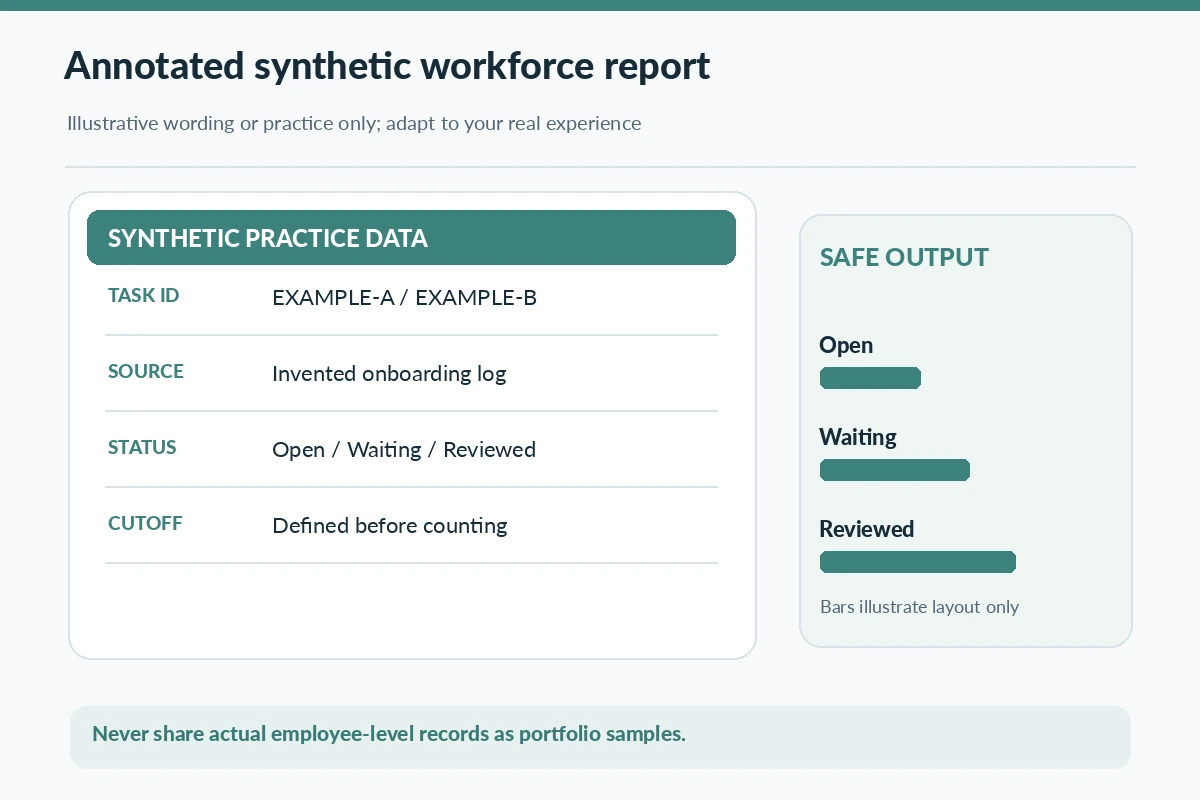
Do not publish real employee-level data, payroll rows, disciplinary notes or recruiting records. A small fictional dataset is enough to practice: invented task IDs, request dates, completion status, department labels and a clearly documented reporting period. Check for duplicate IDs, impossible dates, missing categories and whether every record belongs in the selected period. Keep an untouched input copy and a separate corrected or annotated version so your demonstration makes the checking process transparent.
Produce a simple table or bar chart with units and a note that the numbers are synthetic. Explain one limitation, such as tasks entered after the cutoff or status codes that changed. If you used a spreadsheet rather than SQL or specialized BI software, say so. A practice chart is not evidence that you maintained a production data pipeline, created predictive models or had approval to expose employee records. It is honest evidence that you can structure a question and test the data behind it.
Translate Actual HR Reporting Into Resume Proof
A weak transition statement says “HR data scientist who transformed operations.” A stronger, hypothetical example is: “Maintained assigned onboarding-status reports, checked missing dates against source records and documented exceptions for manager review.” The second statement makes source and role boundaries visible. If your job involved independent process recommendations, describe the real recommendation separately and identify whether a manager approved or implemented it. Keep actual job titles and dates unchanged even when targeting analyst positions.
Some HR systems can export reports, but report generation does not automatically imply advanced statistical analysis. Do not list SQL, Python, predictive analytics or database administration simply because the organization used those technologies elsewhere. Explain the functions you personally performed—filters, joins, pivot tables, consistency checks, visualizations—and make sure you can repeat them. A carefully described spreadsheet reconciliation can support a junior analytical role without overstating your technical scope.
Ask What the Destination Role Really Analyzes
Operations analytics can mean dashboard maintenance, workflow documentation, support for process improvement, business intelligence or sophisticated modeling. Read the essential tasks in each posting rather than assuming every analyst vacancy has the same entry requirements. Ask whether the role owns the data source, builds reports, investigates exceptions, delivers recommendations or approves operational changes. A management analyst position may need substantial previous experience; an operations reporting assistant may be closer to your current evidence.
Write a fit matrix with “done independently,” “done under review,” “practiced on synthetic data,” and “not yet learned.” The honest middle categories are particularly useful. If a posting requires statistical testing, complex database queries or industry-specific forecasting, identify how you would acquire those skills before asserting that you qualify. Avoid filling the gap with a generic course badge. Select training that teaches the precise report or data-check task and provides a demonstrable exercise.
Explain Privacy Before Showing a Dashboard
HR data is sensitive because it can reveal identities and employment decisions, including when direct names are removed. A dashboard with very small groups or unique dates may make people identifiable. Never upload actual personnel exports into unapproved cloud tools or generative AI services merely to make a portfolio. When displaying process analysis outside your employer, use synthetic or public information, label it clearly, and explain which privacy questions would have to be resolved in a real organization.
In a case interview, say how you would determine authorized users, minimize fields, check aggregation levels and document a change request. Do not claim you approved access controls if that decision belonged to IT, legal or HR leadership. A candidate who knows when to stop is often demonstrating more mature judgment than one who promises to make any dataset available. Technical curiosity should be combined with record stewardship and attention to how a recommendation might be used.
Describe Recommendations as Different From Decisions
Suppose a fictional dashboard shows more incomplete onboarding tasks on Fridays. A chart alone cannot prove the cause. You would check whether the work volume, reporting cutoffs, team size or status definitions changed. Your recommendation might be to investigate the handoff between hiring and IT provisioning; it would not prove that a specific employee failed or that you are entitled to modify policy. Name the data limitation and the team that would decide the intervention.
This is an important interview distinction: generating a count, interpreting a pattern, suggesting a test and authorizing a change are four separate actions. Describe the level you performed in your last HR role and the level you aim to learn next. If a manager made the decision, credit that process. If your work led to a documented improvement, explain the evidence without inventing a percentage of savings or hiring productivity. Clear ownership makes a cross-functional transition more convincing.
Check Employers and Build a Practical Portfolio
Research actual operations-reporting vacancies and compare whether they need spreadsheet checks, BI tools, process mapping or more specialized statistics. Design one synthetic sample that directly demonstrates a repeated requirement, along with a one-page explanation of source, definitions, validation, output and uncertainty. The explanation should be understandable to a nontechnical manager. When asked for work samples, do not send confidential employer dashboards; explain that professional boundaries require a sanitized alternative.
Verify interview invitations and employers using independent official channels. The FTC cautions that fake recruiters can request money or early financial information and impersonate real organizations. A data-analyst title or attractive remote-work description does not establish legitimacy. Save your evidence matrix, record which skills are practiced versus employed, and ask about permissions, data quality ownership and decision review during interviews. Those questions matter as much as software names.

Use a Privacy-First Evidence Matrix
Choose three activities that demonstrate the bridge: a recurring record check you actually performed, a process note you wrote or reviewed, and a synthetic analysis you can reconstruct. For each, specify the input, verification method, output, intended reader and authority boundary. A HR employee who merely downloads a scheduled report should not claim authorship of the database; a person who recommended a workflow change should not claim they alone approved it. This precision avoids both overclaiming and unnecessary understatement.
A strong next step may be an internal reporting assignment, a supervised process-improvement project or a junior operations-support position where data validation is central. You may also discover that the destination role has prerequisites beyond your current experience. That is a useful finding: learn the real gap, build honest evidence and protect sensitive information. Career change succeeds through a defensible chain of work and practice, not a new job title pasted onto an HR resume.
| HR work performed | Analytics translation | Validation evidence | Boundary |
|---|---|---|---|
| Headcount spreadsheet | Operational trend table | Reconcile time periods | No forecasting claim |
| Onboarding tracking | Process cycle reporting | Compare status definitions | No employee-level release |
| Policy process logs | Workflow improvement | Document exception patterns | No decision approval |
How We Research and Verify Career Transitions
We compared the documented task descriptions for the starting and destination occupations, rather than assuming that similar job titles grant the same authority. The examples are fictional templates that readers must adapt to work they genuinely performed; they are not verified applicant outcomes, promises of employment, or licensing advice. Sources reviewed on 2026-11-05. Job requirements and permissions vary by employer, position and location. Read our affiliate disclosure for the site policy.
Source basis: O*NET occupational profile — HR specialists manage personnel records and coordinate HR processes and information systems.; O*NET occupational profile — Management analysts gather information about procedures, analyze alternatives and document recommendations.; FTC job-search safety advice — FTC provides warning signs for suspicious recruiter requests and fake online jobs.. Review the actual vacancy and any credential rules before making a final career decision.
Explore Related Career Guides
Yes when it includes meaningful reporting, data checks or process analysis. It does not automatically establish programming, statistics or business-analyst qualifications.
Do not share employee-level records or confidential dashboard screenshots without explicit authorization. Use public or synthetic data and disclose the source.
Describe the report, how you checked its date range and definitions, and which audience received it. Do not claim you created the underlying model.
Some roles ask for SQL, visualization or statistics; others focus more on process documentation. Check postings and practice only the gaps relevant to your chosen target role.
Only if you can substantiate your own contribution and the outcome. Reporting a measure or recommending a process change is different from making the hiring decision.