
Remote scheduling jobs can mean booking customer appointments, confirming medical visits, coordinating interviews, or managing internal calendars. The word “scheduler” alone does not tell you what can be changed, which systems are used, whether calls are required, or who decides exceptions. Before applying, identify the kind of appointment, the permitted calendar actions, coverage hours, and privacy obligations. A scheduler manages the booking workflow under policy; they do not necessarily make treatment, staffing, or pricing decisions.
Choose the scheduling environment first
A medical appointment scheduler may work with clinic capacity, referral information, and patient calls. A commercial scheduler may arrange consultations or service windows; an internal coordinator may book interviews and team meetings. O*NET describes appointment scheduling as part of medical-secretary and administrative support work, but the specific responsibilities differ widely. Search for the job family that matches your experience instead of applying to every listing with “calendar” in its title.
Study the employer’s description for incoming versus outbound calls, appointment volume, rescheduling policies, and the use of a scheduling platform. Appointment setters for sales may be measured on booked leads and may have commission terms; that is not the same as confirming an existing medical visit. Distinguish an administrative task from a sales target or a clinical priority decision.
Map the permitted booking workflow
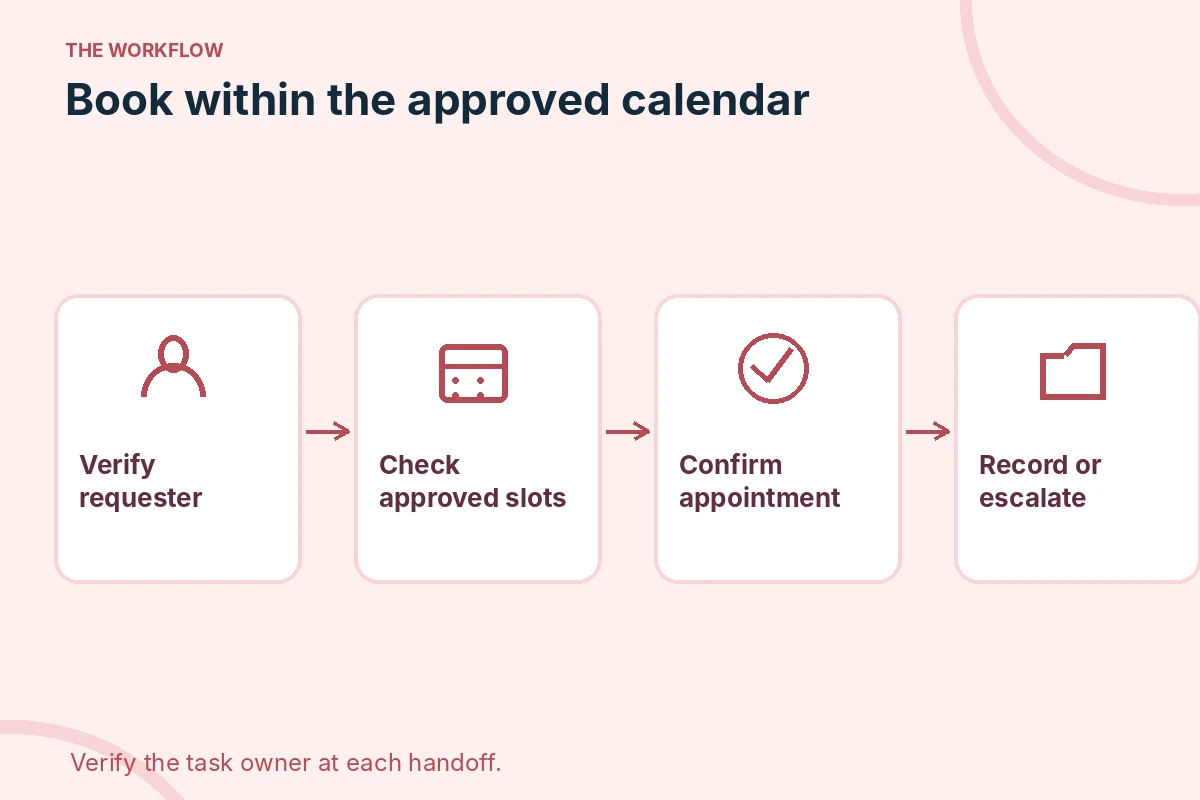
A typical authorized sequence starts with verifying the requester, finding the correct service, checking approved availability, confirming the appointment, and documenting the result in the designated system. An exception—missing referral, conflicting slot, special accommodation, or urgent clinical concern—belongs in a specific escalation queue. Do not invent medical triage instructions or advise someone to bypass the official process to fit an extra booking.
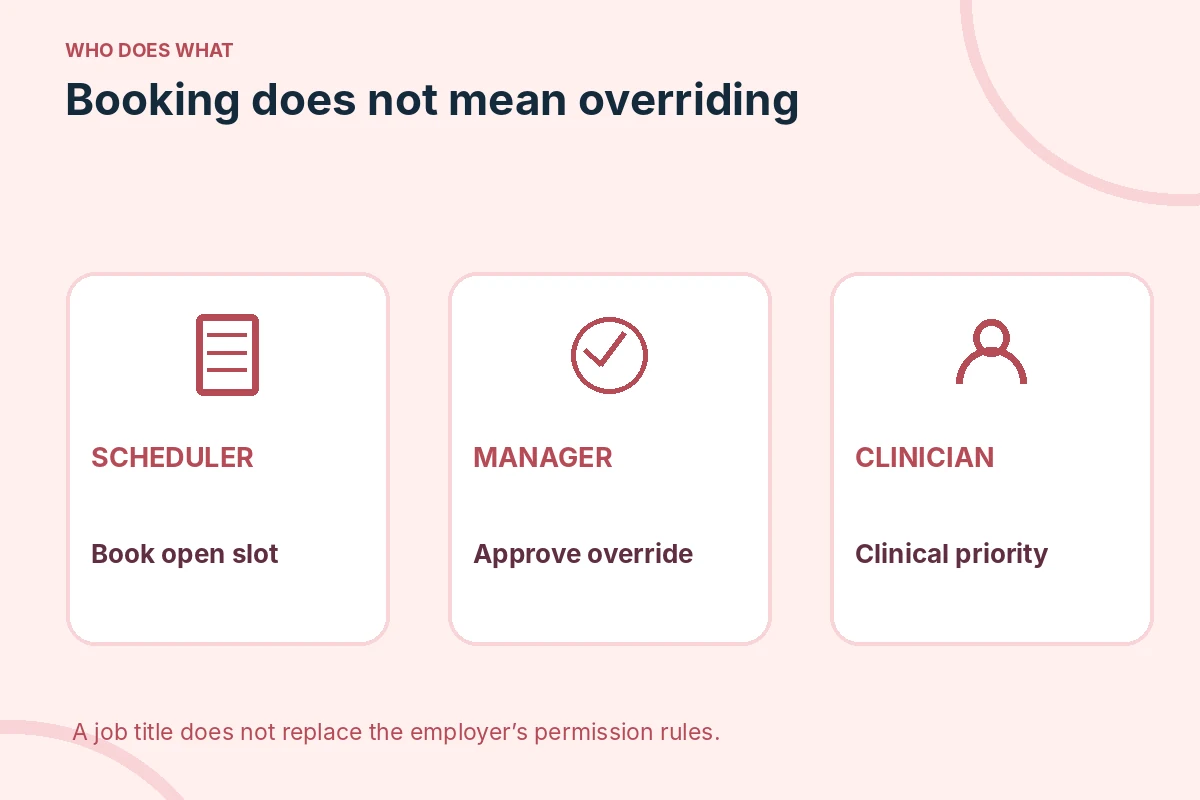
Ask which actions a new scheduler can do independently: send reminders, move an existing slot, cancel, update contact details, or change appointment types. The answer varies by employer. If a cancellation could affect care or a customer commitment, clarify who decides and how the decision is recorded. A calendar is a record of authorized availability, not proof of decision-making authority.
Demonstrate organization with a harmless schedule exercise
Create an invented weekly calendar with service durations, approved availability blocks, breaks, and a fictional rescheduling request. Show how you avoid double-booking and note a case requiring supervisor review. Label the entire sample as illustrative, not evidence of handling real patients or clients. Never use names, appointment histories, or identifying details taken from an employer’s restricted system.
A resume statement can say “coordinated calendars and confirmed schedule changes under team rules” if that was your actual work. If you only planned a school event, name it as a school project. Time-zone conversion and clear written confirmation can be valuable skills, but do not claim you controlled clinical schedules or staffing levels if your role was to transmit information.
Check remote tools, privacy, and phone coverage
Ask whether the team uses a company phone system, shared inbox, approved calendar, and identity-verification procedure. Determine if the employer provides a secure workstation or requires a compatible device, and whether calls must be answered continuously during scheduled shifts. A job can be fully remote while still requiring fixed coverage or residence in a particular state.
For medical scheduling, HHS explains that regulated organizations need safeguards for electronic protected health information. An applicant should not expect patient data in a sample assignment. Ask how access is provisioned, what information can be changed, and how incidents are reported. For ordinary business scheduling, confidentiality still matters even when the specific legal framework differs.
Find the right vacancies and reject vague listings
Try “remote appointment scheduler,” “virtual scheduling coordinator,” “remote medical scheduling,” and “remote calendar coordinator.” Read each posting for specific services, location eligibility, shift hours, required software, and whether the organization provides training. Listings that say only “type appointments for unlimited income” but omit an employer, policy, and customer workflow are not enough to evaluate.
Track the source link, deadline, call requirements, approved location, supervisor, and whether any onsite training is needed. If multiple job boards repeat the same vacancy, submit through the verified employer channel. Do not purchase scheduling software or wire money to an alleged trainer as a condition of receiving the job.
Illustrative scenario: a conflicting appointment request
Illustrative exercise: two clients request the same twenty-minute slot; the approved system shows only one opening and a second opening later. The scheduler checks permitted options, offers the later time under policy, and records the confirmed choice. If one case requires a special override, the scheduler routes it to the authorized reviewer rather than silently overbooking.
An interview answer should name the actual tools you used, the step taken to confirm the correct requester, and the boundary of your authority. Do not disclose real appointment information. Explaining an ordinary, accurate handoff is stronger than claiming you resolved all conflicts yourself.

Ask practical questions about handling exceptions
Ask what happens when a patient or customer is late, when a slot is unavailable, and when a caller requests a change outside standard rules. Who approves overrides? Which cases require an immediate handoff? Where is the confirmation stored? Is the queue shared across time zones? The answers reveal whether the position is mainly calls, back-office coordination, or mixed support.
Ask whether performance is measured by accuracy, response time, completed confirmations, or sales conversions. Do not assume a “non-phone” position has no video or occasional callback duties. If the posting describes medical urgency, ask for the employer’s official escalation and emergency protocol rather than improvising one.
Make the final application accurate and secure
Use one relevant calendar or scheduling example, state whether it came from paid work or training, and match the posting’s location and hours. Mention only software you have genuinely used. If work involves confidential records, emphasize following established permissions rather than claiming expertise you do not possess.
The FTC warns that work-from-home scams may demand fees or use fake checks to impersonate an employer. Verify the hiring company independently, keep personal data out of unsolicited messages, and ask for formal job details before accepting a remote onboarding invitation. Save the exact posting and any authorized interview instructions for reference.
How We Research Remote-Work Hiring Guidance
We checked official occupational descriptions for task scope and the relevant public guidance for privacy or recruitment safety. We did not verify or endorse any current vacancy. Every example in this page is invented for educational use unless explicitly identified as a general occupational task. Sources checked November 11, 2026: O*NET occupation profile, O*NET occupation profile, HHS security guidance, FTC consumer guidance.
Remote-work eligibility, software requirements, and supervision differ by employer. Check the exact vacancy before sharing information. These sources are not paid endorsements. See the JobAsk affiliate disclosure for transparency about links.
Related Job Search Guides
No, but many require calls. Check whether the work involves an inbound queue, outbound confirmations, email, or a mixture.
Only if the employer explicitly grants that authority. Otherwise follow the documented escalation procedure.
Medical schedulers commonly perform administrative duties. They should not independently make clinical triage decisions beyond their authorized process.
Not necessarily. Verify required hours, service coverage, allowed residence, and onsite training expectations.
A clearly labeled fictional calendar and conflict-resolution exercise can demonstrate careful scheduling without exposing real appointments.