
Temporary work-from-home jobs can be useful for defined workloads, seasonal projects, or coverage when a team needs extra support. The crucial question is not simply whether the listing says “remote”: identify the actual employer, any staffing agency or client, the planned assignment length, how you record hours, and who supervises the work. Some assignments end on a specific date; others can end when the project changes. A legitimate advertisement should let you verify the organization and describe the work. Do not assume a permanent opening, a guarantee of extension, or a particular worker classification from the word “temporary.”
Identify the employer and the client separately
A posting can come directly from an organization hiring a short-term employee, from a staffing agency assigning someone to a client, or from a contractor seeking project help. The recruiter’s brand may not be the team where you will perform daily tasks. Ask who issues the offer, who provides the work instructions, who approves hours, and who handles questions about the assignment. If the agency cannot name a client during initial screening for confidentiality reasons, it should still explain when and how identity is verified before sensitive onboarding. Keep the verified employer name, contract contact, and supervisor in separate fields.
Treat the end date as a term to verify
Look for wording such as fixed duration, cover through an employee leave, seasonal workload, project completion, or extension possible. “Potential to convert” does not promise a permanent job. Request the planned start date, expected end or review date, notice rules, and what happens if tasks finish earlier. Read any agreement rather than inferring a duration from a recruiter’s casual message. A useful personal tracker records what is stated in writing and what is still only an expectation. Do not resign from other work based solely on an unconfirmed extension.
Check whether the remote arrangement is fully specified
Some temporary roles are remote only during a trial or require an in-person equipment pickup, training day, or final return. Read the approved work location, time zone, meetings, and internet or device requirements. If the client expects overnight support or a specific service window, a role may not fit your home schedule despite being remote. Ask whether security tools or a company device are supplied. An unknown recruiter offering to send a check and asking you to buy devices from its designated vendor is a classic warning sign, not standard proof of a real job.
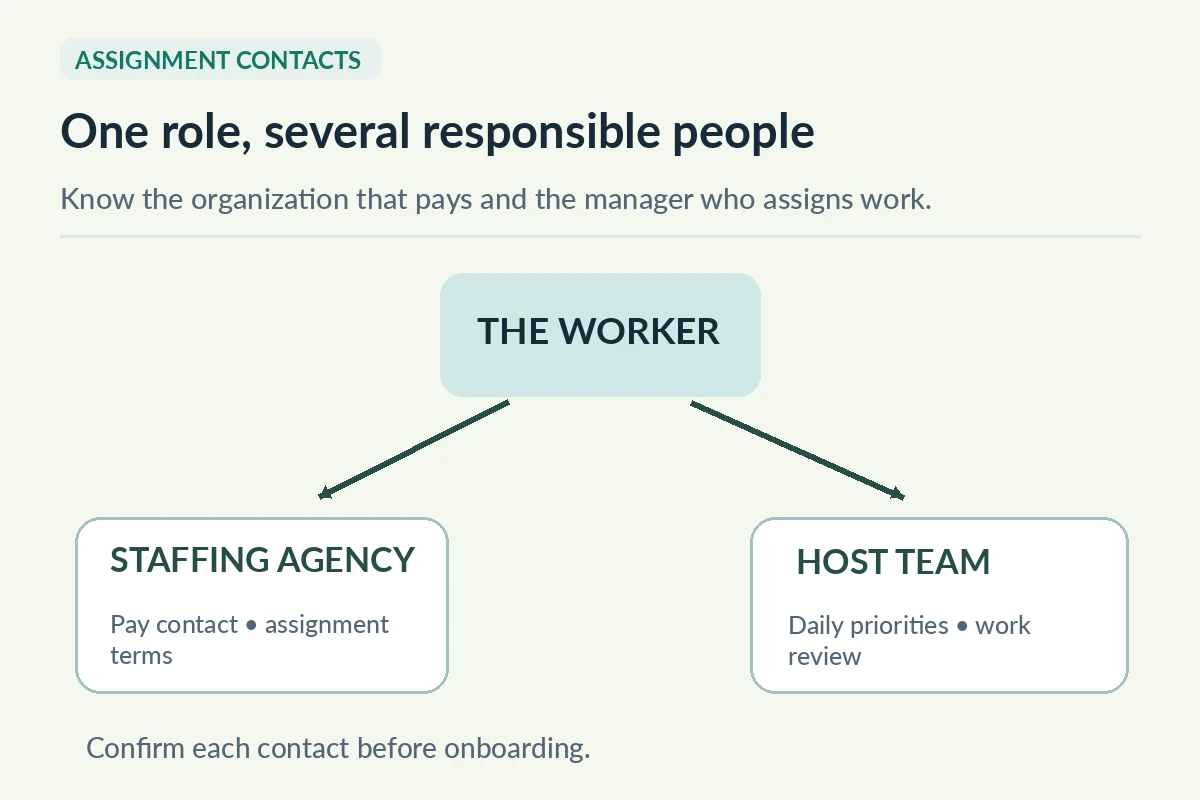
Write a short responsibility map before accepting
For an agency assignment, write three headings: staffing agency, host team, and worker. Under each, list the person to contact about timesheets, schedules, task priorities, system permissions, training, and early termination. OSHA emphasizes coordination between staffing agencies and host employers for safety and training duties; that does not mean every remote situation uses an identical legal arrangement. Your map is practical communication, not an employment-law determination. If two contacts give conflicting instructions, ask for clarification in writing and do not guess whose approval overrides the other.
Recognize short-term tasks worth learning
Temporary remote work can include records cleanup, customer overflow support, event registration, survey administration, basic project coordination, or content review, depending on training and access. Descriptions should specify the actual system, output, and review chain. If the role involves confidential customer information, financial approvals, clinical decisions, or complex equipment, request clear training and authority limits. Being available immediately is not a qualification for privileged access. A credible entry-level assignment usually defines what you may prepare, check, escalate, or hand off instead of calling every duty “simple online work.”
Know the difference between hourly work and deliverables
An hourly assignment normally needs a time-recording procedure; a project engagement may be described through milestones or completed deliverables. Neither label alone determines worker classification or wage obligations. Ask when work starts counting, how to report system outages, who approves additional hours, and whether there is a minimum amount of scheduled work. The DOL describes general FLSA wage and overtime rules, but state law and employment arrangements can matter. Treat a claim that all temporary remote work is “1099” as unsupported without examining the real relationship.

Make application evidence assignment-specific
Instead of a generic remote résumé, provide proof that you can work on a finite task with accuracy and handoff discipline. A hypothetical applicant might say: “During a two-week volunteer event project, reconciled attendance lists against registration forms and flagged missing entries for the coordinator.” This is an illustrative statement to adapt only if true. You might highlight documented availability, familiarity with the stated tools, clear status updates, and ability to follow privacy procedures. Do not invent a past client, claim agency affiliation, or promise completion times unsupported by the scope.
| Question | Evidence to request | Do not assume |
|---|---|---|
| Assignment length | Start and end/review date | Extension is guaranteed |
| Employer contact | Agency and host contact roles | Recruiter is always supervisor |
| Time records | Timesheet system and deadline | Hours approve themselves |
| End of work | Handoff and access closure | Contract becomes permanent |
Ask who reviews the final result
Find out whether a host supervisor will review your entries daily, whether work can be corrected, and how feedback is delivered. For an administrative assignment, a daily completion count is not the same as correctness: the client may need records checked against source documents or exceptions escalated. Ask for a defined quality standard and for access to job instructions. If the agency recruits you for one skill but the host assigns unrelated, sensitive, or regulated duties, bring the mismatch to both contacts. Avoid work outside your authorization while the assignment is clarified.
Prepare for common remote timing problems
An assignment may use two time zones: the agency’s payroll deadline and the client’s task schedule. Write both deadlines down; clarify which calendar controls the timesheet and who signs off on missed shifts or overtime. Ask how you report unavailable systems and whether stand-by periods are compensable under the relevant rules. Do not assume that “work from anywhere” permits cross-state or international work. Some employers limit location for payroll, taxation, privacy, or customer access reasons. Work from the approved location and request written permission before changing it.
Verify the offer, not just the recruiter profile
The FTC describes remote-job fraud where impostors use legitimate employer names, job boards, rushed messaging, and fake checks. Independently navigate to the employer’s career or agency website rather than only a link in a text message. Look for the position or independently confirm it through published contact channels. Do not pay for an assignment, send cryptocurrency to unlock hours, or transfer an equipment check’s proceeds to a vendor. The aim is to establish a real position, a real accountable employer, and a real contract—not merely to receive an attractive PDF offer.
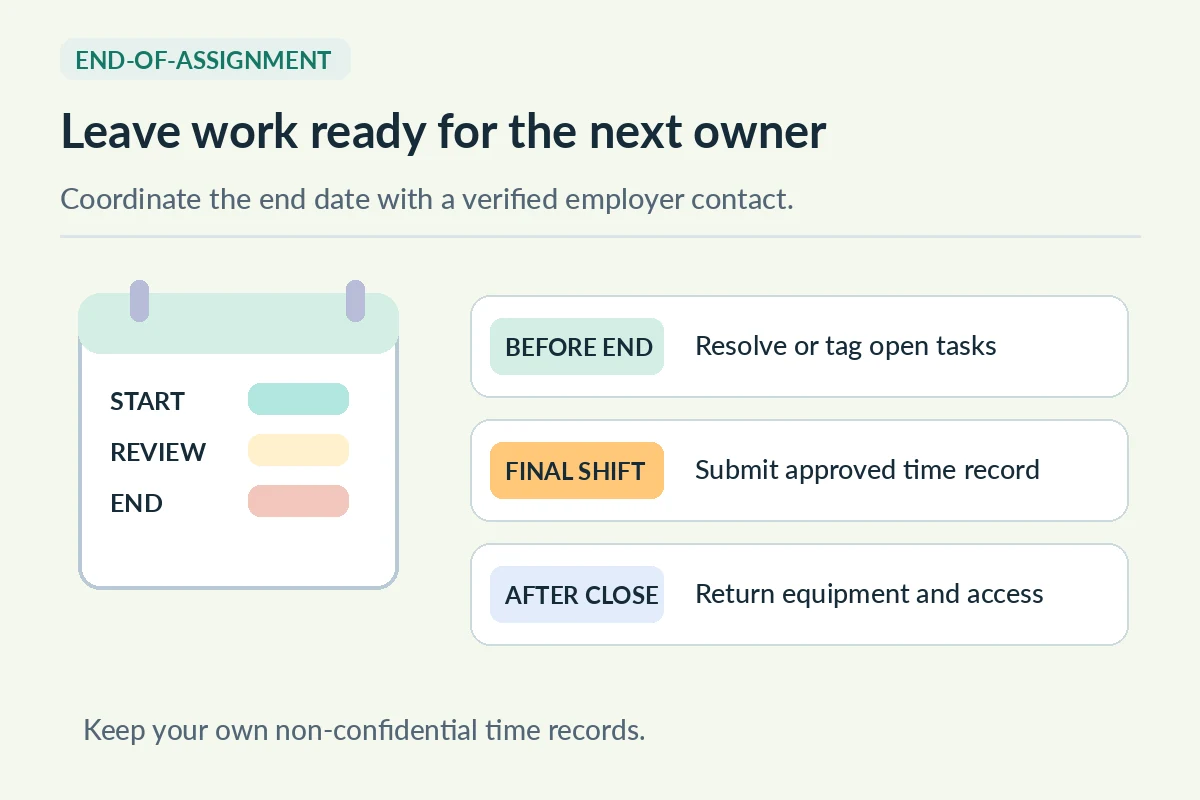
Create an orderly assignment exit checklist
Before the end date, ask who owns unfinished files, open support tickets, customer follow-ups, and work product. Use approved systems to hand off task status and do not copy client files into a personal cloud folder. Confirm the final timesheet deadline, required equipment return, access closure, and the person to contact if a pay record appears incorrect. Keep your own non-confidential records of dates worked and written terms. An extension should be confirmed through the actual employer or agency before you rely on it. Finishing transparently may be as important as beginning quickly.
Decide whether the assignment serves your goal
Use a one-page comparison: contract length, approved location, realistic hours, needed tools, supervision, training, compensation terms, privacy obligations, and end-of-project process. Mark unknown fields as unknown, not “probably fine.” If a genuine short assignment helps you build a specific skill, it may be useful even without a permanent offer. If the recruiter refuses basic details or requests money, do not proceed. The goal is an understandable employment relationship with verifiable contacts and duties, not the largest number of temporary applications sent.
How We Research These Remote Job Options
We reviewed these original public sources on 2026-11-07: www.osha.gov (OSHA explains staffing-agency and host-employer coordination for temporary workers and limits of job titles.); consumer.ftc.gov (FTC warns about fake remote hiring, upfront charges, and fake-check equipment purchases.); www.dol.gov (DOL explains general wage and hours questions under the FLSA without assigning all temp jobs one pay rule.). Sources describe occupations, hiring cautions, or general rules; they do not verify any specific vacancy, recruiter, compensation offer, or individual candidate. The sample situations and application lines on this page are hypothetical teaching examples. Compare each listing with its current official employer description and the terms offered to you.
JobAsk provides independent educational information and does not claim an affiliate relationship with the organizations cited. We do not promise employment, earnings, placements, or acceptance by any employer. See our affiliate disclosure. Never include private customer or student records as evidence for a public application.
Related Job Search Guides
No. Some employers hire directly for a fixed period or project; others use staffing agencies. Check who employs and pays you.
No. The assignment can have fixed shifts, meetings, approved locations, or a client time zone.
No. Treat conversion language as a possibility that depends on written terms and future decisions.
Do not follow instructions to deposit a check and forward funds for equipment. Verify independently; the FTC identifies fake-check job scams.
Ask before starting whether the staffing agency, host supervisor, or a designated payroll contact is responsible for approvals and corrections.