
Remote training coordinator jobs support the logistics that let instructors and learners complete scheduled training: enrollment, invitations, materials, attendance records, and learning-management system (LMS) updates. Check which tasks are administrative and which require an instructor’s or training manager’s approval. A credible listing should explain the course audience, live coverage hours, record privacy, and actual reporting line.
Distinguish administration from instructional authority
A training coordinator may create sessions, organize registrations, send attendance reminders, and reconcile completion records. A training specialist or subject-matter expert may decide course content, assessment standards, and whether a learner has demonstrated competence. The BLS occupational profile includes both instructional and administrative tasks, but the specific vacancy determines the boundary.
Ask “Can the coordinator correct enrollment records?” and “Who approves changes to course requirements?” Do not advertise that you can certify employees in a regulated skill merely because you managed the workshop calendar. Separate an admin completion entry from the qualified instructor’s assessment.
Map the LMS workflow before you claim expertise
An LMS may manage course catalogs, assignments, invitations, attendance, and reports. The system name matters less than the permission level: viewing a completion report is different from altering a learner’s result. Check whether the employer trains new coordinators on its platform and which changes have an audit trail.
For a fictional workshop, show a record with session, learner ID placeholder, enrollment status, instructor, and follow-up owner. Use invented identifiers in samples. Do not publish real course rosters, exam results, employee learning records, or internal credentials to prove you know a platform.
Plan live sessions across time zones
“Remote” may mean work from an approved state while supporting fixed-time webinars. Ask whether the coordinator opens the meeting, checks captions, supports breakout rooms, handles participant questions, or simply sends invitations. Each assignment has a different demand for overlapping hours and accessibility planning.
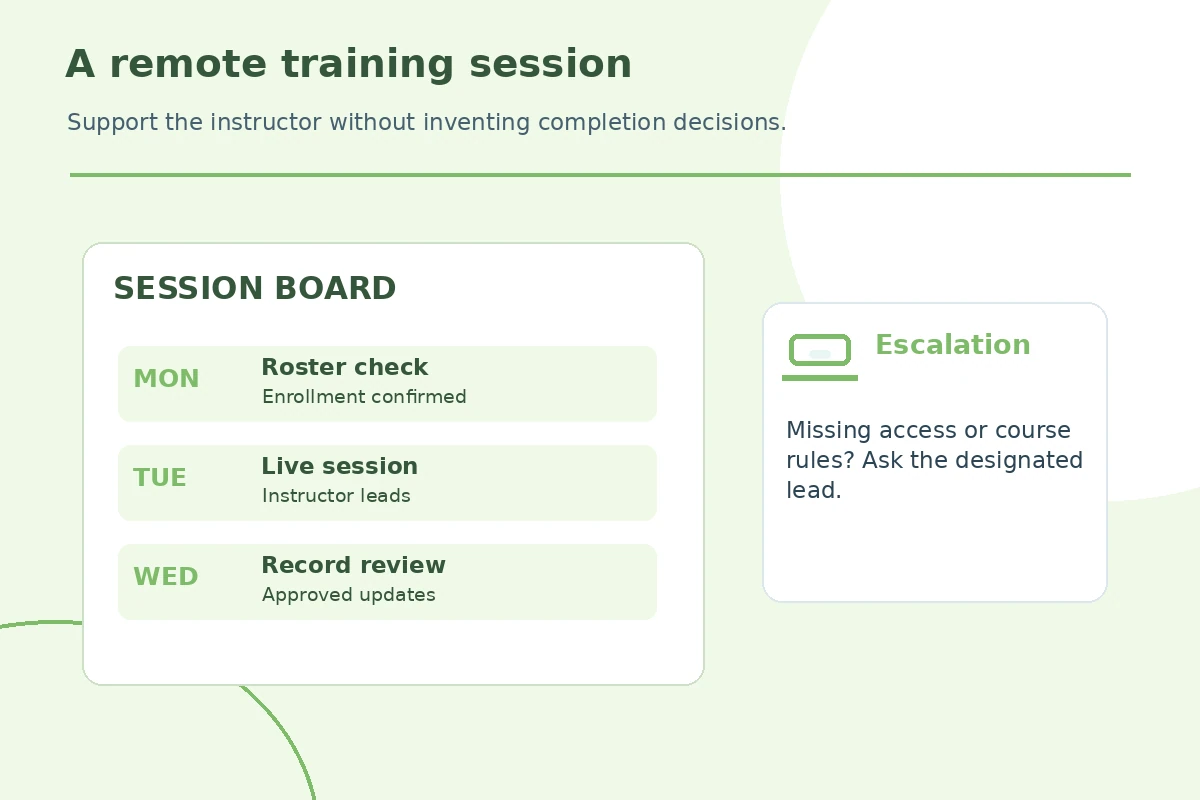
Before a session, verify the instructor, link, materials, roster, accommodation route, and escalation contact. If a webinar fails, follow the team’s recovery procedure: communicate the issue, preserve accurate attendance notes, and let an authorized leader decide whether to reschedule or credit completion.

Track records without inferring assessment results
Attendance, course completion, scores, and required certifications are not interchangeable. Do not mark someone complete because they logged into a meeting unless the course’s approved rules say that is enough. Ask how exceptions are reviewed and who may change evidence associated with mandated training.
An illustrative follow-up note can say: “Session attendance has been recorded; the instructor will confirm completion according to course criteria.” This avoids a claim outside your authority. Be ready to explain how you spotted a duplicated enrollment or wrong time-zone conversion and routed it for correction.
Check the authority boundary in this role
| Task or issue | What to verify | Person or process |
|---|---|---|
| Enrollment | Invite and confirm registrants | Training coordinator |
| Attendance | Log verified session presence | Coordinator with review |
| Learning assessment | Evaluate required skill | Qualified instructor |
| Completion record | Apply approved criteria | Designated reviewer |
Create credible proof from prior coordination work
Relevant experience can include event registration, campus workshop scheduling, volunteer orientations, training reminders, or updating authorized attendance logs. Describe your real contribution and the number of sessions only when verified. A mock training calendar is a legitimate practice sample when labeled as such.
A truthful resume bullet might read: “Coordinated [actual number] online workshop invitations, prepared materials, and reconciled attendance with instructor review.” If you have not used an LMS, do not claim expertise; instead explain that you have worked with schedules or spreadsheets and can learn authorized software workflows.
Evaluate the remote role and support arrangements
Ask whether the coordinator handles technical support alone, who can reset learner accounts, what data may be exported, and whether participants come from multiple regions. Read the posting for the difference between training operations, instructional design, and a sales role described as “education.”
A real employer can identify a course team, provide task examples, and describe onboarding. Fraudulent work-from-home offers may promise unusually easy income or ask applicants to pay for access. Verify the role on the employer’s official site and decline requests to route payments through personal accounts.

Use a training-logistics application checklist
For each opening, record the course audience, LMS and permission level, live session coverage, instructor handoff, records retention contact, and remote hiring geography. Prioritize advertisements where your actual scheduling and data-quality work aligns with the task list.
Tailor a short paragraph around a real coordination example: “I maintained an accurate session roster and escalated changes to the instructor before sending final instructions.” This provides evidence of careful remote support without claiming you developed the course or approved an employee’s qualification.
Practice the workflow before you submit an application
In a remote training support interview, ask who creates course shells, who is allowed to enroll learners, and where an attendance correction is documented. Distinguish helping a participant join a meeting from resetting their credentials; account changes might require an IT administrator. For a helpful role-specific work sample, make a fictional enrollment tracker with session dates, anonymized learner labels, a verified instructor, and status notes. Add a column for exceptions requiring trainer review. Describe what you would do if someone joined the wrong session, missed a required activity, or requested completion credit. Explain that you will record the question, inform the designated instructor, and apply only approved corrections. This demonstrates reliability without assigning yourself evaluation or certification powers. The difference matters in regulatory and workplace learning programs where a course result can affect job eligibility. Before applying, try a fictional pre-session checklist. Confirm the course owner, agreed time zone, participant invitation, accessible materials, software access, and designated support channel. Set the completed checkmarks only for tasks that were actually verified in your mock scenario. If attendance data and the LMS disagree, record the discrepancy and send it to the authorized reviewer rather than making up a learner result. This example shows how a remote coordinator can make instruction smoother without owning decisions about the learner’s competence.
How We Research Remote Job Roles
We reviewed the following US occupational and consumer-protection resources on November 7, 2026: www.bls.gov (Training specialists coordinate classes, equipment, enrollment, materials and evaluation); www.bls.gov (Scheduling, records and communication transferable from administrative support); consumer.ftc.gov (How to verify work-from-home hiring offers). Occupation profiles explain typical work, not a guarantee that a specific advertised position offers remote work, a particular credential pathway, or employment. The checklists and hypotheticals are JobAsk editorial examples. Confirm eligibility, authority, schedules, and terms with the employer.
No employer paid to be featured in this guide, and no job offer, income, or hiring result is promised. See the JobAsk affiliate disclosure. We do not recommend paying a stranger or sending personal credentials to obtain an advertised remote position.
Related Job Search Guides
Not necessarily. Some coordinators use limited LMS functions, whereas system administrators configure permissions and integrations. Check the actual posting.
Many involve logistics rather than instruction, but some include facilitation. Read which duties are required and who owns course content.
Not without authorization. Use invented examples to demonstrate scheduling, audit trails, and handoff procedures.
Only when the program’s approved requirements say so. A coordinator should not independently invent course-completion rules.
Ask about webinar time zones, live help coverage, evening sessions, and the process for handling last-minute cancellations.