
Check whether your internship is tied to academic requirements
Resigning from an internship early can affect more than a line on your resume. First check whether the placement is for academic credit, a required number of hours, a paid internship, an independent experience, or a combination. For credit-bearing placements, the university may have a learning agreement, faculty mentor, course deadlines, or minimum hours that the host supervisor cannot waive. Read those documents before announcing a final date. If a requirement is unclear, ask the internship coordinator for a confidential conversation about options. University policies vary, and a professional email alone may not protect your academic record.
Distinguish an early departure from completing the agreed term
If the internship is naturally ending on the date stated in the offer, your message may be a completion confirmation rather than a resignation. If you must stop before the intended end, say that directly. Record the original period, the number of hours already completed, and any mandatory deliverables still open. Do not suggest that partial attendance automatically qualifies you for a course grade, stipend, or certificate. Ask the program representative what change, withdrawal, or reassignment procedure applies, and keep any approval in writing.
Consult a campus coordinator before taking irreversible steps
University career offices sometimes advise students to consult an academic adviser before terminating a credited internship. They may consider alternate hours, additional assignments, withdrawal dates, or a replacement placement, but none should be assumed available. Contacting the school is particularly important if a scholarship, stipend, visa work authorization, or program requirement is linked to the internship. This article does not determine academic, immigration, or contractual consequences. If your situation involves those issues, use your university’s qualified office before acting on a generic template. You can ask for help without sharing more personal details than necessary.

Review your commitment and practical notice window
Find the host agreement, orientation guidance, project plan, scheduled shifts, and any written notice expectations. Career-center material often presents two weeks as a courteous target, not a rule that every placement can follow. A time-sensitive situation may require a different plan. Give your supervisor a clear proposed last date and avoid promising to finish projects that exceed your availability. If you need to leave because of an urgent safety or conduct concern, do not force yourself into a potentially unsafe meeting; contact the school’s appropriate reporting channel promptly.
Write to the employer with a respectful, specific date
Illustrative message: Subject: Internship resignation — Communications Intern. “Hello Morgan, I am writing to let you know that I need to end my Communications Internship earlier than planned. My proposed last day is [date]. I appreciate the guidance I have received and would like to organize a responsible handoff of the approved materials I have been working on. Please let me know the process for final timesheets and returning my badge. I am also consulting my university coordinator about the placement requirements. Thank you, Alex.” This is a hypothetical script; adapt it after checking the school and host procedures.

Use separate records for school and host organization
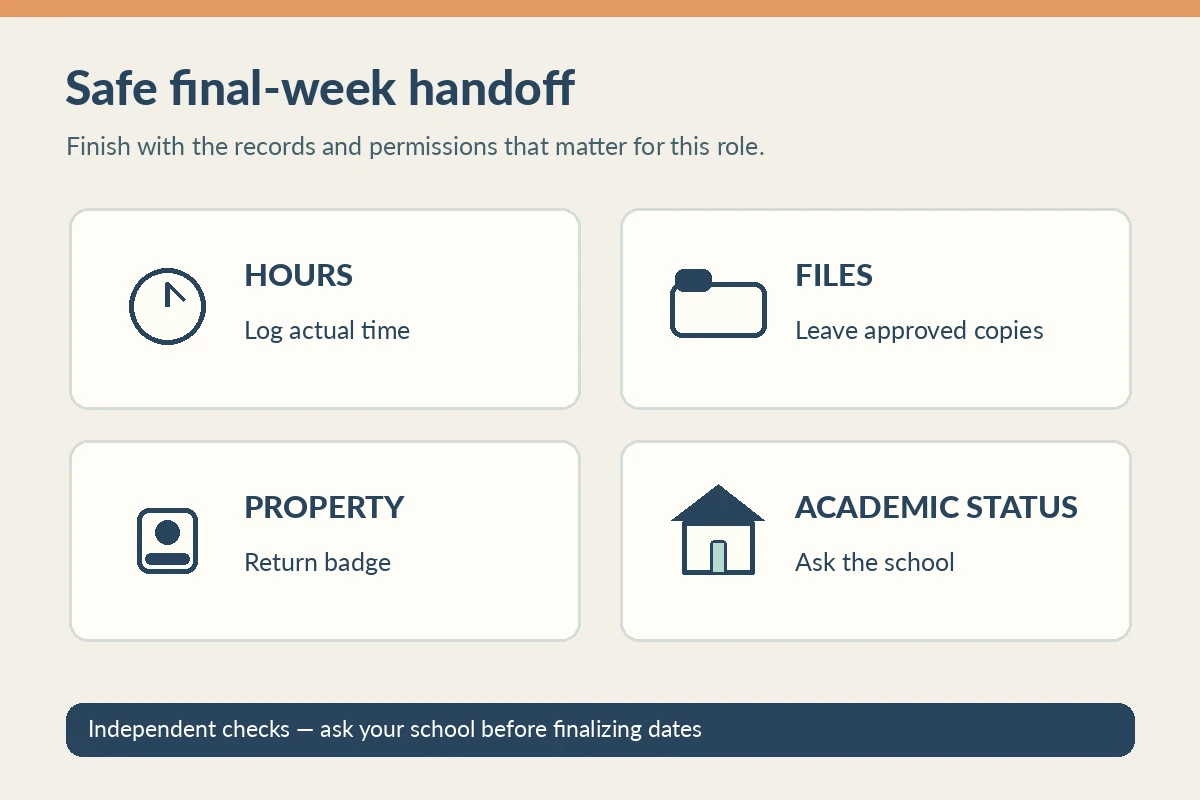
The host organization needs a workplace handoff: the dates, unfinished tasks, return of property, and a reliable contact. The college may need approved hours, academic status, a learning-contract update, or an explanation that stays within its privacy process. Resist sending the same lengthy personal story to both audiences. Use official addresses or portals specified by the program. A message to your supervisor is not proof that the registrar or internship office has recorded a change. Ask each party for the confirmation that falls within its authority.
Complete only work you are permitted to perform
Some internships involve research participants, customer files, marketing drafts, student work, or restricted systems. Prepare a simple handoff describing where authorized work is stored, what remains incomplete, who supervises it, and which review is pending. Do not download company documents or retain participant data as portfolio material. If an assignment was supervised, do not describe it as independently approved or released. The successor or supervisor should take responsibility for unfinished decisions. Offer to answer questions only while you are scheduled and authorized to work.
Set expectations if the host asks you to stay
The host may request a different last day or ask you to complete an urgent deliverable. You can be courteous without assuming you must accept every request. Explain your availability and, for an academic placement, check with the internship coordinator whether revised hours or dates affect the learning agreement. Never tell the university one date and the host another without explaining the distinction. A proposed extension is not an approved academic adjustment until the relevant people have agreed. When no workable change is available, repeat your date respectfully and complete the handoff you can.
Protect professional relationships without inventing success
A short thank-you to a mentor can be appropriate even if the placement was not what you expected. Be specific about help you actually received rather than praising an experience that was harmful or unproductive. You may ask for feedback or a reference when the relationship warrants it; no reference is owed and no future offer is guaranteed. On your resume, list actual duties and verified dates or hours. Do not imply you completed the program or earned credit if you did not. Your goal is to leave an accurate account, not to rewrite an incomplete internship as a completed credential.
Save a final record without copying confidential material
After the school and host each respond, note the confirmed last date, hours already signed off, course or credit status as communicated by the school, and the location of returned equipment. Retain only records you are allowed to keep. If the academic office has not determined the outcome, describe it as pending. If you are an international student with work authorization connected to the internship, obtain institution-specific guidance instead of relying on standard US student advice. Clear, limited documentation reduces confusion for you, your supervisor, and the program office.
How We Research and Verify Resignation Advice
We reviewed the primary guidance linked below and focused on what the source actually covers rather than assuming one workplace has every employer’s rules. The sample messages above are hypothetical. Verify your agreement, handbook, program, supervisor instructions, and actual dates before using them. This article provides general communication guidance, not a legal, immigration, compensation, or academic determination.
Sources checked 2026-11-03: Columbia SIPA explicitly recommends consulting its internship office about early termination and possible credit, stipend, or immigration implications. DePaul internship office distinguishes resigning early from completing the agreed term and recommends respectful notice and school contact. Northeastern University resignation guidance covers internships, co-ops, and jobs. Additional disclosure: Affiliate disclosure. No paid partnership is assumed in this article.
Explore Related Career Guides
Yes, depending on the school and learning agreement. Ask your coordinator about minimum hours, deadlines, and possible alternatives before committing to a date.
For a credit-bearing placement, contacting the school early can prevent avoidable problems. Also follow any urgent safety or host reporting requirements.
Unpaid status does not eliminate agreed educational or host requirements. Check the actual placement and program documents.
You can describe work you genuinely performed and accurate dates; do not claim completed credit, awards, or projects that remain unfinished.
Discuss feasible dates with the supervisor and, when applicable, the school. Do not assume a changed schedule automatically changes academic requirements.