
If you are leaving a campus job, give a clear notice with your proposed final date, then handle the role-specific work separately. Your supervisor should confirm the employment date and decide who accepts unfinished responsibilities. This guide shows what to check, what to document, and which decisions belong to managers or specialist teams—not the departing employee. It is written for US readers; your employer policy, agreements, state rules and actual duties can change the correct process.
Start with a documented notice and a precise final day
A resignation letter should establish your decision; it does not need to settle every task, financial question, or equipment issue. Check the notice terms you actually agreed to and ask HR or your supervisor how the end date is recorded. There is no universal federal rule requiring every employee to give two weeks of advance notice; contracts, organizational policies, and state requirements may differ. Keep the message factual and preserve your own permitted record of the confirmation.
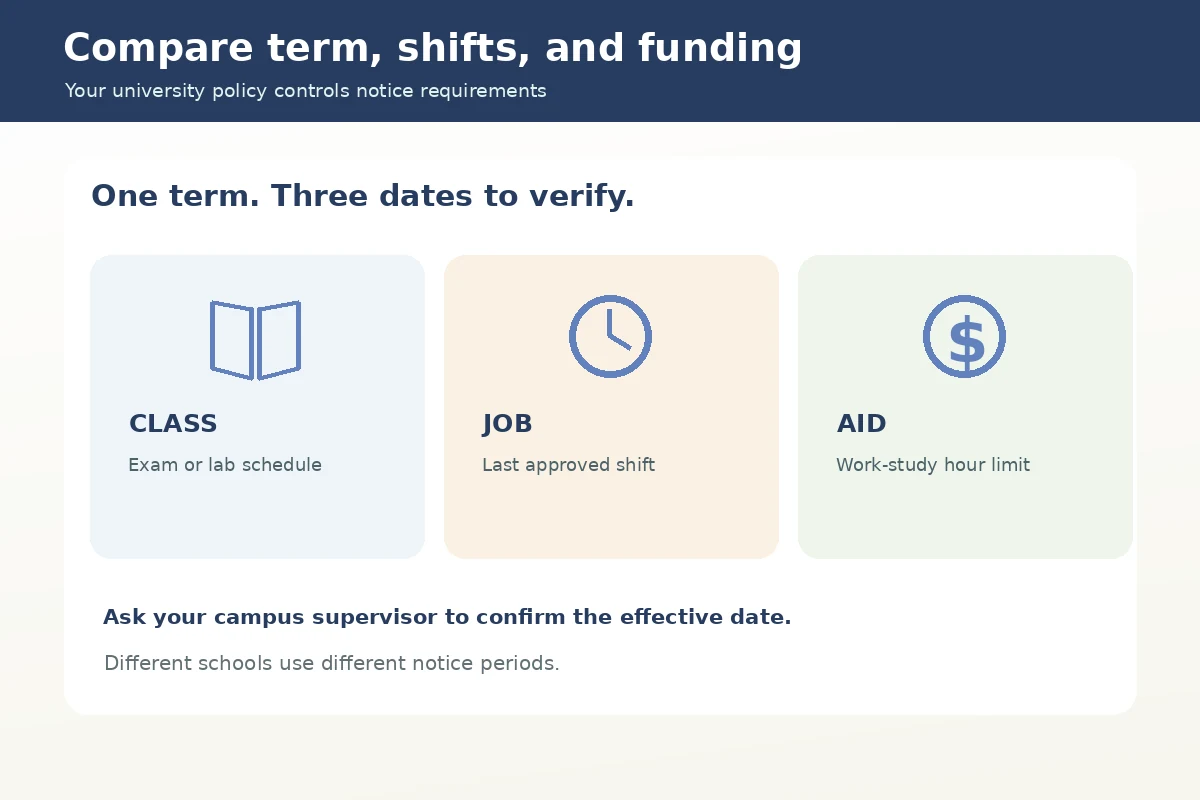
Start with your own campus policy, not a universal rule
A student job may be supervised by a library, department office, dining unit, research group, or student employment office. School rules differ. For example, Penn’s guidance expects notice before leaving a position, while other institutions publish different timelines or procedures. Read your own campus employment handbook and appointment terms before choosing a final day. Federal law does not automatically make every student job a standard two-week-notice role.
Suppose a student plans to stop working before finals. They should check the posted calendar, school resignation policy, and whether the end date conflicts with a scheduled exam or approved leave. The most useful first message names the proposed last shift and asks which office processes the separation. It need not explain personal academic issues in detail.
Keep class schedules separate from work roster promises
Academic responsibilities can change unexpectedly, but a posted shift is still a workplace commitment until the manager changes it or excuses the absence. Compare the class, exam, internship, and work calendars. Ask about any approved schedule adjustment if you need to leave earlier. Do not promise to cover the entire term while privately planning to stop attending. Do not persuade another student to take a shift without the required approval.
An illustrative exchange is: “My spring class schedule no longer allows Tuesday evening shifts. I plan to resign with [date] as my proposed last day. Could we confirm the shifts remaining and the school’s notice procedure?” This is a clear request, not a claim that exam week automatically cancels notice requirements. If a school offers a schedule accommodation, get the outcome in writing.
Check whether the position is Federal Work-Study
Not every campus job is funded by Federal Work-Study. If yours is, Federal Student Aid says it is typically part-time and that schools set hour limits in light of academic demands. Ask the supervisor and financial aid or student employment office how departure affects remaining eligible hours or changes to your employment record. Do not assume unused work-study funds are paid out to you when you resign.
If you work eight scheduled hours in the final week, enter only hours actually worked through the authorized timesheet. Do not shift hours to another week to use a remaining award or claim pay for shifts not completed. Federal Student Aid describes wages through payroll rather than a guaranteed lump-sum job allocation. A school can explain the individual award and any changes.

Write a student-specific notice that names the last shift
A student resignation can be short and professional: role, proposed last day, and a willingness to complete approved handoff. Thank the supervisor if sincere. Do not overshare health, family, grades, or financial aid details. Ask who must receive the notice—department supervisor, student employment office, or online HR system—and whether written acknowledgment is needed.
For example: “I am resigning from my library circulation assistant position. My proposed last shift is Thursday, November 19, from 2 to 5 p.m. I will return my desk key and complete assigned inventory notes. Please confirm the effective date and any student employment form I need to submit.” The shift and date are hypothetical. Your school may require a different form or notice period.
Hand over academic and departmental materials safely
Campus jobs often involve room reservations, student records, library loans, event calendars, lab equipment, or departmental communications. Keep private student information in approved university systems, even if another student is replacing you. A handoff should identify the task, the normal procedure, the contact person, and any deadlines. Do not export student records, lab credentials, or private advising messages to personal cloud storage.
A safe note might say: “Three room booking requests await approval in the department scheduling system; office coordinator is the next owner.” It should not include students’ educational records in an informal group chat. Ask the supervisor how to return access cards, keys, uniforms, or school equipment. A student worker is not authorized to decide which person should receive sensitive files.
| Item or deadline | Who decides or receives it | What to record |
|---|---|---|
| TERM CALENDAR | Supervisor or designated owner | Status and confirmed end date |
| WORK-STUDY | Authorized specialist or manager | Approval needed and next step |
| CAMPUS ACCESS | Receiving team or successor | Where approved records live |
| Personal employment record | HR or payroll contact | Permitted copy of notice or pay record |
Understand how pay and employment records are handled
Confirm the final timesheet submission route, payroll contact, direct deposit status, and how you will obtain pay records after campus login changes. Student wages are not a reward for an academic grade; payroll should reflect eligible work under the job’s actual terms. Federal Student Aid says work-study earnings are paid through regular checks; school schedules may vary. Your institution can explain the timing and how to correct an entry.
A practical closing checklist includes submitting real hours, seeking supervisor approval, saving permitted personal pay statements, and providing a valid post-separation contact. Do not take screenshots of coworker schedules or other students’ information to document your own hours. For unresolved wages, contact university payroll or the appropriate labor agency; do not assume every institution follows one state’s final-pay rules.
Ask before describing your campus role to new employers
A campus job can provide legitimate examples of reliability, customer service, records accuracy, research support, and communication. While you are exiting, ask whether the supervisor can serve as a reference and which person handles employment verification. Do not present work-study funding itself as a professional credential or claim lab methods you were not trained to perform. Preserve only nonconfidential achievements and authorized work samples.
An honest resume example is: “Maintained a room reservation queue and escalated conflicting requests to the office coordinator.” It does not require downloading restricted reservations or naming students. If you were employed only for the semester, list the real employment dates. Re-employment next term is typically a separate decision; a friendly exit does not guarantee a new assignment.
Close the job before leaving campus for the term
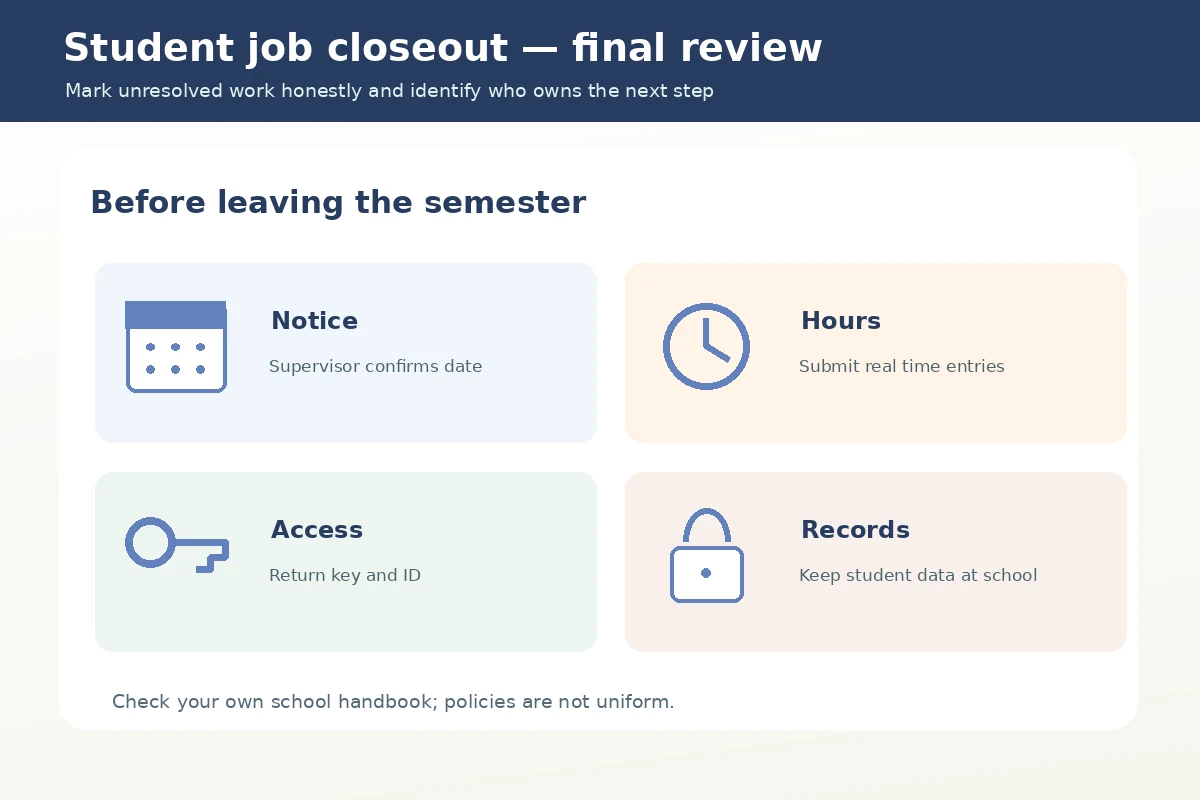
Before departure, confirm the effective date, final shift coverage, timesheet, key or badge return, and where any outstanding tasks now live. If your supervisor will not be available, use the school’s designated alternate contact rather than leaving the notice only on a desk. Record acknowledgment of return items where practical. Ask student employment whether the departure changes other campus job paperwork.
A final-status note might say: “Supervisor confirmed last shift; timesheet submitted; book-cart keys returned to circulation lead; event roster review transferred to office assistant.” It is better to leave one task honestly marked pending than to imply your successor has accepted it when no one has. Your aim is accurate, school-specific closure while protecting fellow students’ information.
How We Research Resignation and Handoff Guidance
We reviewed the following primary or authoritative US sources on November 7, 2026: studentaid.gov (Federal Student Aid explanation of work-study pay and hours). srfs.upenn.edu (Penn’s student job change and notice policy example). www.bu.edu (Boston University guidance on student job resignation and notice). www.ithaca.edu (Ithaca-specific student resignation written notice and property return). These sources address specific employment, security, tax, or organizational practices, not a universal resignation form. Where policy or legal obligations differ, consult the actual employer terms and current state guidance. Illustrative examples are not real employee records or professional legal or tax advice.
This article contains no paid ranking of templates or confirmed commercial relationship. Read our affiliate disclosure. Do not expect a particular reference, paycheck date, or rehire outcome merely because you use this format. Accurate records and respectful communication are more useful than unsupported promises.
Explore Related Career Guides
Check your employer agreement, school or workplace handbook and applicable state rules. A two-week custom is not a universal federal requirement; obtain date confirmation from the appropriate office.
A concise dated email is often useful as a written record, but follow your employer’s actual notice process. Keep a permitted copy and ask the receiving manager to confirm the effective date.
No. Inform the designated supervisor or HR first. Let management decide who needs a role handoff and which external contacts should receive an approved notice.
Document the status, urgency, location of authorized records, and receiving owner. Do not mark unapproved or incomplete work as finished or keep personal access to complete it later.
Keep only employment records you are entitled to retain. Do not copy protected customer, donor, student, credential, or business information to personal accounts for reference or portfolio use.