
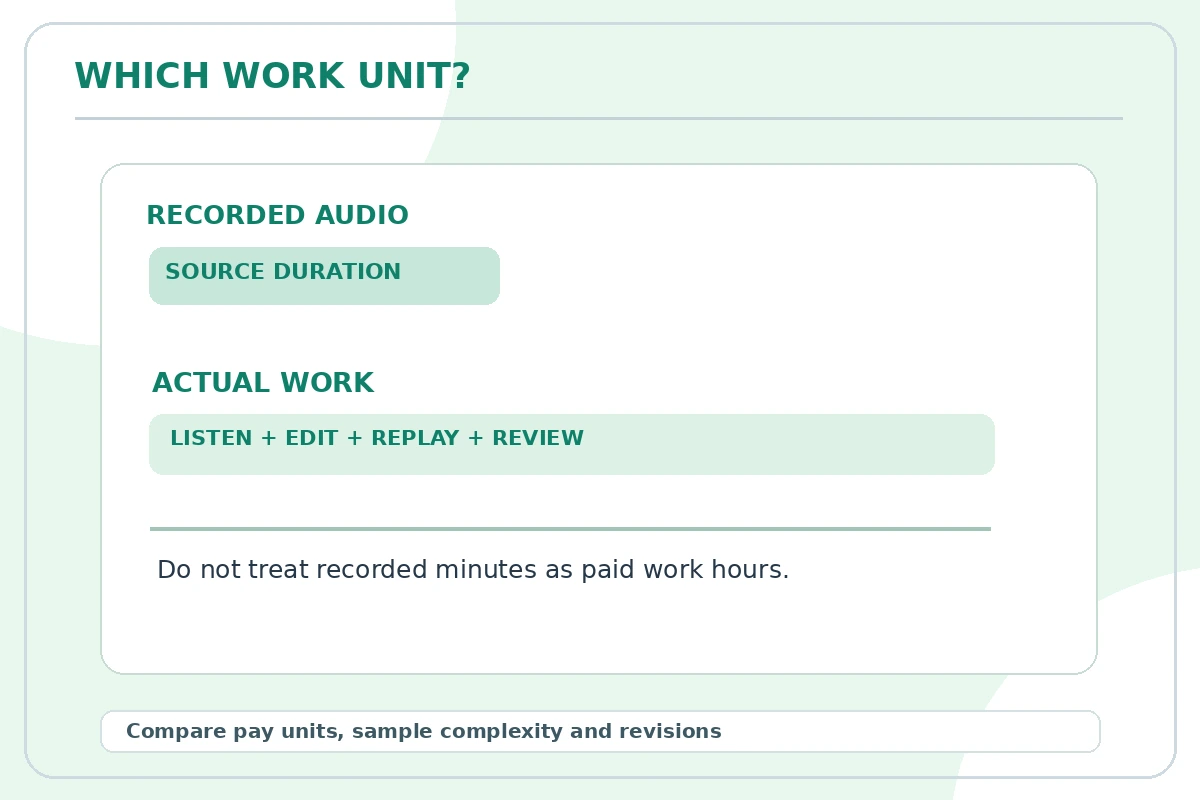
Remote transcription jobs turn permitted audio or recorded speech into text, sometimes with speaker labels, timestamps, verbatim conventions or editing of speech-recognition drafts. Check the content type, audio quality, expected turnaround, editing rules and confidentiality before applying. Crucially, one hour of audio is not the same as one hour of typing or reviewing.
Transcription can describe general interviews or meetings, specialized medical reports, captioning and other tasks with different requirements. BLS describes medical transcriptionists as reviewing recordings and speech-recognition drafts, checking accuracy, and routing reports for professional approval. That medical profile is not a universal credential rule for general transcription work, but it illustrates why specialized material and protected information need a distinct process.
How to identify the real duties behind the remote title
Start by copying the actual responsibilities from the vacancy into a private comparison sheet. Highlight words that describe doing the work, words that describe review or approval, and words that describe availability. This separation matters because remote work can look flexible in a headline while the body requires a specific time-zone overlap, secure equipment or narrow permissions. Use the employer’s own description as your evidence; no generic title guarantees that every company has the same requirements.
Plain text versus strict verbatim. A clean transcript may omit certain fillers under a project style guide; strict verbatim may preserve repetitions, pauses or false starts. Other clients need speaker labels, time codes or event tags. Ask for a sample style guide and correction criteria. You cannot know whether a transcript is “perfect” without the actual project rules and source audio.
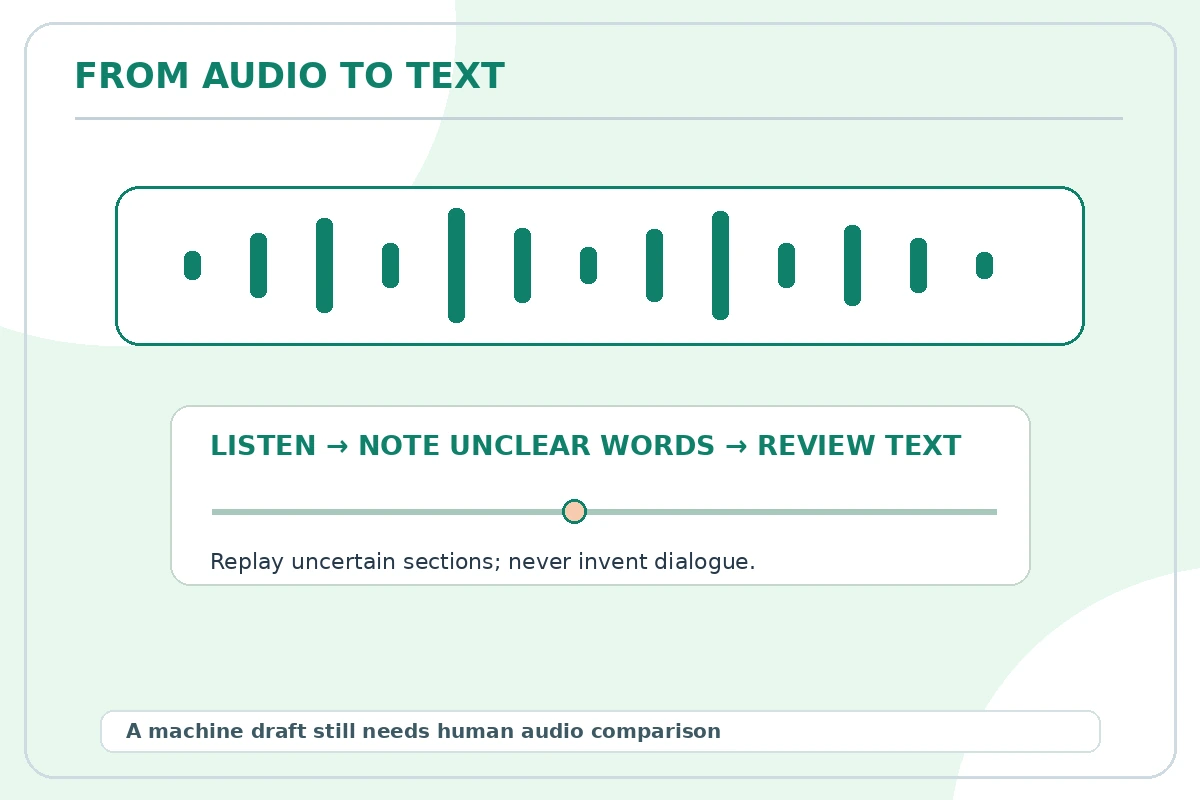
Editing AI drafts versus first-pass transcription. Some jobs begin with machine-generated text and require comparison against the source recording. Others need the worker to create the first draft from scratch. In both cases listen for names, dates, numerical amounts and ambiguous words. Never assume that an automated transcript is accurate merely because it looks polished.
Specialist language and information handling. Medical, legal or technical material can introduce terminology and additional review boundaries. Ask whether the work is general speech or a specialist record, what training is required, who reviews unclear terms, and whether the worker can access appropriate references. Do not present ordinary podcast captioning as proof of medical-document competency.
Real workload and delivery times. Clarify whether units in the offer mean recorded minutes, completed transcript words, actual paid hours or batches. Pauses, multiple speakers, accents and background noise can change work effort dramatically. A realistic job description should state the deadline, revision expectations and method for flagging truly inaudible sections instead of encouraging invention.
A four-question checklist for evaluating a real listing
What is the audio source? Ask about language, speaker count, noise level, subject matter and whether a practice sample represents typical work. If the listing omits the answer, make it a question for the recruiter rather than assuming the most convenient arrangement.
Which style and accuracy rule applies? Find out whether the task uses clean or strict verbatim, timestamps, speaker labels, a glossary and a second-review step. If the listing omits the answer, make it a question for the recruiter rather than assuming the most convenient arrangement.
What is the payment unit? Distinguish per recorded minute, per transcript unit and hourly compensation. Do not infer real hourly earnings from an audio-minute rate. If the listing omits the answer, make it a question for the recruiter rather than assuming the most convenient arrangement.
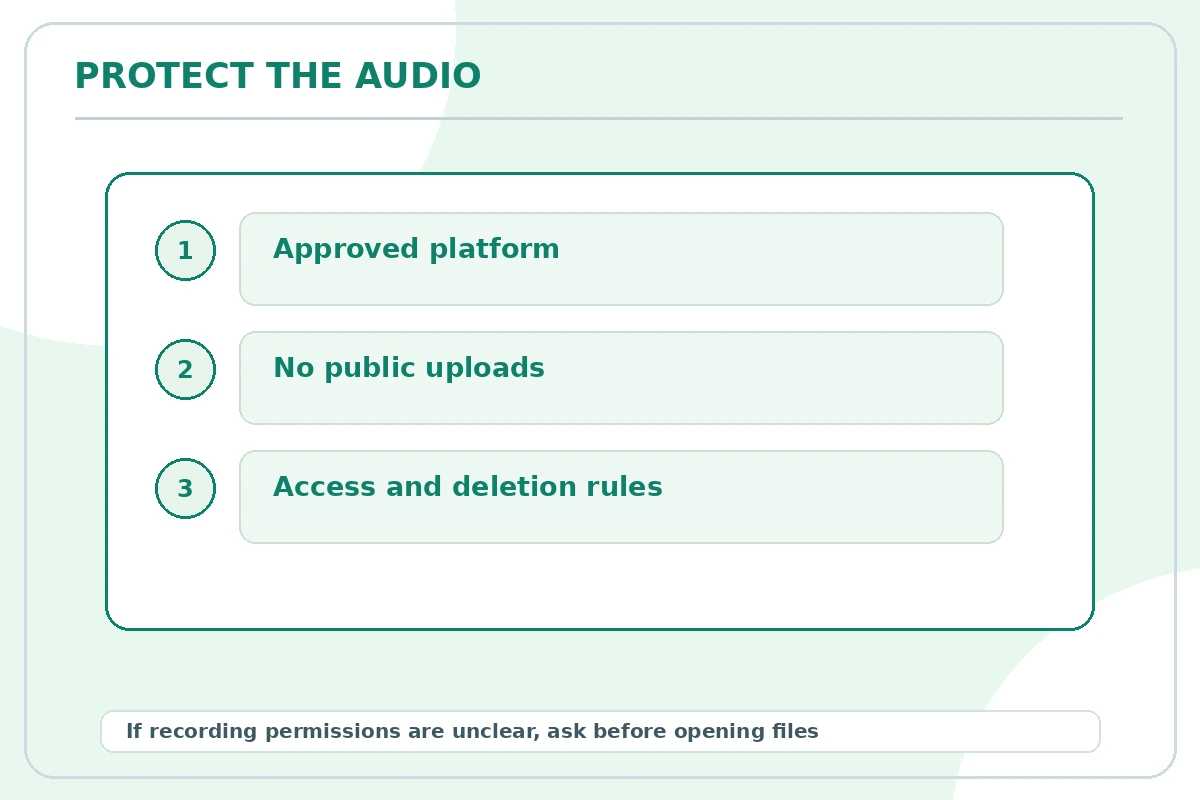
How is private audio protected? Check approved devices, software, retention rules, confidentiality agreements and whether content may be used in public portfolio samples. Usually it may not. If the listing omits the answer, make it a question for the recruiter rather than assuming the most convenient arrangement.
Use the four checks above as a decision table: one column for the exact wording of the listing, one for what you can prove, one for what you still need to ask, and one for a decision to apply, clarify or pass. A “missing” answer is not necessarily a sign of fraud. It may simply require clarification; however, a recruiter who refuses to identify the employer or explain actual tasks gives you little reason to send sensitive information.
An honest work sample with clear scope
Illustrative exercise: A candidate records a short fictional two-person conversation with both speakers’ permission. They create a transcript, mark uncertain words for replay, apply a stated punctuation guide and compare the final text with the recording. This demonstrates process, not professional job history or a verified production accuracy percentage. Never upload a real meeting recording or client audio to a public AI service merely to create an application sample.
In an application, explain your specific action, the system or material you worked with, the safeguard or review checkpoint, and the output you can truthfully describe. The purpose of a sample is to show judgment, not to imitate access you never had. If your example is from a class, personal project or volunteering, name that setting. The sample should never contain confidential employer files, account credentials, private customer data or an invented achievement.
A focused application plan for this remote role
Choose a narrow search phrase. Compare general transcription, audio transcription reviewer, caption editor and medical transcription listings separately. Their training, privacy and delivery requirements may differ significantly.
Demonstrate your actual method. Make an original recording with permission, specify the chosen style rules, show one corrected line and explain how you resolve an inaudible phrase without inventing it.
Calculate effort before accepting. Review the sample task, compensation unit, required rework and deadlines. Ask whether revision time is paid or included and use your own trial timing rather than promises from advertisements.
For each application, record the role title, verified employer domain, source of the listing, application date, required location and core-hours language, tools, and the one capability you can genuinely demonstrate. If you do not meet a must-have requirement, decide whether an adjacent support role is more realistic rather than pretending the requirement does not exist. An online “remote” search result is not proof that the employer can hire you in every state or country.
How to verify a remote recruiter and protect your information
Remote vacancies are an attractive target for impersonation scams. The Federal Trade Commission warns that fake recruiters may contact people from personal email addresses or messages, send polished offers before any real interview, and seek banking or identity information. Verify the organization using a website and contact channel you find independently, not the number in an unexpected message. Read the actual role on the employer’s careers page when available.
Never send money to obtain a job, buy access to a list of tasks, release earned commissions or deposit an unexpected check and return part of the funds. The FTC also documents task scams where supposed online earnings appear inside an app and workers are asked to deposit their own money. Treat those offers as warning signs, not as normal onboarding. Share sensitive identity and payroll information only through a properly verified employer process at an appropriate hiring stage.
Ask a practical interview question rather than relying on vague reassurance: “Can you walk me through the first real assignment, the system I would use, who reviews it, and what happens when something cannot be completed safely?” The answer should describe a recognizable workflow with boundaries. If it remains unclear, record the gap in your comparison sheet and move on to a listing with better evidence.
How We Research remote job-search guides
This JobAsk guide uses the occupational or professional source Bureau of Labor Statistics occupational profile for the underlying work and the FTC’s remote recruiter warnings for application safety. The source profiles describe occupations or comparable duties; they do not guarantee that a specific remote vacancy exists, that its requirements are identical, or that every candidate qualifies. The illustrative scenario is fictional and is provided only to explain how to describe experience honestly. Sources checked on 2026-11-02.
This page provides general job-search guidance, not financial, legal or career-placement guarantees. Requirements, equipment policies and hiring restrictions vary by employer and location. JobAsk does not claim to recruit for the employers discussed, receive offers on their behalf or guarantee results. Read our affiliate disclosure for information about commercial relationships on the site.
Frequently asked questions about this remote role
Related Job Search Guides
Employers may supply a secure platform or specify tools, playback controls, foot pedals or transcription editors. Ask for the actual workflow before buying anything.
They overlap, but caption tasks may require time synchronization and accessibility conventions. A transcript alone may not meet the project’s captioning requirements.
Only if the employer authorizes it and the data-handling terms permit it. Even authorized drafts still require careful review against the recording.
Medical transcription uses specialized terminology, confidentiality and clinical review rules. Do not assume a general audio project qualifies you for specialized medical work.
First distinguish recorded audio length from your real editing or listening time. Check sample complexity, revisions and payment terms without assuming a guaranteed hourly equivalent.