
Effective bartender resume bullet points show the service you actually handled—not just “made drinks.” Describe taking or preparing orders, working with the service team, checking IDs under applicable procedures, stocking supplies, maintaining the bar area, and processing tabs if assigned. Separate direct work from manager approval and avoid made-up tip totals, sales increases, or certifications. Below are hypothetical sentence examples, an evidence checklist, and a way to show responsibility accurately at a busy bar, restaurant, hotel, or event.
Choose evidence from the actual bar shift
The Bureau of Labor Statistics describes bartending as preparing and serving drinks, taking orders, handling some payments, restocking supplies, cleaning work areas, and checking identification. That is an occupation description, not a list of duties you automatically performed. A barback may replenish ice and glassware without taking tabs. A banquet bartender may work an assigned event station rather than manage menu pricing or inventory purchases. Select only the duties that belonged to your specific role.
Create a shift inventory for your resume: order flow, beverage preparation, customer guidance, payment or tab tasks, replenishment, cleaning, and incident escalation. For each area, record who assigned the duty and any written procedure you followed. Notes about the work are more reliable than trying to reconstruct impressive statistics months later.
Turn drink preparation into a credible bullet
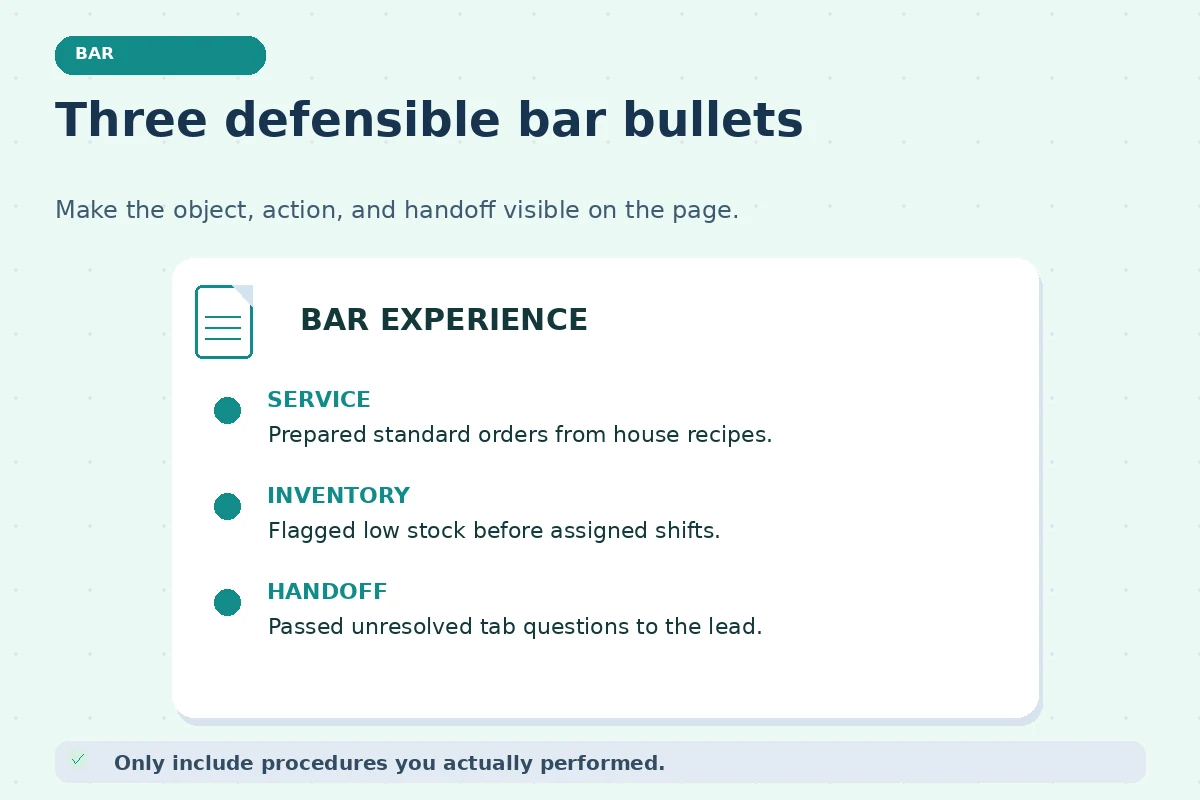
“Made drinks” conveys little about setting or procedure. Hypothetical alternative: “Prepared standard drink orders from house recipes and communicated out-of-stock items to the service team.” Another example, for someone with that responsibility: “Organized garnish and glassware stations before service and replenished supplies during shift changes.” Neither sentence assumes the worker created recipes, controlled costs, or ran the bar.
If you trained new colleagues, distinguish demonstrated tasks from independently signing off on their readiness. “Demonstrated station setup and drink-ticket routing to new team members during assigned shifts” is narrower than “certified bartenders.” Only say you developed recipes if you genuinely proposed or created them and they were used with appropriate approval.

Describe identification and responsible-service practices carefully
Bartending can include checking ID, observing service conditions, and following workplace procedures for refusing or escalating service concerns. The exact requirements depend on location and employer. Avoid publishing specific claims about legal age rules, training credentials, or personal decisions unless they are true for your jurisdiction and role. A workable bullet is “Checked customer identification using house procedures and referred uncertain cases to the shift lead.”
Service incidents should never be turned into sensational stories. Use privacy-safe language such as “Documented service concerns through the manager escalation process.” That conveys judgment without disclosing patron details or implying law-enforcement authority. If your role did not involve ID checks or incident review, focus on tasks you did perform.
Show tabs and cash handling without implying financial control
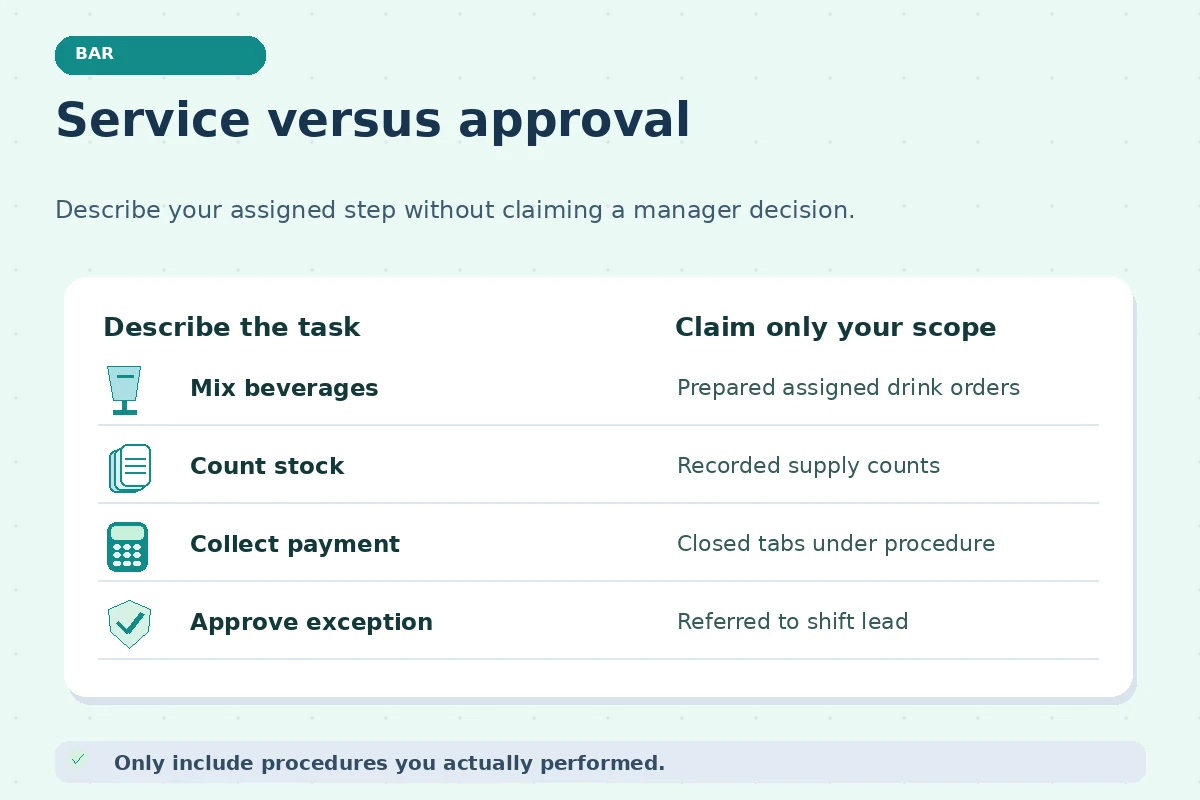
BLS and O*NET both list payment handling as a possible bartender responsibility. But there is a real distinction between entering an order in a point-of-sale system, collecting payment, reconciling a till, and authorizing a refund or adjustment. Choose the exact step. An illustrative bullet might say “Entered beverage orders and closed assigned customer tabs using the venue’s POS procedures.” If you handled only cash collection, do not imply you controlled financial reporting.
For shared registers or tips, say “assisted with shift-end count” only if you did and if that phrasing reflects your scope. Do not include actual customer payment data, full transaction histories, or unapproved internal numbers in a public resume. The interviewer can ask about the workflow without needing private records.
Make stock and sanitation work visible
Replenishing glassware, ice, mixers, garnishes, and other bar supplies is relevant work. Try “Checked station supplies against opening checklist and flagged low stock before service.” Someone who actually counted inventory may write “Recorded end-of-shift supply counts and reported differences to the bar manager.” Avoid saying you “optimized inventory” without evidence of a change you made and could explain.
Cleaning matters too. “Maintained bar surfaces and equipment according to workplace cleaning procedures during open and close” is specific, although it should be adapted to what you did. Do not claim food-safety credentials, regulatory compliance inspections, or authority to approve equipment repairs simply because you cleaned work areas.
Adapt examples for entry-level and experienced bartenders
For a first bar role, prioritize transferable tasks: restocking, guest communication, accurate tickets, closing checklists, and reliable handoffs. For more experienced workers, identify real increases in responsibility: training on specific procedures, coordinating service between stations, planning preparation lists, or helping track supply requests. A bartending title does not automatically mean supervisory scope.
Compare “Assisted the lead bartender by preparing garnishes, refilling ice, and clearing glassware during peak service” with “Coordinated service tickets between floor staff and the bar station during scheduled events.” Both are hypothetical and reflect different assignments. Choose one only if you performed that work. A strong resume needs a few defensible examples, not every possible bar duty.
Check that the final bullets can be defended
Read each line for three things: action, object, and boundary. If a bullet says “balanced accounts,” can you explain whether you counted a drawer or completed accounting reconciliation? If it says “ensured guest safety,” did you actually manage risks or follow an established escalation procedure? Prefer the narrower truthful description. Remove any claimed tip percentages, sales growth, bar volume, and credentials that you cannot substantiate.
Keep a private note of the venue type, your shift function, and the relevant procedure for interview preparation, but avoid sharing patron data or proprietary records. Order your bullets by the hiring venue’s needs: high-volume ticket flow, guest communication, inventory support, or payment accuracy. Export the resume and inspect wrapping so that the task and qualifier remain in the same readable sentence.
How We Research Resume Examples and Role Boundaries
We use U.S. career-center guidance for writing truthful accomplishment statements and role-specific public occupational references where available. We compare tasks listed by official occupational sources with what an individual applicant may or may not have done. An occupation description is not proof of a particular person’s skills, assignments, performance, certification, or authority. Every example in this article is hypothetical and must be adjusted to documented personal experience. We do not promise hiring outcomes, approval by automated resume tools, or a measurable result without evidence.
Sources checked November 13, 2026: bls.gov — BLS describes bartending duties including orders, recipes, ID checks, payments, supplies, cleaning, and monitoring service., onetonline.org — O*NET lists bartender tasks such as drink preparation, payment handling, ID checking, service, and stocking., careerdevelopment.princeton.edu — Princeton career guidance explains action, context, and end result as a framework for accomplishment statements..
This article provides general U.S. resume-writing information, not individualized legal, privacy, employment, or professional advice. See the JobAsk affiliate disclosure. Links to our resume category are informational; no paid partnership is claimed here.
More Resume and Cover Letter Guides
Use the few most relevant, nonrepetitive bullets that accurately show your experience. The appropriate count depends on your work history and available page space.
Only for duties actually performed. A barback can document setup, stocking, cleaning, and team handoffs without claiming independent drink service.
Only if the figures are accurate, relevant, and appropriate to disclose. Do not estimate sales improvements or imply sole responsibility for shared results.
Yes, if you were assigned and performed that task. Keep legal statements and credential claims specific to your actual training and jurisdiction.
Describe the transactions or tab steps you personally completed. Do not imply that you controlled reconciliation, refunds, or register policy if someone else did.