
For second interview after phone screen, expect to go beyond the first conversation and explain what you personally did, how you made decisions, and which questions remain open about the work. A later-round invitation is not a promise of an offer. The format may include a manager, a panel, a work example or a practical case, depending on the employer. This guide focuses on recruiter screen, hiring manager and mutual decision rather than memorized confidence claims. Use only genuine employment history in answers about your background; any sample situation here is hypothetical and must be adapted to your real authority and evidence. Before participating, confirm the invitation, time zone, participants and any approved presentation or work-sample instructions.
Turn screening notes into an evidence map
A phone screen usually establishes whether your background and basic conditions may fit the role; it does not necessarily test your daily judgment. After the call, record the exact role name, requirements the recruiter emphasized, topics you answered briefly, and promises you made about availability or skills. Put each claim next to an example you could explain without confidential data. If you said you coordinate projects, identify a particular schedule, the people you informed and a decision you did or did not own. Recheck the posting before the second interview because the manager may use different vocabulary. Do not invent a metric just to make a screen answer sound impressive.
Choose two job-related work stories
Pick stories about actual tasks likely to matter on day one, not a list of generic strengths. For each, note the context, what was assigned, the action you personally took, and how you confirmed the outcome. The U.S. Office of Personnel Management describes job-related behavioral and situational questioning as approaches to structured assessment. You can practice with that logic even if the employer uses an informal conversation. Bring a short story about ordinary reliable work as well as one about a difficult handoff. If you worked in a team, distinguish your contribution from the supervisor’s approval, the group’s total output and claims you cannot independently verify.
Prepare to expand rather than contradict
The manager may ask the same question the recruiter used, such as why you changed roles or how you use a particular tool. Consistency matters more than novelty. You can say that the phone answer was a short summary, then provide a concrete example with dates and responsibilities that match your record. If a previous answer contained a genuine mistake, correct it plainly instead of building an elaborate new story around it. Do not assume the manager has read the screening notes. Start with enough context that the answer stands alone, then stop so the interviewer can probe a detail.
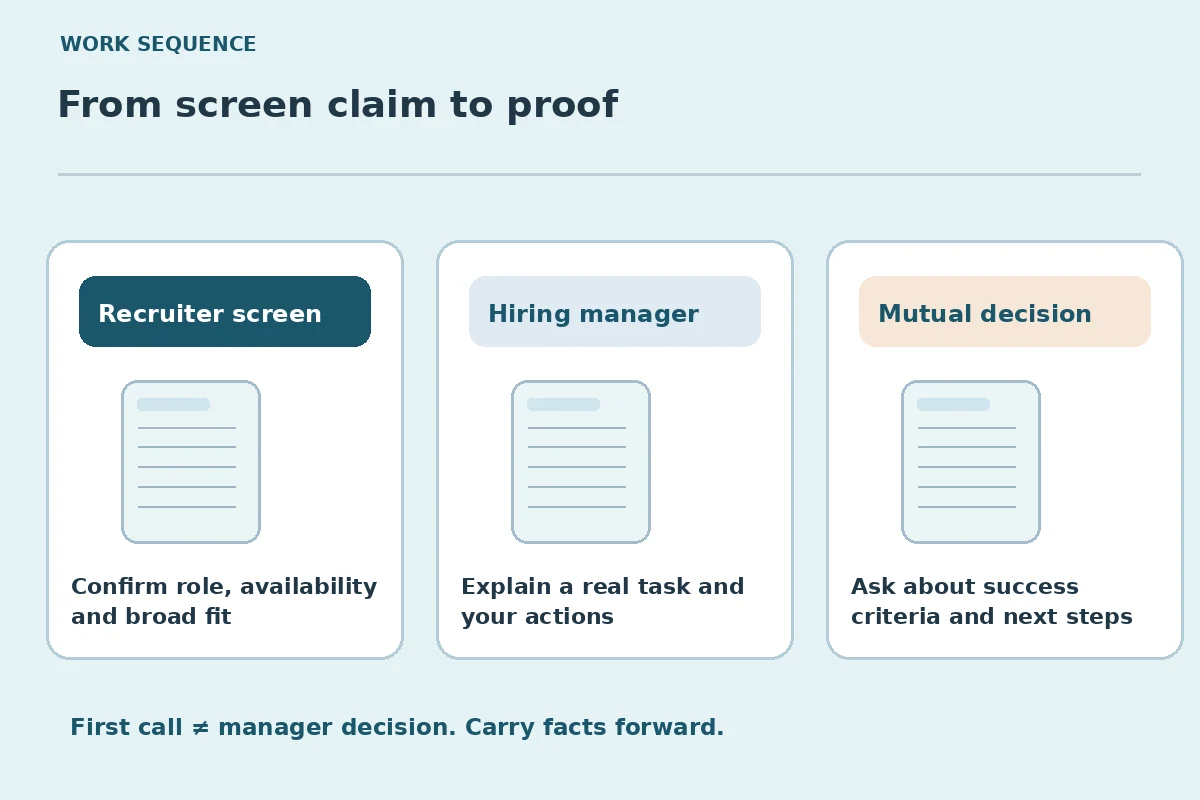
Practice the evidence bridge visually
For a hypothetical operations coordinator, the first-round claim might be “I kept shipments on schedule.” A defensible second-round explanation names the types of updates, who received them, what was flagged when a delivery shifted and who approved any customer promise. The visual map below separates an initial claim from the underlying task and its reviewer. Your example can be shorter than this: one sentence of context, two sentences describing the action, and a sentence about the observed result and lesson. Never turn a collective delivery outcome into an unverified individual achievement.
Discuss the role you would actually enter
Use the second interview to learn who assigns work, the first deliverables, the tools or records you would maintain, and what decisions must be escalated. A hiring manager may evaluate whether your experience translates to this particular operation, not an abstract version of the job. Ask “What would a well-documented handoff look like in the first month?” instead of only “What is the culture like?” If the manager describes duties that differ materially from the posted role, ask for clarification and note the answer after the meeting. Avoid agreeing to qualifications or responsibilities you do not yet hold.
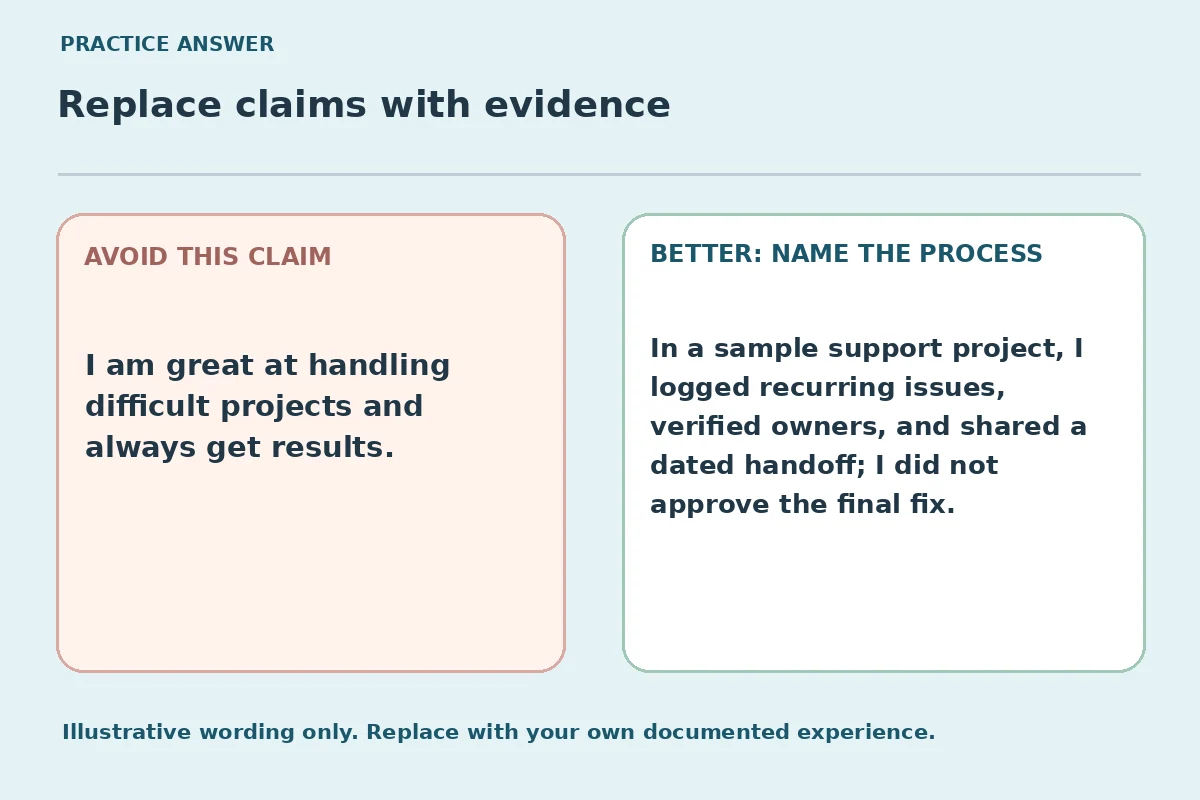
Write a stronger answer with limits
An unsupported answer promises perfect performance. An evidence-based answer describes what you actually did, the boundary you followed and the result you observed. A hypothetical response could be: “I tracked issue ownership, asked the assigned specialist to verify the correction, and updated the customer-facing log after the review.” Use this wording only if it reflects your real history. Practice pausing after the main answer rather than filling silence with speculation. For decisions outside your authority, name the role responsible for sign-off. This makes the example credible without underselling the helpful work that you performed.
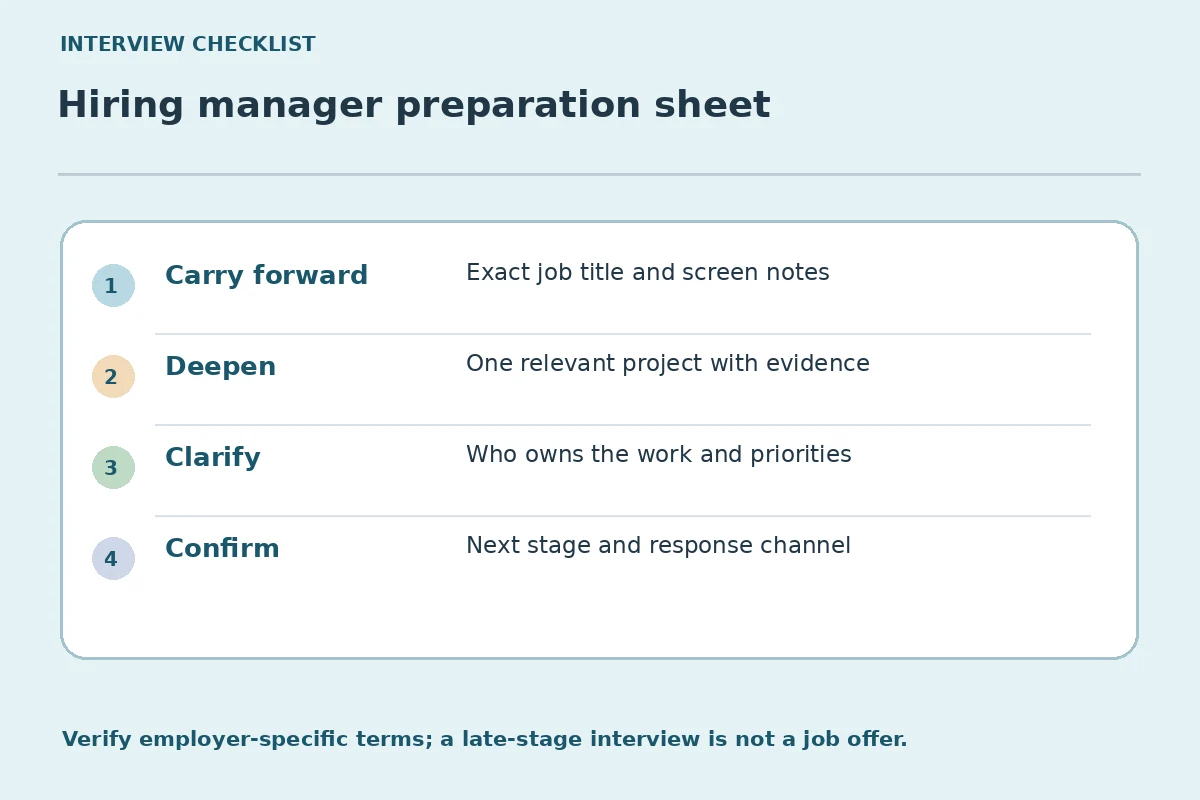
| Decision area | What to confirm |
|---|---|
| Carry forward | Exact job title and screen notes |
| Deepen | One relevant project with evidence |
| Clarify | Who owns the work and priorities |
| Confirm | Next stage and response channel |
Ask precise questions without negotiating too early
The interviewer can often answer questions about immediate priorities, success measures, feedback and collaboration. Compensation or start-date questions may be routed back to the recruiter or HR contact; there is no universal stage at which every employer discusses them. Keep one question about priorities and one about how performance is evaluated. If you have a material work-condition requirement, such as a fixed shift or workplace location, it is reasonable to clarify the accurate terms before making any commitment. Do not suggest that being invited back means the decision is final.
Close the interview and track an accurate next step
At the end, ask who will communicate the decision and whether another interview or assessment is expected. Thank the manager for the specific work discussion, not for a job that has not been offered. Update your private notes with interviewers, questions and new role facts. Follow the employer’s stated timing before checking status; if no date was provided, a concise, professional inquiry after a reasonable interval is more useful than repeated daily messages. No advice here guarantees a response. Do not email employer-owned examples, client records or unrequested attachments as proof.
How We Research Second and Final Interview Advice
JobAsk reviewed these occupational, government and university sources on November 17, 2026: University of Chicago explains that second-round interviews probe work experience and can involve supervisors, other staff, panels and assessments. Santa Clara University describes second interviews as deeper evaluations of qualifications, job interest and behavioral examples. U.S. OPM explains competency-based questions and the distinction between behavioral and situational interviewing. EEOC explains that pre-offer questions about disabilities are restricted and that job-task questions may be asked. These sources describe typical interview formats or real occupational duties; they do not establish what any individual employer will ask or how a hiring decision will end. We checked that this scenario answers a more specific reader question than general interview preparation, while the employer remains the final source for its own hiring process. Examples in this guide are hypothetical and must not be presented as actual employer results or client outcomes. No affiliate approval, employment offer, guaranteed interview score or hiring outcome is implied. Read the JobAsk affiliate disclosure.
More Interview Preparation Guides
Expect more detailed questions about actual tasks and your decisions; the format still depends on the employer.
Yes, if relevant, but provide the missing details and maintain the same truthful facts.
Only when requested or permitted; remove protected employer information from any example.
Acknowledge the earlier summary and add an accurate example rather than silently changing dates or results.
No. It is a further evaluation and not a promise of hiring.