
For a security guard position, a former shift supervisor, site lead or operations manager can be a useful professional reference if they observed your patrols, access control, incident documentation or shift handoffs. Ask before sharing their contact information. The reference should be able to describe reliability, communication and adherence to the duties you actually held—not reveal camera locations, alarm procedures, client identities or confidential incident reports. A positive reference is also different from proof of any registration, licensing or training the new role requires. Choose someone who can discuss your performance within appropriate security and employer confidentiality boundaries.
Choose someone who saw the assigned post
A shift lead who checked your post logs may offer a more relevant account than a regional director who never worked at the site. Identify whether the person supervised patrol routes, visitor access checks, radio communication, report writing or a reception post. The BLS lists these as common security functions, while noting duties vary by employer and property. Match the reference to the new site’s needs. An office lobby position may emphasize visitor service and accurate sign-in records; a logistics facility may emphasize consistent handoff protocols. Do not imply that working in one setting authorizes duties at every other site.
Get permission and identify the correct employer
Security work is sometimes provided by a contractor at a client’s location. Your employer may be the security company even though the supervisor worked daily at the client facility. Ask which entity should be used in application fields and how the reference wishes to be contacted. The client manager’s approval may not be a substitute for the guard company’s HR verification. A simple request is: ‘Would you be comfortable speaking about my patrol checks and shift handoffs during our assignment?’ Confirm the person’s role, work period and current contact. Do not label a client employee as your direct employer unless that was true.
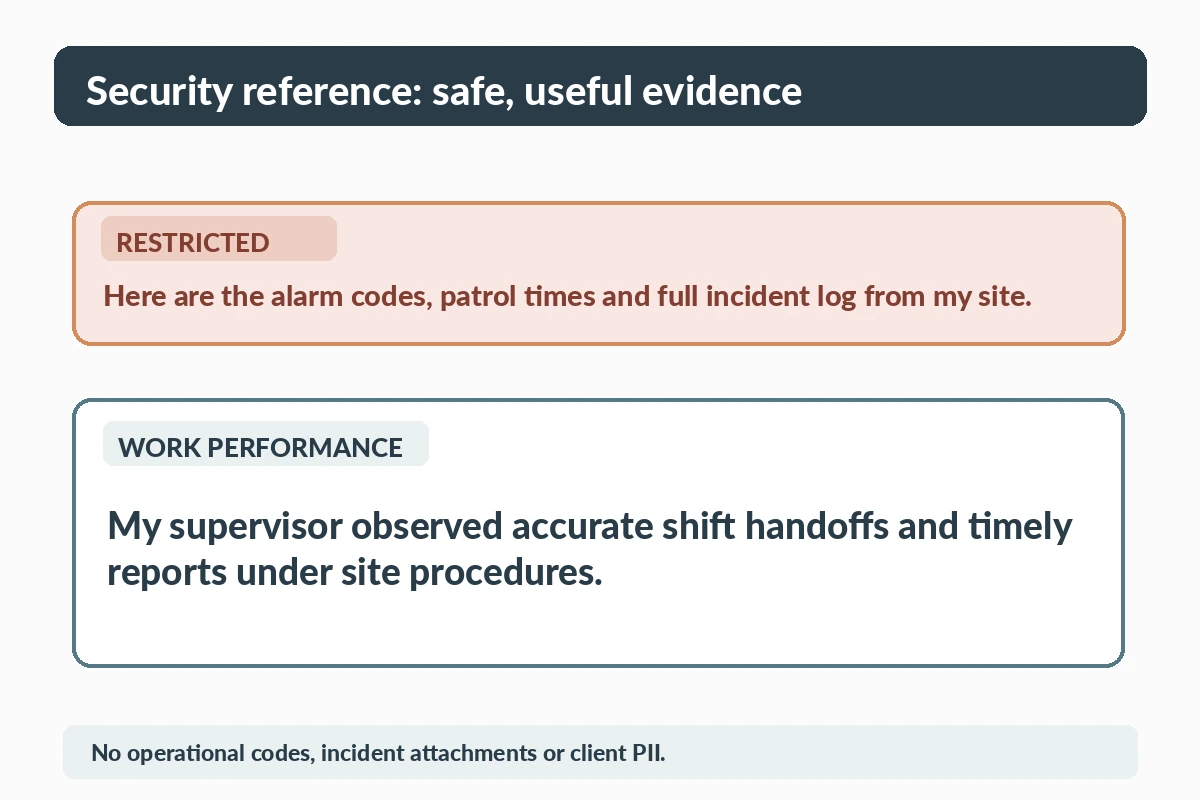
Use patrol and handoff evidence instead of restricted logs
A useful reference can talk about whether you completed assigned rounds, accurately reported observations and passed open items to the next shift. It should not need a screenshot of patrol tracking software, gate codes or exact response procedures. State the process at a high level: ‘I documented an unusual condition according to site policy and notified the designated supervisor.’ Do not identify specific restricted areas, times when a site was unstaffed or vulnerabilities in camera coverage. The BLS describes the importance of observation and communication; you can demonstrate these competencies without releasing sensitive operational detail.
Keep incident descriptions within permission boundaries
A prospective employer may ask how you handled a stressful event. Pick an example you are authorized to discuss without naming involved people, revealing incident numbers or distributing official reports. Explain your assigned part: observing, using established notification procedures, writing a factual note or requesting supervisory guidance. Avoid exaggerating that you conducted an investigation or performed law enforcement duties if you did not. If confidentiality prevents a detailed story, describe an anonymized workflow and emphasize sound judgment. A former supervisor should not be expected to release confidential documentation to support an applicant’s claims.
Do not treat a reference as a license
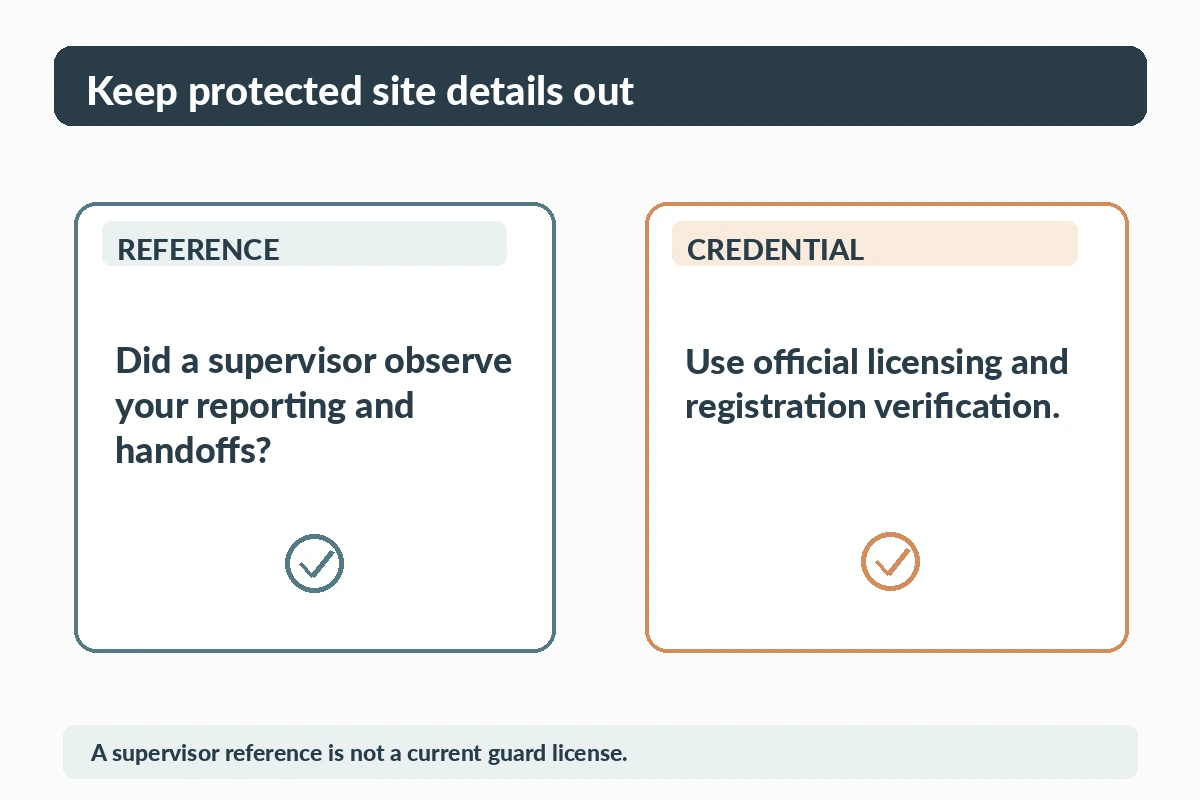
Guard registration or licensing rules vary by state and by role. A former supervisor might verify that you completed training they actually observed, but cannot transform an expired credential into a current one. For positions involving additional regulated duties, follow the specific hiring agency’s official verification route. Do not ask a supervisor to state you were armed, licensed or certified unless those facts are accurate and permitted to be disclosed. The BLS notes varying licensing and training requirements; reference calls are not a substitute for reviewing current credentials and job conditions.
| Reference source | What they may know | Before you share |
|---|---|---|
| Shift supervisor | Patrol and handoff reliability | Verify historical assignment |
| Security company HR | Employment dates and title | Use authorized channel |
| Site or client lead | Observed on-site collaboration | Clarify they are not employer |
Separate contractor and client site references
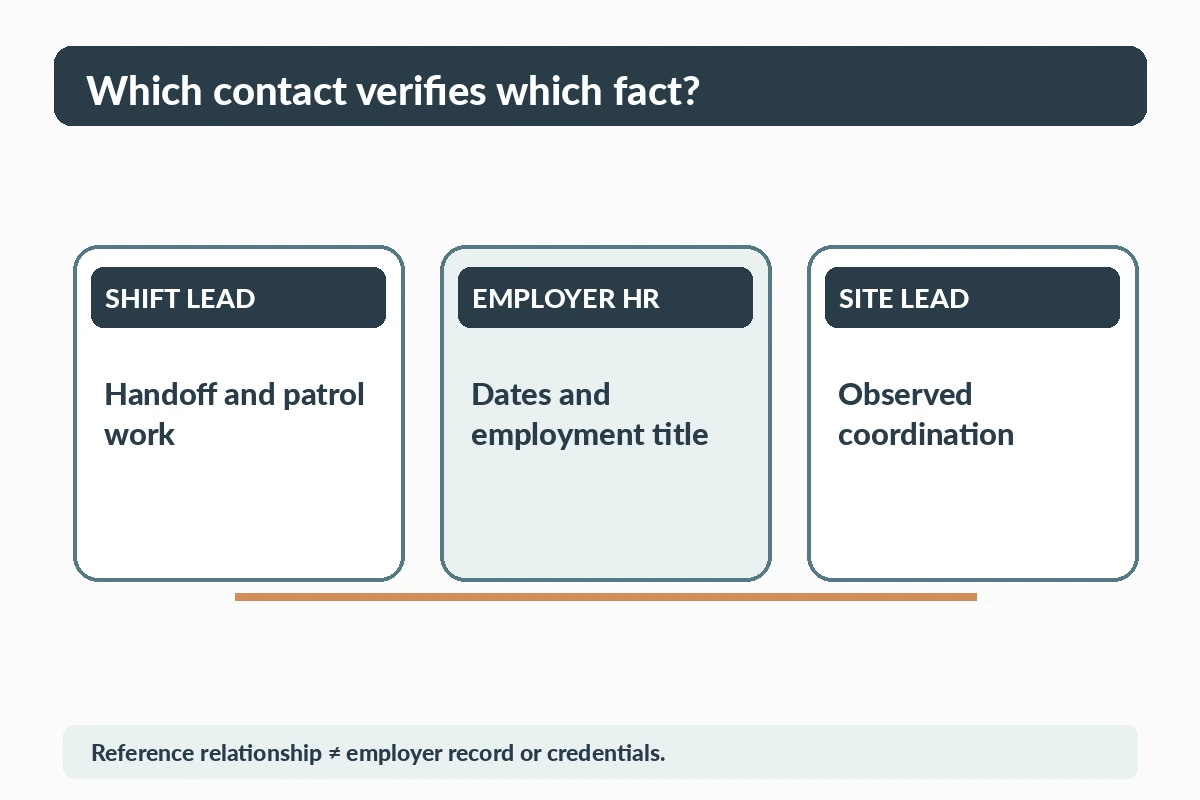
You may have interacted with an on-site facilities manager and a contract company supervisor. Decide who can verify which part. The employer’s HR office may confirm dates and title; the site lead may describe patrol reliability or visitor coordination; a client contact may only know the service your team provided. Ask the hiring manager whether the required reference must be a direct supervisor. Do not list a client contact as a manager or ask someone to confirm employment dates they do not control. A precise relationship note helps prevent follow-up delays and makes differences between employer and assignment site understandable.
Prepare a short, non-sensitive evidence sheet
For a consenting reference, prepare the true post type, period, broad shift schedule and two role-relevant examples. Write ‘completed scheduled access checks and documented handoffs’ rather than listing exact gate checks or alarm placements. Remove client names where contracts prohibit disclosure, along with personal identifiers and incident photos. Invite the reference to correct your memory. Do not demand a fixed script or pressure them to give a positive review. A strong work reference is independent testimony from someone who actually observed you, not a duplicate of unsupported resume claims.
Handle supervisors who changed assignments
Security staff often change sites or employers. If a shift lead has moved, explain their historical role and use a new preferred contact only with consent. Confirm the time the person supervised you rather than suggesting they hold the same post today. If the prior client has changed contractors, seek official verification through the company that employed you during that time. Keep the two relationships separate on a reference list. If a recruiter requests site-specific documentation, ask about approved verification rather than trying to obtain internal logs after your access has ended.
Answer questions about problems without blaming others
If a reference may mention a missed handoff or a documented coaching issue, be ready to discuss the actual corrective steps without contradicting records or exposing confidential events. An appropriate interview example may describe how you began using a verified checklist after receiving feedback. Do not pressure a supervisor to conceal a real performance issue or invent a perfect record. Clear acknowledgment of the role you held and what changed is better than shifting blame to colleagues. Security employers value reliable reporting; accuracy in a reference check is itself relevant evidence of professionalism.
Update the list before each security application
Check the job posting for required registration, shift type, reporting tools and reference categories. Ask the chosen contacts whether they can speak about those duties and whether their information is current. Notify them before a likely call, then thank them. Avoid uploading access badges, internal SOPs, building maps or incident reports as supporting materials unless the owner has specifically authorized disclosure. Keep a second consenting contact who saw different work, such as a training lead for communication and a supervisor for shift handoffs. A careful reference list should verify your own behavior without revealing site security.
How We Research Professional References
JobAsk reviewed these source materials on November 16, 2026: BLS identifies access control, patrols, alarms, incident reporting and training as common security guard responsibilities. CareerOneStop says to choose references who know specific work and to obtain contact permission. Yale career advisers emphasize references with first-hand work knowledge, not prestige or seniority alone. We compared the intended search question against the supplied WordPress post inventory and recent batch titles, and we checked the relevant JobAsk category and disclosure page. An external search cannot confirm that an unpublished WordPress slug is available. Example names, situations and reference wording are hypothetical and must be adapted to real duties, permissions, contact details and employer requirements. We do not invent testimonials, credentials, legal rules or promises about hiring results. Read our affiliate disclosure.
More Resume and Cover Letter Guides
A consenting shift lead, site supervisor or manager who observed your assigned duties. Identify any contractor/client relationship accurately.
Not without explicit authorization. Discuss general reporting processes without disclosing restricted records or personal information.
They may describe on-site work, but formal employment verification may require the security company or HR.
No. Follow the applicable jurisdiction’s official licensing or registration verification requirements.
Record the supervisor’s former role and work period, ask permission for current contact details, and keep employer records separate.