
For a teaching position, choose references who can speak to the instruction and professional practice they actually observed. A principal may know your formal evaluation and school-wide contributions; a mentor teacher may have seen lesson planning, classroom management and feedback cycles; a grade-level colleague may know collaboration and handoffs. Ask each person before listing their contact details. Prepare accurate classroom examples, but do not send student records, identifiable assessment results or parent communications to a new employer. If a district has an official reference process, follow it. Your goal is to give a hiring team a reliable picture of your own work, not to disclose information about children.
Start with the duties the new school needs to verify
Read the teaching vacancy for grade level, curriculum, instructional planning, assessment, family communication, classroom routines and required credentials. A reference can only credibly discuss what they observed. A principal who completed formal classroom observations may describe lesson delivery and professional responsibilities, while a mentor may speak to how you revised instruction. A grade-level peer can describe planning meetings and shared resources, but may not know your formal evaluation record. Match the reference to the employer’s actual request. Do not assume a senior administrator is best if they have never visited your classroom.
Distinguish principals, mentor teachers and colleagues
A school leader may verify employment and discuss broad professional expectations; a mentor teacher may recall a specific lesson revision; a specialist may describe your part in a collaborative support plan. A hiring panel may request particular types of references, such as a recent direct supervisor, so check the application instructions before choosing. If you are a student teacher, an assigned cooperating teacher may be more relevant than an administrator who only greeted you. Describe a peer as a peer, not as your supervisor. Accurate relationship labels make the reference’s account understandable and prevent mistaken claims about authority.
Request permission through the correct district channel
Some school systems have formal employment verification or references policies. Ask whether the person can respond individually or must use an authorized HR portal. A hypothetical request is: ‘Would you be comfortable speaking about the literacy lessons you observed and the feedback cycle we completed? I can send the job description and my current resume.’ Make clear that they may decline. Verify their preferred email, availability and title. Do not share a district directory phone number for personal contact without the person’s consent. A system requiring the current principal may need special handling if your search is not yet public.

Keep FERPA-protected records out of reference packets
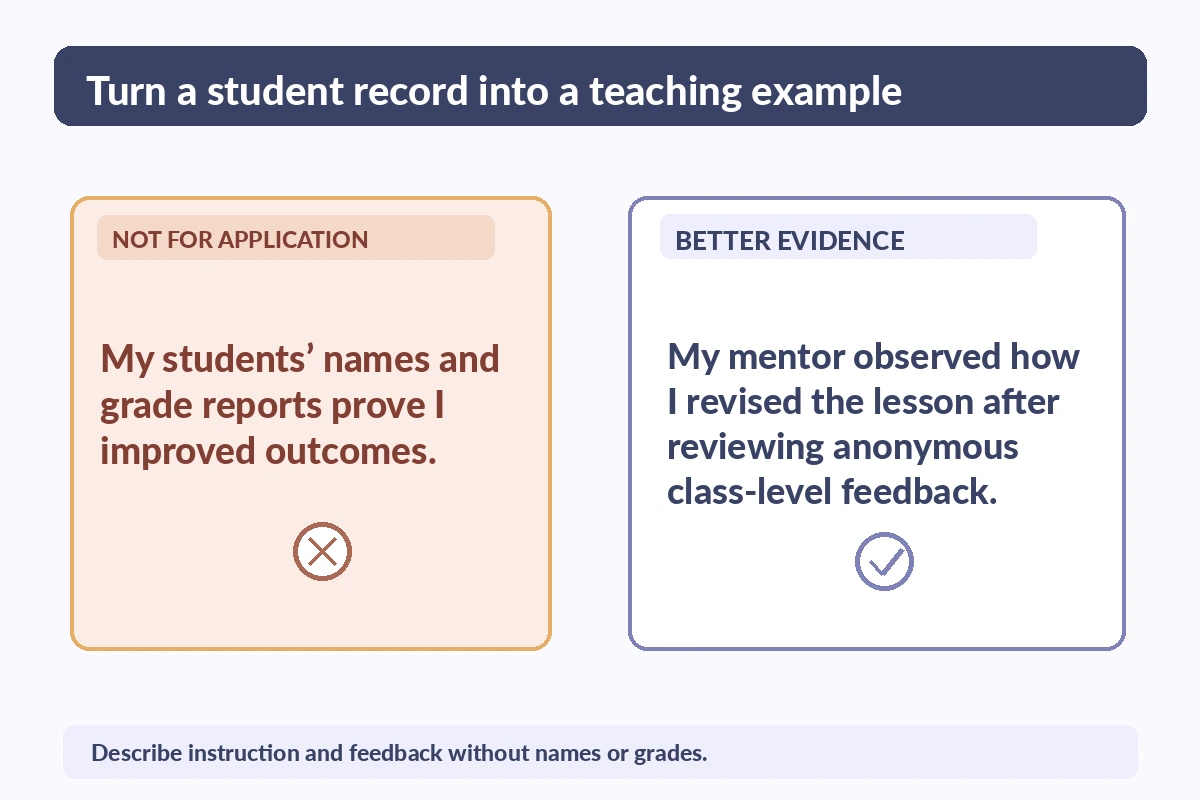
FERPA protects personally identifiable information from education records in covered settings; the U.S. Department of Education explains disclosure requirements and exceptions. Do not attach identifiable student grade reports, individualized education materials, discipline notes, or private family correspondence to a reference request or job application. Even when an anecdote seems complimentary, a child’s identity is not part of your hiring evidence. Describe the teaching method instead: ‘I used exit-ticket trends to adjust the next lesson,’ without naming students or including their results. Follow your current institution’s privacy policy for any permitted work samples.
Show instructional evidence at the right level
A strong reference may recall how you planned a unit, delivered a demonstration, adjusted pacing after a formative check and collaborated with specialists. Prepare two concise examples with their actual context: grade band, broad subject area, your role, what feedback you received and what you changed. If you were a student teacher, identify work completed under your cooperating teacher’s supervision. Avoid inventing test-score gains or attributing a school-wide outcome to your individual lesson. BLS describes teaching as a profession involving planning, instruction and assessment; your examples should identify the part you really performed.
| Reference source | What they may know | Before you share |
|---|---|---|
| Principal / evaluator | Formal observation and scope | Ask district contact rules |
| Cooperating mentor | Lesson revisions and feedback | Identify supervised teaching |
| Grade-level colleague | Planning and collaboration | Describe peer role correctly |
Explain license status separately from a recommendation
A principal’s praise does not establish that your teaching license is issued, valid for the jurisdiction, or appropriate for a particular grade or subject. The job posting or credentialing authority defines those requirements. If your license is pending, say so with the accurate application status, and do not ask a reference to certify it has been awarded. A mentor can speak to classroom preparation; the licensing office or official documentation handles licensure verification. This distinction matters for applicants moving between states, student teachers and career changers who have practice experience but are still completing required credentials.
Build a teacher reference sheet with precise relationships
A hypothetical entry might read: ‘Taylor Chen — Cooperating Teacher, [school], supervised my student-teaching lessons during [term]; preferred contact approved.’ Another may be ‘Former Principal, [school], observed classroom instruction in [year].’ Use actual roles and dates. If the contact now works at another school, show the former relationship and their approved current method of contact. Include the number of references the application requests instead of automatically putting contact details on the resume itself. Do not invent a school address or provide a personal mobile number without permission.
Prepare for a confidential search from a current school
A teacher may be exploring other positions before telling their current administrator. Some districts expect a current supervisor contact, while others permit a substitute at an early stage. Read the exact application rule and ask HR or the recruiter whether contact may be deferred until a particular point. Do not lie on a field requiring a direct supervisor. You may be able to supply a former principal, supervising mentor or department colleague with firsthand knowledge while keeping current employment confidential. A hiring process may later require a formal check; discuss that timing instead of promising secrecy cannot be broken.

Avoid using parent or student testimonials as substitutes
A parent might appreciate your communication, but a job requiring professional references often seeks educational leadership and classroom observation, not unsolicited testimonials. Do not collect identifiable student praise or family emails to attach to applications without institutional permission. If the school accepts a portfolio, use anonymized or authorized examples of planning and reflection. A reference should be able to discuss your professional judgment, collaboration and duties, not access to children’s personal histories. Ask how the school wants teaching samples and references submitted; follow its security and file handling procedures.
Give references an accurate heads-up and thank them
When a hiring team is likely to call, provide each consenting person the vacancy’s role expectations and a short factual reminder of the instruction they observed. Ask them to correct any outdated title or contact information, and avoid scripting what they should say. Afterward, thank them without pressing for private details of the call. Before using them in another district application, reconfirm availability. The best teacher reference list reflects different, real views of your work: teaching practice, feedback response and school teamwork, with student information kept out of the transfer.
How We Research Professional References
JobAsk reviewed these source materials on November 16, 2026: BLS describes teachers’ instructional, assessment, communication and licensure responsibilities. The U.S. Department of Education explains FERPA protections for personally identifiable information in education records. CareerOneStop advises reference selection based on objective first-hand knowledge and advance permission. We compared the intended search question against the supplied WordPress post inventory and recent batch titles, and we checked the relevant JobAsk category and disclosure page. An external search cannot confirm that an unpublished WordPress slug is available. Example names, situations and reference wording are hypothetical and must be adapted to real duties, permissions, contact details and employer requirements. We do not invent testimonials, credentials, legal rules or promises about hiring results. Read our affiliate disclosure.
More Resume and Cover Letter Guides
Choose the person who directly observed the duties the posting asks about. Follow any stated requirement for a current supervisor.
Yes, especially for student teaching, if they observed your lessons and consent to contact.
Only when permitted by the school and applicable privacy requirements. Avoid identifiable student records and sensitive family information.
Not by itself. Credentials should be confirmed using the applicable official process.
Ask whether the prospective employer permits a former supervisor or mentor until a later stage; answer required form fields truthfully.