
A staffing agency cover letter, when requested, should identify the actual assignment or role, explain your relevant experience, and make clear whether you are writing to the agency or directly to an employer. Do not guess the end client's name when the agency has not disclosed it. A brief, factual letter is often more useful than a formal essay; many agencies may want only a profile or resume, so follow their posted process. The format below includes a crucial check: discussing an assignment is not the same as agreeing to send your materials to every client without clarification.
Know Which Organization Will Read the Letter
Read the assignment listing carefully. The staffing agency may be the recruiting contact and a separate business may supervise the day-to-day work; sometimes the client is confidential until later. Address the letter to the real recruiter or staffing team shown in the posting. Do not invent the client company's name, address, hiring manager or internal requirements. If the assignment is advertised only as “Office Support — Westside,” keep the identifier the agency uses rather than pretending it is a direct corporate vacancy. This makes the greeting and role reference accurate.
If the recruiter supplies a requisition code, include it in the subject line or opening when asked. A hypothetical example is “Application — Office Support Assignment, Ref. [confirmed code].” The bracket is a reminder to verify rather than a field the reader should leave blank. Ask where the letter belongs if the agency portal does not accept one, instead of emailing unrequested attachments to several employees. A cover letter is optional in many placement workflows; the employer's actual instructions control.
Use a Simple Agency-Facing Letter Structure
A short letter can follow four parts: identifying the assignment, demonstrating one directly relevant skill, stating accurate availability or work preferences if pertinent, and asking about the next step. Example for adaptation: “Hello [Recruiter name or Staffing Team], I am interested in the [verified assignment title/reference]. In my [actual work or training], I have [specific action related to the posting] and [supporting result or deliverable]. I am available for [accurate schedule, if requested] and would welcome clarification of the assignment’s responsibilities and submission process. Thank you for reviewing my materials. Sincerely, [Your name].”
Do not insert phrases like “I know your client values innovation” without a named, verified client and source. If the opening is temporary, a clear indication of actual dates or shifts can be useful, but it is not a promise to accept any assignment. If the agency is recruiting for permanent placement, do not write as though the job is automatically a short-term contract. University career centers generally recommend tailoring the letter to the specific opportunity and providing evidence rather than a generic trait list. That principle still applies when the recipient is a recruiter.
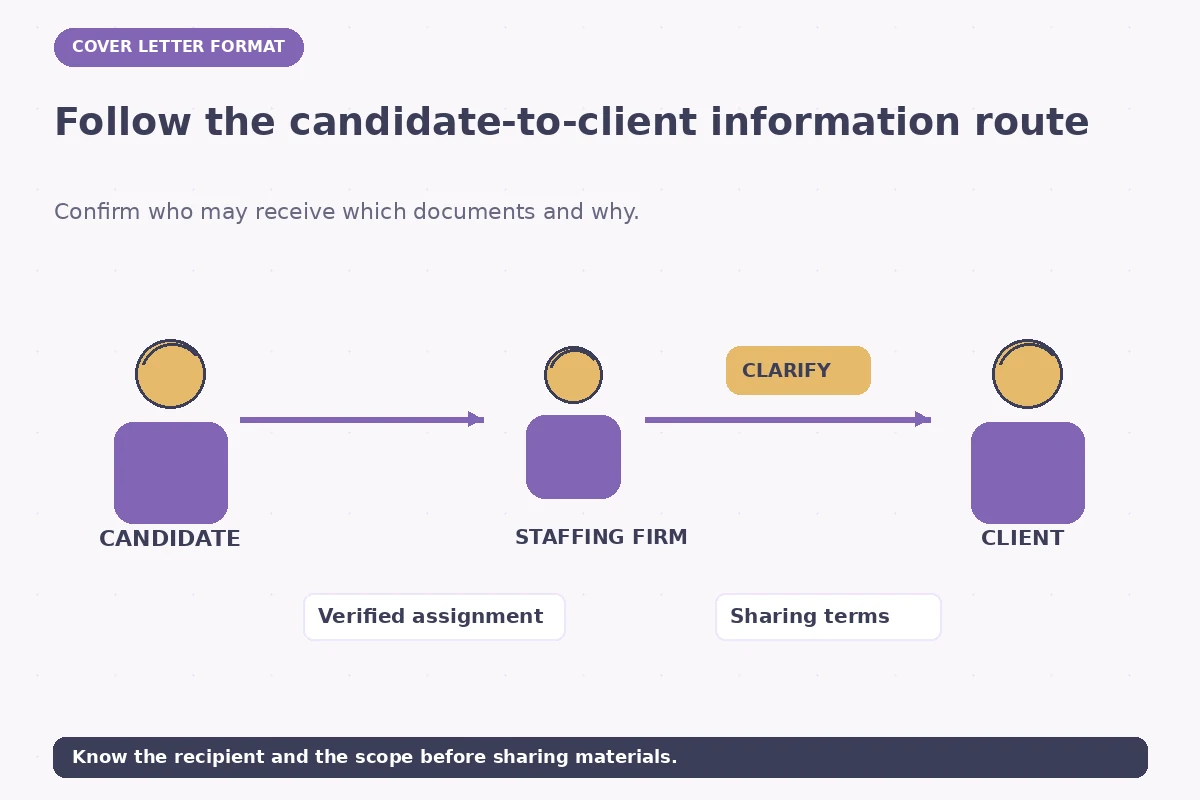
Separate Your Skills From the Client’s Approval Rules
Describe tasks you genuinely completed: logged incoming calls, checked purchase-order fields, documented service requests, organized inventory labels, or supported scheduled meetings. Choose only work that relates to the assignment. Do not present yourself as authorized to access a prospective client's confidential systems, approve financial transactions, operate restricted equipment or perform licensed duties simply because the listing mentions those responsibilities. Training, supervision and authorization depend on the actual assignment and employer policies.
Suppose the agency advertises data-entry support. An honest applicant might write, “I checked source records for missing fields in a supervised class project and noted items for correction.” This is different from “I managed a company's financial database,” which would be untrue for the same experience. The cover letter should help the recruiter judge whether you deserve a conversation; it should not silently certify skills or credentials that a client may verify later. If the role requires a qualification you do not have, ask about eligibility rather than implying it has been completed.
| Question | What to verify | Safer letter action |
|---|---|---|
| Recipient | Actual recruiter / agency | Do not guess end client |
| Assignment | Real reference and duties | Name exact advertised role |
| Candidate data | Who receives which materials | Clarify sharing process |
| Availability | Real dates and work site | State accurate limits |

Check Candidate Confidentiality and Submission Scope
Recruiters may need to share a resume or candidate profile with clients as part of placement. The American Staffing Association's search and placement ethics guidance identifies candidate confidentiality and the circumstances in which information may be shared as important issues to consider. The precise rules and policies depend on the agency and circumstances; do not assume a single universal permission rule. It is reasonable to clarify which role and client are involved, what documents will be shared, and how the recruiter plans to handle your information before authorizing a particular submission.
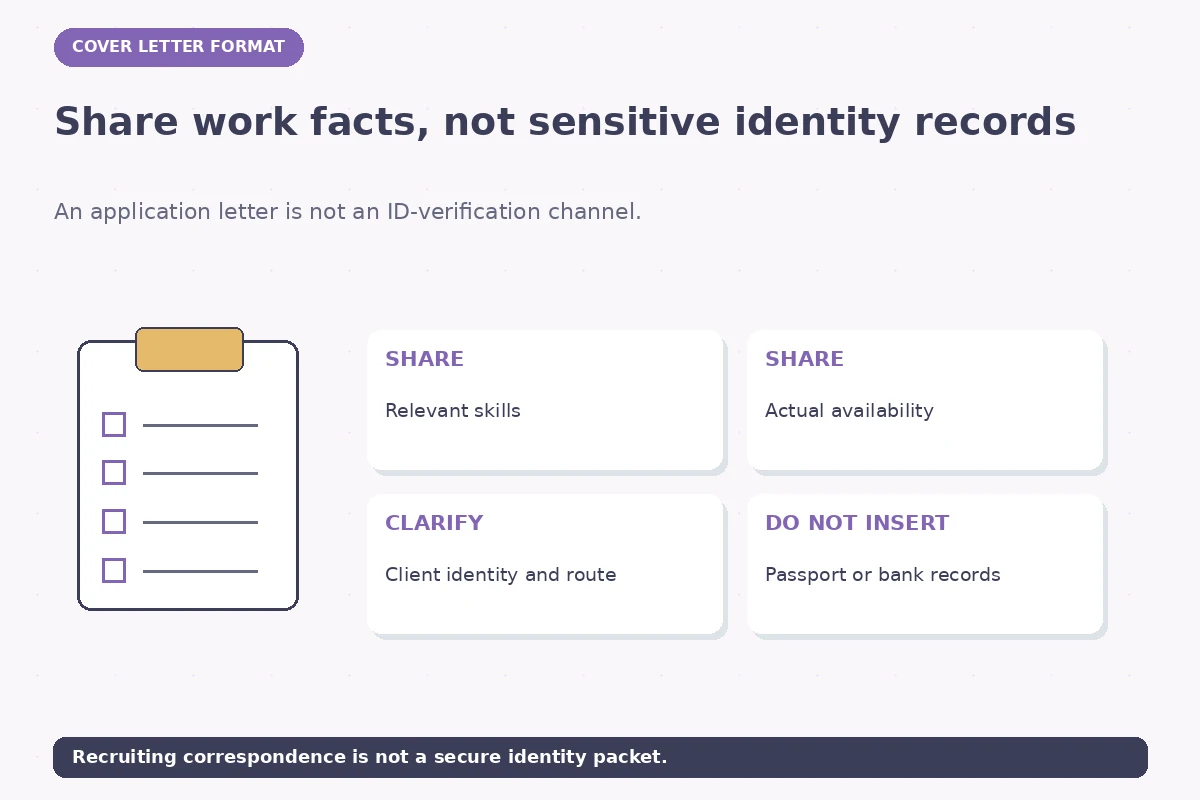
Do not add national ID numbers, bank details, scans of passports or private workplace files to a cover letter. The letter's purpose is to show suitability, not to serve as an identity-verification packet. Be accurate about your contact preferences, especially if you are currently employed and do not want a recruiter contacting your present workplace without a discussion. Where an agency explains its privacy and candidate-submission procedure, read that policy rather than relying on broad assumptions made from the assignment description.
Clarify Dates, Location and Work Arrangement
The letter can briefly state an accurate availability window if the agency asks for it. For example, “Available for weekday morning shifts from [real date]” is more actionable than “available immediately” when you need notice. If you are open to hybrid work only under certain conditions, say what you know and avoid promising commute or relocation arrangements you have not checked. The agency may be advertising several locations; do not assume they are interchangeable. Clarify the location and schedule through the recruiter or official listing.
Do not include a requested pay figure unless the employer has asked for it in the submission method, and do not invent a wage range to appear competitive. Avoid assigning yourself an employee classification or benefits status; temporary staffing, direct-hire placement and contracts can operate differently. The cover letter can ask for the assignment's duration and reporting relationship as questions, but should not declare facts the recruiter has not confirmed. Keep the most relevant verifiable work example in the middle paragraph.
Before Sending, Run a Two-Party Accuracy Check
Review the document as two connected relationships: you and the staffing agency, and the agency and the potential client. Is the agency named correctly? Is the assignment reference from a real listing? Have you accidentally named a client that has not been disclosed? Are your credential claims accurate? Does the letter contain a protected document or private client record that should never appear in recruiting correspondence? Remove material not needed to assess your fit and avoid posting a full identity packet in an ordinary email.
If the recruiter proposes sending your application to a specific end client, verify the details and permission expectations through the agency's actual process. Keep a private record of where you have authorized submission to avoid confusion with other agencies representing the same vacancy. Do not claim an interview, client approval or application receipt before it exists. A clean cover letter establishes relevance; the hiring and consent process is separate and may require additional communication.
How We Research and Maintain This Guide
This guide was reviewed against the linked U.S. university and professional career resources on 2026-11-13: American Staffing Association University of Maryland Career Center UC Berkeley Career Engagement University of Pennsylvania Career Services. Every template, role, organization and decision example is illustrative unless expressly attributed; adapt it to the actual employer instructions and your true experience. See the affiliate disclosure for relationship transparency. No hiring outcome or employer approval is implied.
More Resume and Cover Letter Guides
No. Follow the agency’s actual application instructions; some ask only for a resume, profile or screening form.
Address the agency contact or staffing team shown in the listing and use the verified assignment identifier.
Avoid guessing or revealing an unconfirmed end client. Ask the recruiter to clarify as appropriate.
Do not assume that. Read the agency process and clarify the role, recipient and information-sharing scope.
Not to an ordinary cover letter. Any later legitimate verification should follow the organization’s documented secure process.