
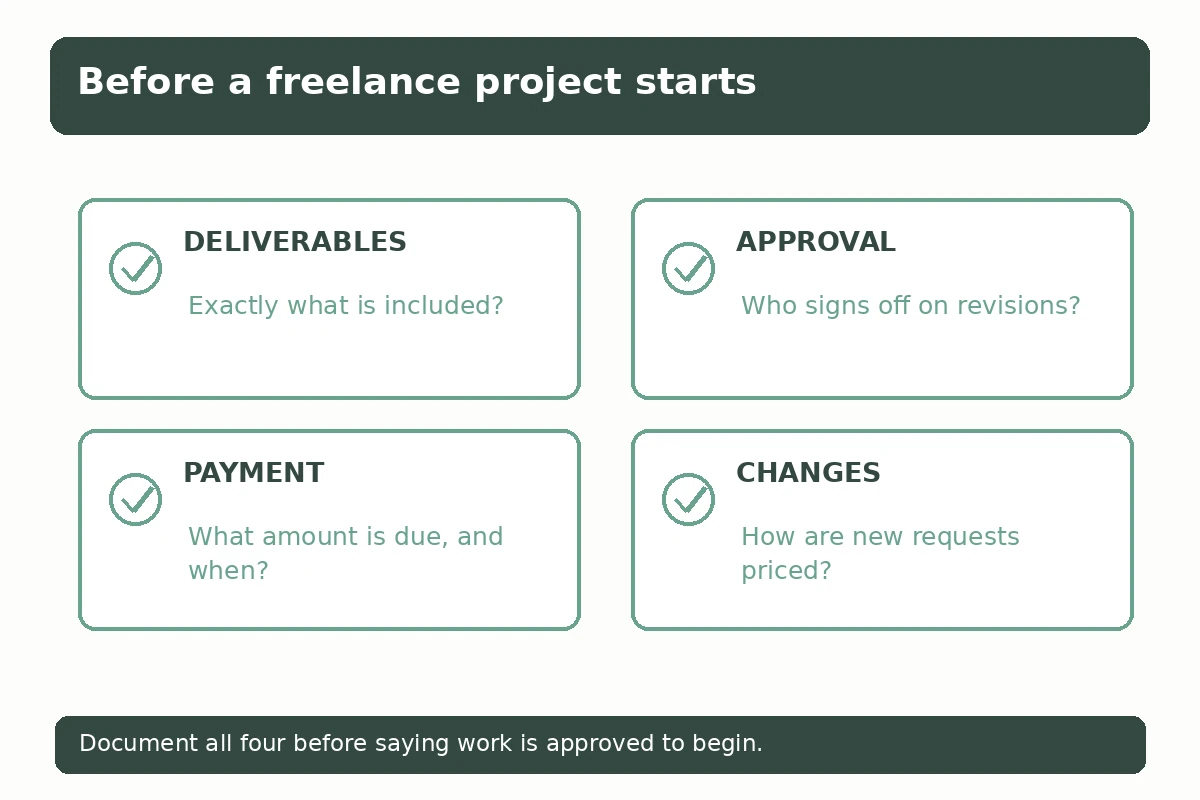
To accept a freelance project offer, first agree in writing on the services, deliverables, timeline, revision limits, ownership, approval contact and payment schedule. A quick ‘sounds good’ in chat can leave several important details unclear. Unlike a normal employee offer, a freelance assignment may be defined by a project contract and invoices; however, labeling somebody a contractor does not by itself decide their legal status. Verify the client and agree on how change requests will be priced before doing the work. This guide addresses the practical acceptance workflow, not individualized legal or tax advice.
Identify exactly what the client is asking you to deliver
Begin with an outcome the client can review: a short explainer video, a set of approved website pages or a technical editing pass on supplied documentation. Specify file formats, intended audience, inputs the client provides, and what is outside the project. Avoid accepting vague phrases like ‘manage all content’ without an expected volume or time frame. Freelancers Union’s contract creator provides fields for services and work dates. A concrete statement might say: ‘Edit three provided documents for style and clarity and return tracked changes in DOCX format.’ This is illustrative, not a quotation of an actual client agreement. Written specificity protects both parties when the project evolves.
Define the decision maker and review window
A project stalls when several stakeholders send conflicting feedback. Ask who will provide source material, who may request revisions and who gives final approval. Set a practical response window for review, but never invent an approval deadline the client has not accepted. If the client needs multiple departments to sign off, identify a single coordinating contact and how contradictory notes will be resolved. In creative or research work, access to source files and permissions matters as much as the deliverable itself. Do not use proprietary footage, confidential data or third-party content without appropriate permission. The offer should identify an accountable reviewer, not merely a generic team mailbox.
Write revision boundaries before you begin
A revision can mean fixing a typo or rebuilding a whole project. Define how many review rounds are included, what counts as a material scope change, and how additional work will be approved. The Freelancers Union contract tool includes revision and change language, which demonstrates why this issue belongs in the agreement. For example, clarify whether feedback on an approved video script can reopen the entire concept phase. Don’t assign arbitrary fees after the fact; agree on rates and approval rules beforehand. When the client changes requirements, summarize the proposed change, adjusted date and price, and wait for written authorization before doing the extra work.

Tie payment to a documented schedule
Know the fee, currency, invoicing contact, payment method and agreed timing before accepting. Depending on the project, the parties may use an upfront payment, milestone invoices or a final payment; there is no universal schedule. Define when a milestone is considered delivered and whether acceptance depends on review. The Freelancers Union payment guide recommends establishing payment terms in the contract and documenting scope changes. Do not infer that sending a file automatically triggers payment unless the agreement says so. If the client mentions an unusual transfer service or asks you to purchase equipment with a forwarded check, verify identity and stop: FTC materials describe this as a common scam pattern.
Clarify who owns what and what you can show later
Work samples may involve client logos, footage, internal reports or confidential information. Confirm whether the agreement assigns ownership of final deliverables, grants limited usage rights, or reserves particular tools or background materials to you. Ask whether and when you may show finished work in a portfolio. Do not upload sensitive project files to public sharing tools simply because the client has asked for a quick preview. Rights, confidentiality and termination provisions can have consequences; seek professional advice if the contract is complex. The goal is not to reproduce a one-size-fits-all copyright clause but to make the issue visible before both parties sign.
| Stage or party | Evidence or responsibility | Your next action |
|---|---|---|
| Scope | Deliverables, format, exclusions | Both parties agree |
| Review | Approval contact, rounds, changes | Client authorized reviewer |
| Payment | Invoice milestones and schedule | Documented agreement |

Do not confuse a freelance label with worker classification
The IRS explains that whether someone is an employee or independent contractor depends on factors including behavioral control, financial control and the relationship between the parties. A heading saying ‘freelancer’ or payment through an invoice is not conclusive. If the client expects fixed hours, extensive supervised training and control over how every task is done, ask questions rather than assuming the label settles the matter. This guide does not determine your status or tax duties. If the arrangement is ambiguous or significant, consult an appropriately qualified adviser. Document what the project actually involves and use accurate terminology in the agreement and invoicing records.
Use a short acceptance subject to the signed agreement
A practical hypothetical reply is: ‘Thank you for the proposal. I would be happy to take on the three-page editing project on the scope, review rounds, timeline and fee listed in our agreement. Please send the final contract for both parties to review and sign before work begins.’ When the contract is already fully agreed and signed, a shorter note can confirm kickoff and next deliverables. Do not call a casual inquiry a binding contract if essential terms remain unresolved. Avoid sending tax identification numbers or bank details to unverified contacts in chat. A professional yes identifies the agreed document and the next authorized action.
Verify a remote client independently
Look up the company through an independently reached website, confirm the business contact and be cautious about pressure to act immediately. The FTC warns about fake recruiters who request bank information, send fake checks or demand equipment payments. A sophisticated-looking contract template and video call are not proof the client is legitimate. Ask for a company name, authorized contracting contact and reliable payment channel. If the project would involve access to sensitive records, insist on approved data handling and permissions. A client who refuses to define the work or verify their identity is not a reason to lower your safeguards because the promised fee sounds attractive.
Build a kickoff checklist that follows the contract
After signing, summarize project goals, source materials needed, the first milestone, feedback owner, agreed communication channel and invoice contact. Set a reasonable date for a kickoff call or document exchange if one is needed. Track changes to scope using the process in the contract rather than informal messages scattered across several platforms. Avoid starting billable work on verbal promises when the agreement explicitly requires written approval. Do not deliver final source files before the agreed stage without understanding the ownership and payment arrangement. Organized kickoff records make it easier to distinguish a delay caused by missing client assets from a change you agreed to perform.
Close with a delivery and acceptance record
When you submit a milestone, include the file names, what was completed, what remains, and where the client should send approved feedback. If the contract has a defined review period, use it; otherwise request confirmation without inventing an automatic acceptance rule. Track invoices and receipts separately from design files or source documents. If the client requests new tasks at the finish line, quote the additional work under the change process before proceeding. A successful freelance acceptance is not merely a yes on day one. It is a shared and documented understanding of the project, its boundaries, the people authorized to approve it, and how payment is handled.
How We Research Job Offer Acceptance
JobAsk reviewed these sources on November 16, 2026: Freelancers Union contract creator lists scope, milestones, payment, revisions, ownership and cancellation clauses. Freelancers Union emphasizes written scope, payment terms, and signed changes to freelance projects. IRS explains that worker classification depends on actual control and relationship, not contract label alone. FTC advises verifying employers and avoiding advance-fee and equipment-check scams. We checked the distinct user question against the supplied WordPress post inventory and searched for competing information. Public search cannot verify that a private WordPress slug is unused. Examples are hypothetical, not legal advice; organizational policies, local requirements and individual contract terms control. We do not invent employer terms, approvals, guaranteed outcomes or payments. See our affiliate disclosure.
Related Workplace Guides
Not necessarily. It can be a contract for services rather than employment. Worker classification depends on facts and applicable rules.
Review the material terms first. If agreeing in principle, say clearly that the final decision awaits a written agreement.
Clarify what is included, how changes are authorized, and how additional work will be priced.
Only as permitted by applicable agreements and rights. Seek explicit permission for confidential or restricted work.
Treat advance-fee and fake-check requests as warning signs. Independently verify the client and avoid sending money to secure work.