
A team lead resume summary should answer two questions immediately: what team activity did you coordinate, and what authority were you actually given? “Team lead” can mean peer coaching, shift coverage, quality review or formal supervision depending on the employer. Confusing these levels makes the top of a resume harder to trust, especially when it implies hiring, payroll or policy decisions that belonged to a manager.
Use specific evidence from shift handoffs, documented coaching, workload routing or escalation logs. A lead who trained coworkers and kept a service queue organized can show strong value without claiming to set company policy. The goal is a short opening connected to your real responsibilities, with the fuller examples and dates in the experience section.
Locate Your Role on the Leadership Ladder
Separate helping a peer, coordinating a shift, assigning tasks within delegated limits and formally supervising employees. These may all occur in one workplace, but they carry different responsibilities. If you gave new employees a walkthrough, say you trained or coached them. If you prepared coverage options for a supervisor to approve, say you coordinated rather than independently set staffing policy.
Look for evidence: a training checklist you prepared, a shift handoff template, a routing procedure, or a supervisor-approved coverage schedule. Keep confidential employee information private. A summary does not need personal staff performance details, disciplinary records or individual customer stories to demonstrate leadership. State the function and the level of accountability instead.
Build a Leadership Summary Without Hyperbole
A hypothetical summary for a lead with shift coordination experience: “Team lead experienced in coaching new coworkers, coordinating daily coverage and tracking open issues for manager escalation. Helped maintain clear shift handoffs and supported quality checks within established procedures.” This gives a manager enough specifics to ask how the coordination worked and what authority was delegated.
Contrast “visionary executive who directed every team decision.” Unless the candidate truly held executive duties, that phrase adds risk and no evidence. If your official title was senior associate, retain that title in the chronology and make the leadership function visible through actual examples. A resume opening should not transform helpful peer behavior into a fabricated promotion.

Describe Coaching, Coverage and Escalation Results
Coaching evidence might be an updated onboarding checklist, a reviewed training example or a documented handoff that made responsibilities clearer. Coverage evidence might be a shift plan you coordinated with assigned staff. Escalation evidence might be the process you used to identify blocked cases and connect them with an authorized manager. All three can be explained without inventing a productivity improvement percentage.
When citing a measurement, distinguish your work from team outcomes. If the team met a quality goal, your documented contribution might have been checking records and flagging exceptions. Unless you can establish your role in the outcome, do not claim to have personally caused the entire improvement. Likewise, “resolved escalations” should not imply you had authority to refund customers, discipline staff or override safety instructions.
| Leadership activity | Verifiable trace | Authority limit |
|---|---|---|
| New-hire coaching | Training checklist | Not formal HR evaluation |
| Shift coverage | Reviewed staffing plan | Manager may approve hours |
| Issue triage | Escalation notes | Policy decision stays assigned |
Adapt the Opening to the Team Environment
A warehouse or retail lead may emphasize coverage, safety handoffs and accurate task routing. A customer support lead may emphasize coaching, case triage and correct escalation of policy questions. An office team lead may emphasize records, deadlines and service continuity. Compare the role description with your history and select the tasks that genuinely overlap, not every leadership skill imaginable.
If a position requires direct people management, do not hide the distinction between supervising and supporting. The summary can still be a compelling fit if it openly says “coordinated shift work under supervisor direction.” If you did supervise, clarify the size and character of your responsibility only when the information is accurate and disclosable. The work history must substantiate whichever level you claim.

Run the Ownership and Accuracy Checklist
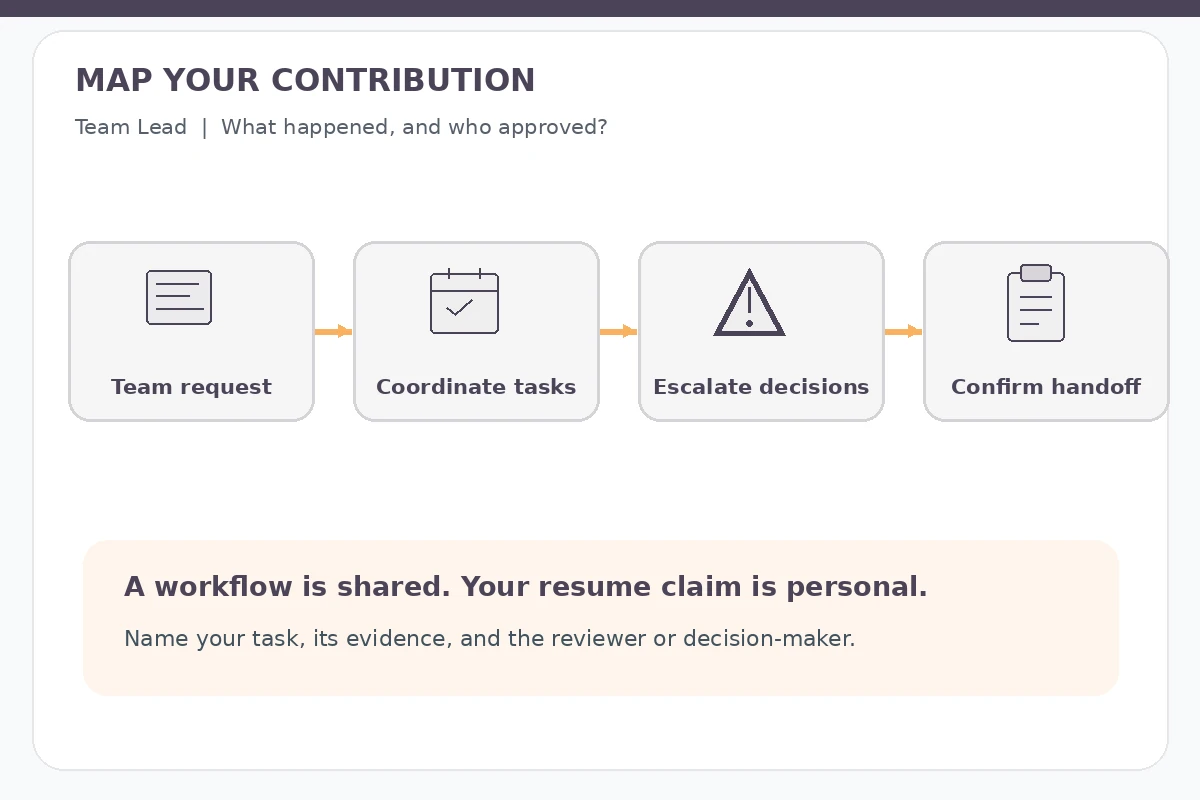
For each line, ask: Who assigned the task? Who made the final decision? What did I document? What happened if the situation exceeded my limits? This sequence prevents a summary from confusing initiative with unapproved authority. Avoid listing disciplinary action, payroll approval or policy enforcement if you only relayed information to the relevant manager.
Look for inconsistencies between job titles, dates, summary and experience bullets. If “supervised scheduling” appears in the opening but the supporting bullet says “submitted schedule suggestions for approval,” replace the opener with “coordinated coverage requests.” A precise description is more persuasive than a broader one you cannot defend in an interview.
Worked Example: A Coverage Gap at Shift Change
Consider a fictional service desk where one employee calls out shortly before the evening handoff. The lead checks the approved coverage roster, asks available coworkers about permitted swaps, documents the uncovered time and sends two options to the supervisor. The supervisor approves a revised schedule, and the lead updates the handoff notes so incoming staff know who is handling the remaining work. The useful leadership evidence is accurate coordination and communication; it does not prove that the lead controlled payroll or staffing policy.
A resume summary for someone who actually performed that work could mention “coordinated coverage options and documented supervisor-approved shift handoffs.” A supporting bullet might describe the procedure for notifying the next shift without naming employees or including confidential absence details. If the person only offered to help a colleague once, that may be a good behavioral interview example but not strong proof of a recurring formal leadership role. The summary should reflect the pattern and scope of responsibility, not the most flattering possible title. A hiring manager can then ask for concrete handoff examples, and the candidate can explain how options were documented, who reviewed them and how coworkers learned the final decision. This makes an interview discussion more informative than a broad claim of leadership without a traceable situation.
How We Research and Verify the Examples
This U.S.-focused article was checked on 2026-11-14 against the following reference materials: Career Center resume guide (UC San Diego provides guidance for concise, evidence-focused summaries). Occupational or technical source (O*NET distinguishes supervision, complex problem guidance and oversight). Occupational or technical source (BLS describes coordination and leadership in administrative operations as a related comparison). All sample summaries are hypothetical demonstrations, not records of real applicants, employers, projects or employment outcomes. Practices vary by employer; verify actual role definitions, confidentiality rules and approval rights. No salary, applicant tracking score or hiring outcome is guaranteed. See our affiliate disclosure.
More Resume and Cover Letter Guides
Only if your actual duties included supervision. Otherwise state that you coordinated or supported assigned shift activities.
One that names coaching, coverage and escalation tasks you performed and identifies approval limits when they matter.
Only with reliable evidence and accurate attribution. Do not present a team result as an individual achievement without support.
Not automatically. Training is valuable leadership evidence but does not itself establish managerial authority.
Use a verified team size when relevant and appropriate; distinguish those you helped coordinate from staff who formally reported to you.