
An investment banking resume template works best when the reader can immediately distinguish finance coursework, independently completed analytical projects, and tasks performed within a bank or advisory team. Put the most relevant proven experience first. Name the financial tools or modeling approach only when you can describe how you used them and what checks you performed. The example layout below is a starting point, not a credential, interview guarantee, or evidence that you worked on a completed transaction.
Investment banking recruiting may involve analyst internships, finance-related full-time roles, or experienced candidates changing teams. Your section order can reflect that difference. The U.S. Bureau of Labor Statistics describes related financial analysis work as reviewing information, building forecasts and preparing reports; that occupation profile does not imply every candidate has participated in mergers, client negotiations or investment recommendations. A resume should make the boundary between analysis, review and final decisions unmistakable.
Choose Section Order for Your Actual Experience
For a student without a banking internship, a clear order is contact information, education, relevant technical projects, work or leadership, and skills. Education can lead because it explains coursework that the target program values. For an experienced analyst with substantive professional work, start with experience and move education farther down. Keep familiar labels such as Education, Experience, Projects and Skills, and use the same date format throughout. Avoid squeezing a large list of finance courses into the top third if the target role instead needs evidence of execution and review.
A hypothetical applicant with a classroom valuation assignment might use “Selected Finance Projects” rather than “Investment Banking Experience.” That heading tells the reader exactly what kind of work follows. Distinguish an employer and title from a school project; list group work under its true course or organization. Make the section relevant to the posting without concealing the real dates, student status or responsibility level. A plausible-looking template cannot turn class work into a bank internship.

Describe Financial Models With an Input-Check-Output Chain
The most useful modeling bullet contains the task, source material, analytical method and your contribution. A hypothetical example is: “Built a three-statement classroom forecast from publicly available filings; reconciled historical assumptions and documented sensitivity cases for instructor review.” This is stronger than “Expert in financial modeling” because it specifies how the evidence was made. You can name Excel, financial statements, discounted cash flow or comparable-company analysis only if you can explain the assumptions and your actual involvement.
The same reasoning applies to charts, presentations and market research. If you summarized public filings, say so; if a supervisor provided a dataset or model, distinguish your edits from the team’s approved version. Never invent an enterprise valuation, client revenue, deal size, accuracy percentage or investment return. When confidentiality prevents detail, describe an authorized task at the correct level of generality, without exposing client identities, material nonpublic information or internal materials.

Separate Transaction Exposure From Transaction Ownership
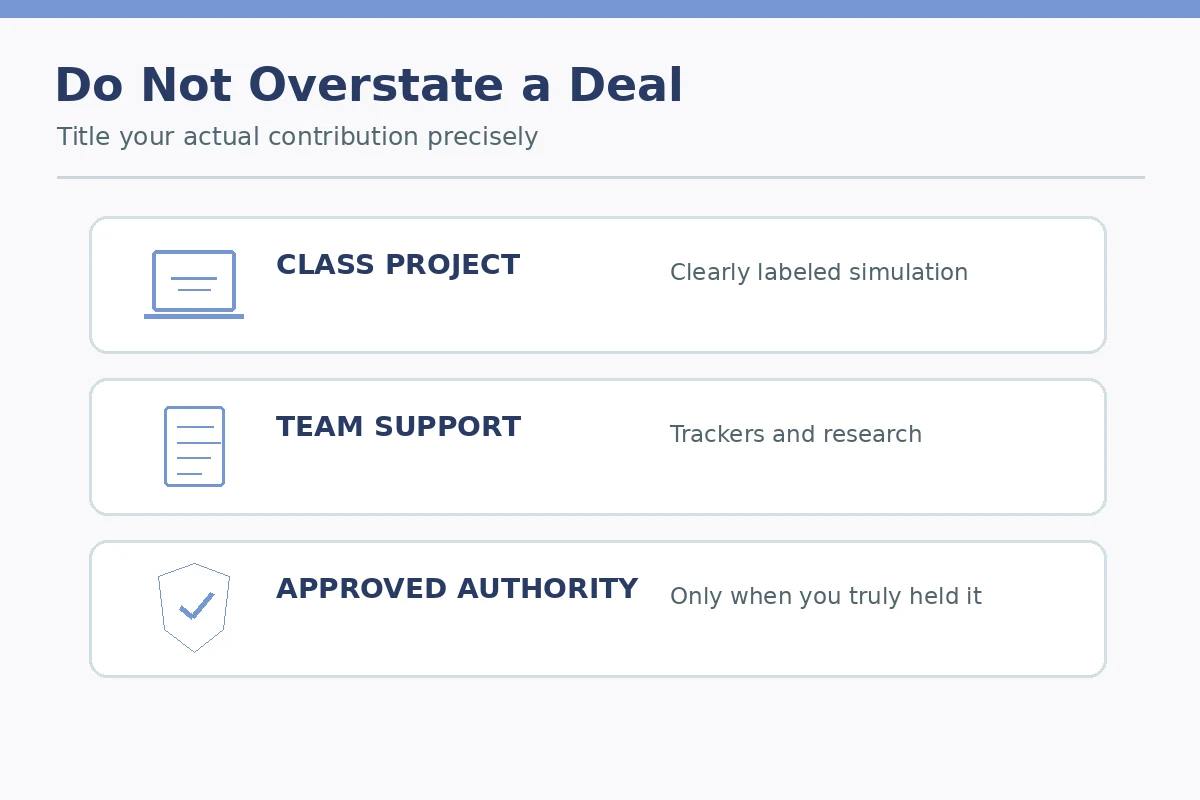
Words such as “closed,” “led,” “priced” and “advised” can suggest authority the candidate did not have. A bank intern who prepared diligence notes or updated a tracking workbook should say that rather than implying they negotiated a merger. Consider three evidence tiers: classroom simulation, supervised client-facing support and accountable decision-making. Each tier may be valuable, but the reader should be able to tell which one applies. Verify any permission to mention deal names, confidential counterparties or working papers before including them.
A practical test is to ask: What was my deliverable? Who checked it? What part of the financial conclusion did I personally control? If you cannot answer these questions, rewrite the bullet at a narrower scope. “Supported a team presentation by checking comparable-company data against dated source documents” can be accurate where “Led transaction valuation” would be false. A project that stopped at research or a practice pitch should not be presented as a completed transaction.
| Evidence or document | What to show | Claim to avoid |
|---|---|---|
| Class valuation project | Name course and sources | No client or closed-deal claim |
| Intern diligence support | Show specific permitted deliverables | No independent advisory authority |
| Analyst presentation draft | Identify the evidence and review | No unverified transaction outcome |
Use a Focused One-Page Working Layout
Many entry-level industry applications benefit from a tightly edited page, but the employer’s instructions always take priority. Use high-contrast text, consistent headings, readable spacing and straightforward bullets. Put employer, role, location if relevant and dates in a format that is easy to scan. The bullet should explain what changed or what you produced rather than merely listing software. The example template can be copied into Word or another text editor without needing graphics, progress bars or fabricated firm logos.
Sample order: Name and contact; Education; Investment or Finance Experience; Selected Valuation Projects; Leadership or Other Experience; Technical Skills. Under Selected Projects, identify the course or independent setting explicitly. If you have substantial work experience, lead with that instead. Keep file names professional and follow the requested PDF or DOCX format. Test the final export by selecting and copying text; if headings and dates become scrambled, simplify the layout before submission.
Audit Every Claim Against a Defensible Source
Before sending, compare each bullet with a project record, source workbook, approved presentation or supervisor feedback you are allowed to discuss. Check spelling of financial concepts, dates, employer names and degree status. “Completed” should mean completed, “present” should mean ongoing, and a model’s assumptions should not masquerade as a real forecast adopted by a client. A peer reviewer can catch missing context, but the candidate remains responsible for the factual truth of each claim.
Use a final reader check: Can the first screen tell whether this person is a student, intern or experienced hire? Does every technical phrase have a specific example? Is any client information private? If the answer to a key question is unclear, revise before applying. A narrow, accurate claim is more credible and more useful than a vague claim of exceptional impact.
Two Illustrative Cases and What They Prove
Hypothetical case: A finance student produced a discounted-cash-flow worksheet for a class and presented sensitivity scenarios. The appropriate section is “Selected Projects,” with the actual school context and public data sources; it is not “M&A Advisory Experience.” The resume can discuss the student’s assumptions and checks without inventing real transaction participation.
Hypothetical case: An intern maintained a diligence request tracker and checked public-company comparables under team supervision. The resume may describe that authorized support work if confidentiality rules permit. It should not identify undisclosed clients or claim the intern approved pricing, made an investment recommendation or closed a deal.
How We Research and Verify Resume Advice
This article was prepared using primary occupational, documentation, and university career resources checked on 2026-11-14. The www.bls.gov source supports the Bureau of Labor Statistics describes financial analysts as evaluating financial information, forecasts and written reports. The careercenter.tamu.edu source supports texas A&M Career Center distinguishes concise industry resumes from longer academic CVs. The career.berkeley.edu source supports uC Berkeley Career Engagement provides resume writing guidance for tailoring experience to an opportunity. Examples above are hypothetical and must be replaced with your own verifiable dates, duties, permissions, and results. Our editorial purpose is to explain format choices rather than promise a hiring outcome or automated screening acceptance. Read the JobAsk affiliate disclosure for editorial transparency.
More Resume and Cover Letter Guides
For many early-career industry applications a concise page is practical, but follow the actual employer instructions and include enough evidence to explain relevant experience.
Yes, if you label it as coursework or a personal project and can explain the sources, method, assumptions and your contribution.
Use only descriptions permitted by your employer or client, without naming restricted counterparties or disclosing private numbers or materials.
Include it when required or when it strengthens the application and is accurate; do not invent or round a result misleadingly.
Use precise verbs such as researched, checked, prepared or supported and identify where review or final authority sat.