
A former coworker can be a useful professional reference when they directly observed your work and the employer accepts peer references. The coworker should say they were your teammate, not claim to be your manager. Strong peer evidence often covers collaboration, dependable handoffs, quality of shared deliverables, and how you responded when work changed. It cannot responsibly replace private management evaluations or prove that you held authority you never had. Before sharing a person’s contact information, ask permission, clarify the actual relationship, and check the job application’s rules.
Check whether the employer accepts peer references
Read the application request before choosing names. ‘Professional reference’ may permit a former colleague, project partner, or client who observed your performance. ‘Direct supervisor for the last two employers’ is a different and more restrictive request. Do not submit a peer with the label ‘manager’ to bypass a requirement. If you lack an accessible supervisor, tell the recruiter which references you can provide and ask whether they will accept a peer alongside other evidence.
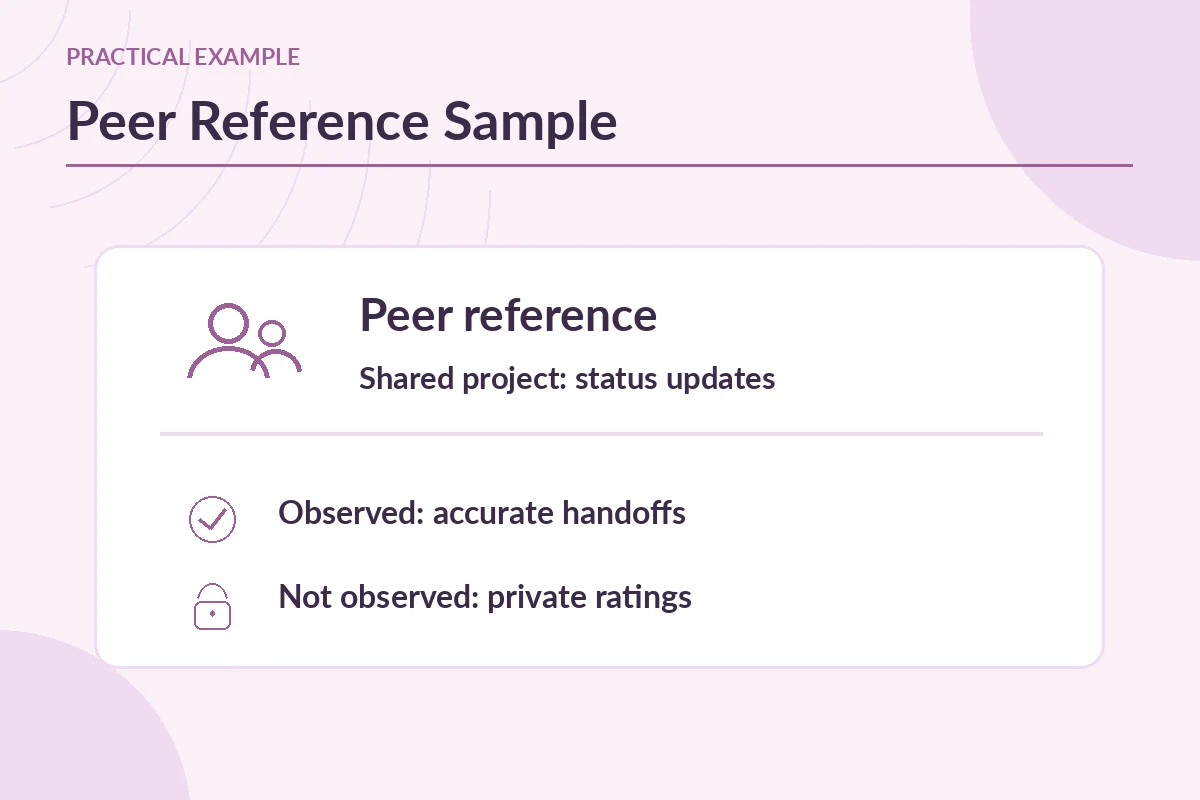
A peer reference is not universally better or worse than a manager reference. It provides a distinct view of your working methods. A coworker may speak with precision about a shared release, schedule, customer-service process, or project handoff; they may not know your private performance rating. The usefulness depends on the role, what the coworker saw, and what the hiring team needs to verify.

Select a peer who worked beside you on a real task
Prefer a former teammate who can name a shared deliverable and explain your individual contribution. If you only shared an office but never collaborated, that person may offer little beyond friendliness. A strong choice might have reviewed your code, coordinated shift coverage with you, co-authored a report, or handled a documented client handoff. The reference must not disclose confidential customer data or internal records to prove these points.
Consider whether a coworker has the incentive and ability to be impartial. A close personal friend may sound enthusiastic but lack specific professional observations. A former team member with a bounded, direct working relationship often offers stronger evidence. If the person is still at your current employer, consider confidentiality risks before making any request.
Describe the peer relationship without title inflation
A clear relationship label might say ‘Former teammate, customer-support operations team, 2022–2024’ or ‘Project collaborator on an internal reporting tool.’ These are hypothetical formats; use your real time period and position. Don’t introduce your colleague as a team lead because they once coordinated a meeting. If the person later became a manager elsewhere, list their current role separately from the peer relationship that lets them evaluate your earlier work.
Job references are not job referrals. A referral usually introduces a candidate to an opening, while a reference responds to a hiring team’s questions about actual performance. A coworker can sometimes do both, but those are separate acts requiring different context and consent. Avoid making the relationship sound more formal than it was.
Give examples the coworker can truly confirm
For a team project, organize a reminder note around ‘shared task, what I owned, what we both observed, and which result is documented.’ If your coworker saw you identify data inconsistencies and notify an analyst, they can discuss that action. They should not say you independently approved financial adjustments or led the entire project unless they actually know it is true. Keep personal estimates and team-wide outcomes distinct from individual work.
A short hypothetical peer observation might be: ‘We coordinated weekly shipment status updates. She checked missing fields and brought unresolved cases to the supervisor.’ That is concrete and limited. The peer cannot infer your attendance record or personnel-file evaluations from it. It is acceptable for a reference to say ‘I did not supervise them’ and then speak to the work they did observe.
Ask for consent and independence
You can write: ‘We worked together on [real shared work]. Would you be comfortable acting as a peer professional reference for a [role title] application? I would describe you as a former teammate and only share your contact details with your permission.’ Invite the person to decline or suggest a narrower description. Send the job posting so they understand which parts of your collaboration might be relevant.
Don’t draft an enthusiastic recommendation and ask them to repeat it unchanged. The reference belongs to the person giving it. They should be able to describe weaknesses as well as strengths honestly if asked, within their direct knowledge and organizational rules. An accurate, modest assessment is more trustworthy than a generic promise of excellence.
Build a balanced list if the employer requests several people
If the employer wants a manager and two additional contacts, a peer could complement a past supervisor and an internship mentor. The people should have different, relevant perspectives rather than overlapping as three friends. When a hiring form specifically demands a manager, do not assume a coworker alone resolves it. Ask for an exception or clarification before submission.
Use a small separate reference list with name, current role, former working relationship, and approved contact information. If a peer is no longer at the organization where you collaborated, identify that past workplace clearly. Verify their address rather than copying stale contact details from a shared roster.

Protect confidential projects while giving practical context
Many peer references are strongest because they know how the work happened, but that creates a risk of sharing private details. Use generalized project types and public responsibilities in the background note. Never attach unapproved client records, employee performance files, medical details, or confidential customer incidents as proof. The coworker should be able to discuss workplace behavior without forwarding internal material.
When a prospective employer asks a peer about an item outside their knowledge, the responsible answer is ‘I can’t verify that.’ A strong reference is not obligated to fill every gap. For claims about direct reports, discipline, or pay decisions, a designated former supervisor or authorized office may be a more appropriate source.
Prepare for questions about why no manager was listed
Do not automatically treat the question as an accusation. A truthful explanation may be that the manager retired, the workplace closed, the search is confidential, or the peer worked most closely with you on the relevant project. State the actual reason without disparaging your prior employer. Offer an alternate supervisor or verification method where available, and let the employer decide which combination meets its requirements.
Once a call may happen, update your peer with the role and timing. Thank them afterward. Do not list them indefinitely without checking whether their willingness remains current. Accurate boundaries give an employer useful evidence and protect both you and the person who agreed to speak.
How We Research Professional Reference Advice
We checked guidance from ocs.yale.edu; hr.cornell.edu; careercenter.ucdavis.edu; careerservices.cns.utexas.edu about selecting people who observed real work, requesting permission, describing professional relationships accurately, and limiting claims to what a reference can genuinely know. The sources describe general career practices rather than rules at every employer. Example names and events here are hypothetical and do not represent an actual reference check, legal conclusion, or hiring outcome. Follow the instructions of the specific hiring organization and use only approved contact information. For commercial relationships and links, review our affiliate disclosure.
More Resume and Cover Letter Guides
Sometimes a hiring team accepts peers, but an explicit direct-supervisor requirement may call for a separate person or recruiter clarification.
Shared projects, observed collaboration, reliable handoffs, and concrete tasks that person directly witnessed.
Choose someone with real work-based knowledge and disclose the professional relationship accurately. Friendship alone is not a performance reference.
No. They should comment within their own observations, not claim access to management or HR records.
Include their current professional contact details and identify your former teammate relationship and the past workplace.