
In a cashier interview, “Tell me about yourself” is an opportunity to explain how you treat customers, handle accurate transactions and follow store procedures. Begin with relevant work or transferable experience, give one specific example, and connect it to the cashier position. If you have never operated a register, say that plainly and use a truthful example of careful handling, service or learning an approved process instead of pretending to have point-of-sale experience.
Read the register and service duties in the posting
Cashier jobs vary by store. A grocery register, cafeteria checkout and retail returns counter can involve different workflows, age-verification rules, account systems and shift arrangements. The Bureau of Labor Statistics identifies common duties such as greeting shoppers, scanning purchases, processing payments, answering questions and counting a register. Choose the duties in the actual vacancy that you understand or have practiced; do not assume the employer uses your previous register or return policy.
A good opening shows that you can perform your own part of the work while respecting store procedures. If the role requires handling a discrepancy, explain that you would follow the posted process and ask the authorized supervisor when needed. Do not say you will override payment controls, decide on exceptions or give refunds without permission. Showing that you understand where to escalate is a practical strength, not a weakness.
Choose a real example of accuracy under routine pressure
Think about a time you checked details while people were waiting. You might have scanned items carefully, verified that a price displayed as expected, organized change or noticed that a receipt did not match a transaction. The point is not speed at any cost. Explain what you did to avoid a preventable error and what happened next, including whether you called for assistance.
If you have no cashier work history, choose a different verified example: carefully counting materials at a school event, following a checkout checklist as a volunteer or updating a simple inventory list. Label the context accurately. A school fundraiser does not make you an experienced retail cashier, but it can demonstrate that you can follow steps, communicate and learn systems. Never claim you handled regulated transactions if you did not.
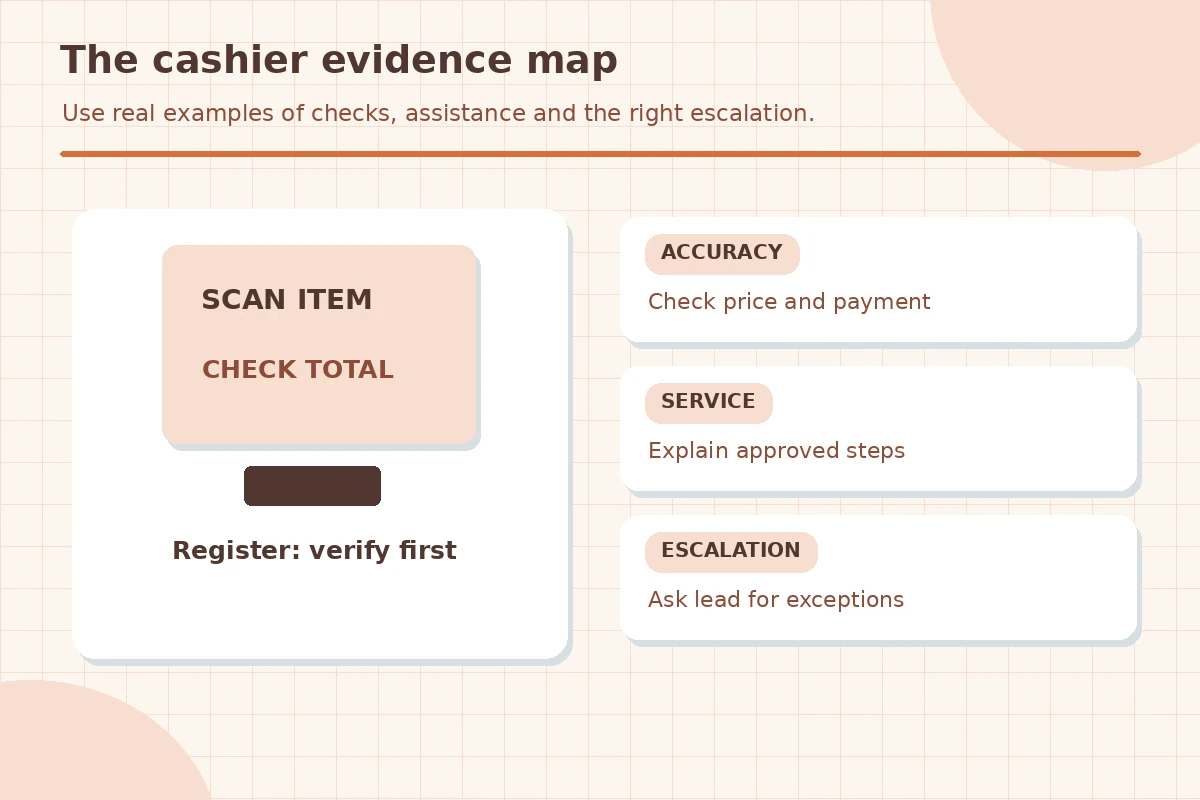
Put customer assistance alongside transaction control
A friendly manner matters, but it should not replace accurate procedures. You might say, “I answered shoppers’ basic questions and checked with a lead when a return required approval.” This joins courteous service with a clear authority boundary. If a customer is frustrated, explain that you listen, confirm the issue and follow the store’s escalation route rather than promising an exception you cannot grant.
Avoid empty phrases such as “I always make everyone happy.” Customers can leave disappointed even when a staff member follows a fair and correct rule. Employers can assess an answer more easily when you describe how you remain respectful and how you verify a policy. Speak about actual behavior, not guaranteed satisfaction scores that were never measured.
Make a first-job introduction without inventing work
For an applicant without paid experience, a useful shape is: relevant strength, truthful task example, reason for applying. For instance, “I am looking for my first retail job. In a school volunteer activity, I helped organize supply counts and answered visitor questions, and I learned to check information instead of guessing. I would like to bring that careful approach to a cashier role and learn your register procedures.” This is a hypothetical model, not a claimed personal history.
Do not apologize for having no register record. It is reasonable to discuss how you learn a new procedure, ask questions early and check your work. But avoid saying you can process payments unsupervised on day one if you have not been trained. Mention a genuinely available schedule if the interviewer asks; your availability is not evidence of past cashier skills, though it may be relevant to the employer’s operational needs.

Explain register discrepancies without blaming customers
A cashier may notice a mismatch between the displayed amount and a shelf label, a barcode that will not scan, or a payment that does not complete. Your introduction does not need a full technical explanation, but a brief mention of checking the information and asking the right colleague shows practical judgment. Do not describe bypassing a payment warning or guessing a price to keep the line moving.
If you have done cash reconciliation, distinguish counting assigned funds from approving final store accounting. “Counted the till with the closing checklist and reported a discrepancy” is a defensible description when true. “Managed store finances” is much broader and likely misleading. The interviewer may ask about your routine; be ready to describe your real shift responsibilities without naming private customer or account details.
| Role need | Useful real example | Do not claim |
|---|---|---|
| Accurate checkout | Checked item and payment details | Never made an error |
| Customer service | Answered questions and escalated exceptions | Approved every refund |
| Shift reliability | Followed opening and closing steps | Managed the entire store |
Keep the answer short and easy to follow
A cashier introduction should usually be an opening rather than a full chronological biography. Start with one line about your recent relevant work, one concrete example of accurate and respectful service, and one sentence connecting those abilities to the position. If you are changing fields, explain the transferable task instead of forcing a connection through inflated numbers. CareerOneStop advises practicing honest examples aloud so they sound natural.
Record yourself once if that helps, then listen for jargon or repeated adjectives. You do not need an exact rehearsed speech, and the interviewer might request a shorter version. Replace “I am a perfectionist and a people person” with “I check each step and ask for help with an exception.” The latter is a process an employer can explore with follow-up questions.
Edit a sample answer for your own experience
Illustrative answer for someone who has worked retail: “I have worked in customer-facing store support, where I greeted shoppers and helped keep checkout areas organized. When a transaction detail looked wrong, I checked the information and involved the lead rather than guessing. I value accurate, respectful service, and this cashier position appeals to me because it combines customer contact with dependable store routines.” Replace every statement with something you can substantiate.
Before speaking, check four details: were you really responsible for payments, did you follow an approved process, how were exceptions handled, and which task is especially relevant to the new job? If an example includes an age-restricted sale, do not describe evading identification requirements or inventing an approval. A strong introduction invites questions about your actual work, not impossible promises.

How We Research and Verify Interview Guidance
JobAsk compared this role-specific question with the user-provided WordPress inventory, original content queue, relevant public search results and US occupational and career guidance on November 7, 2026. The sample responses are hypothetical writing models, not employee testimony or promised hiring outcomes. Follow the employer’s current instructions, describe your own verified experience and see our affiliate disclosure.
Source: cloudfront.careeronestop.org — CareerOneStop recommends researching the job and employer, practicing truthful examples aloud and asking informed questions.
Source: careerservices.fas.harvard.edu — Harvard career guidance describes a brief, job-relevant introduction with background, current strengths and a next-step connection.
Source: www.bls.gov — BLS describes transaction accuracy, point-of-sale systems, customer assistance and register procedures.
More Interview Preparation Guides
Use a truthful school, volunteer or other service example and explain your willingness to learn the employer’s register process.
Only if you can support it with an actual task. Accuracy checks and following procedures are more useful than a vague claim.
Usually only briefly. Save a detailed story for a behavioral follow-up and keep personal details private.
No. Returns, overrides and exceptions depend on the employer’s policies and authorized staff.
Choose one or two job-relevant examples, not every role or shift you have held.