
In a fashion designer interview, “Tell me about yourself” should connect your creative direction to a real piece of work: the intended wearer, the sketch or technical task you performed, the sample or fit feedback you used, and the team you worked with. Avoid saying that you “launched a collection” if your contribution was research, illustration, or sample tracking. The best opening makes your design perspective and production awareness visible in about a minute.
Open with product and customer, not a list of aesthetics
An introduction like “I have always loved fashion” can be genuine, but it does not establish job fit. Identify the category you have actually worked on, such as casual apparel, accessories, costume pieces, or fit-related sample coordination. Then say what problem you tried to solve: comfort, construction clarity, cost-aware material choices, or a coherent range for a defined wearer. Do not invent sales results or claim a commercial collection if you only completed a class assignment.
A candidate for an assistant designer role might emphasize sketches, range boards, and change tracking. Someone interviewing for a product-development position might instead lead with technical communication and sample comments. Read the exact posting before choosing the evidence. There is no single “fashion designer” story that works for every part of the apparel process.
Use one garment to show your actual work
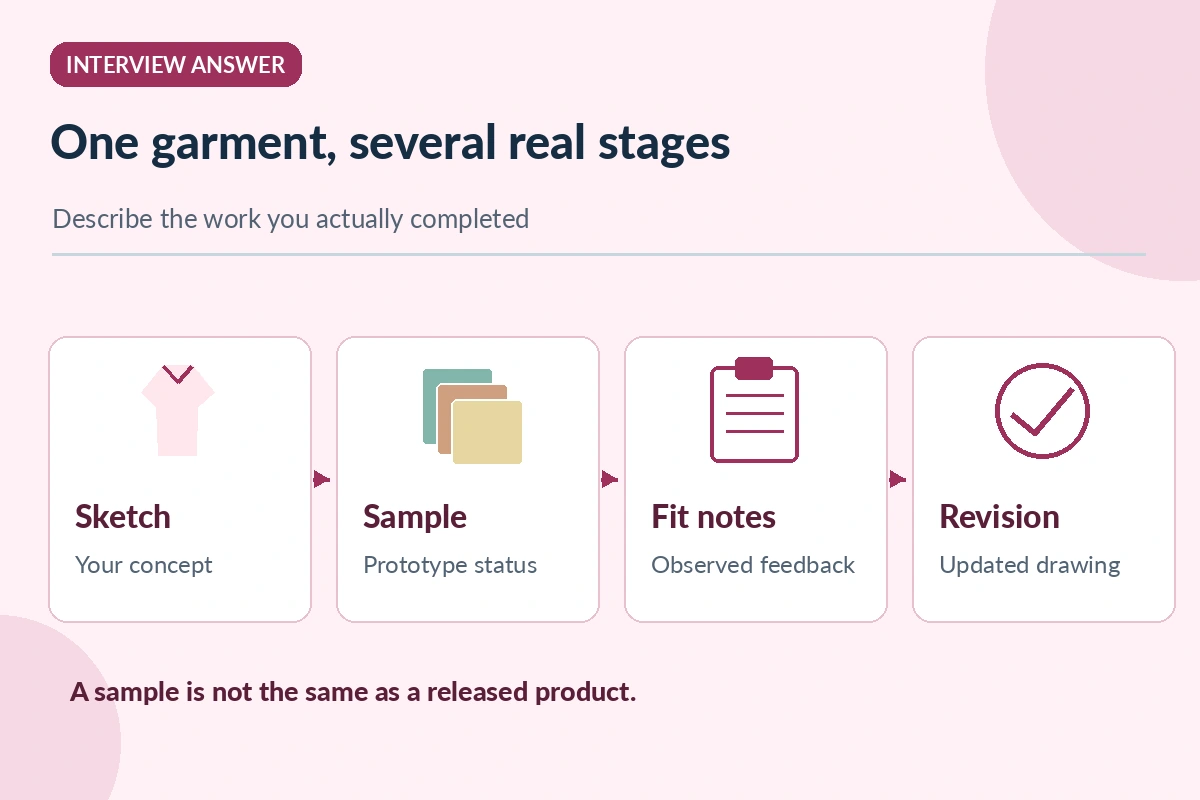
Pick a sample with a traceable path. You may have prepared a concept sketch, developed a technical drawing, researched fabric options, logged fitting comments, or compared revisions. Name only the stages you actually handled. A photo of a finished garment does not show whether you drafted the pattern, stitched the sample, or helped with the presentation. Be ready to make that distinction in one sentence.
When a manufacturer or technical designer did the fitting or construction, credit that work. For example: “I updated the design specification after reviewing the fit team’s notes” describes a meaningful contribution without asserting you fitted the garment yourself. If you saw a prototype that was never produced, describe it as a prototype; production and shipment are later steps that need their own evidence.
Build an interview answer around sample revision
Illustrative answer for an entry-level candidate: “My recent work has focused on translating apparel ideas into clear sketches and sample documentation. For a supervised capsule project, I drew a small set of coordinated looks, compared suitable fabrics, and maintained a revision page as the sample changed. I discussed fit feedback with the project lead and updated the presentation drawings so the choices were easier to review. I’m interested in this assistant designer role because I enjoy the connection between creative decisions and organized sample development.”
The example is invented for teaching, not a real candidate biography. Replace “capsule project” with an authentic garment, assignment, or employer. If you have not handled fitting, replace that sentence with verified research or documentation work. Keep the phrasing comfortable enough to say aloud, and avoid naming luxury brands or manufacturer relationships you cannot substantiate.
Keep fabric claims and technical terms precise
Materials can tell a useful story when you explain why an option was considered: drape, stretch, durability, care requirements, or availability. Avoid making performance or sustainability claims about a textile without relevant evidence. Distinguish a visual inspiration board from a verified specification. A thoughtful candidate can say “I compared two fabrics for the concept” without claiming that either passed a formal laboratory test.
If the posting uses terms such as CAD flats, tech packs, or grading, describe your real experience with each. Watching a team use a platform is not the same as authoring specifications independently. Show a sample page you created when possible, and explain what parts required technical review.

Credit the patternmaker and sample room accurately
Fashion design often involves work crossing several functions. The designer may establish concept and visual intent, while a patternmaker builds patterns and sewing staff assemble samples. In an interview, the important point is not a rigid organizational chart but a truthful handoff. Explain which document or decision moved between people, what questions came back, and what you changed in your own work.
Never claim to have authorized factory production or approved final product quality if you only supported a sample review. Likewise, an intern may observe fit sessions without conducting measurements or signing off on changes. Being clear about these boundaries signals that you can collaborate rather than inflate your contribution.
Tailor the pitch to different design workplaces
An accessories studio may want material experimentation and detail control; a mass-market apparel team may value organized specifications and revision discipline; costume work may involve close communication with performers and production schedules. Choose evidence that maps to the actual job. You can mention transferable skills, but avoid giving the impression that a small school project demonstrates end-to-end commercial manufacturing experience.
For a portfolio review, put the best relevant project near the beginning and label its status and date. If work was created in a group, put a compact attribution note on the slide. Avoid showing unpublished company files or revealing a production partner’s confidential process without permission.
Answer confidently when you have no factory experience
If your experience is mainly student-based, focus on how you respond to a brief, revise a sketch, select an option with reasons, and communicate what remains unknown. An honest explanation of one rejected idea often reveals more about your approach than a vague claim to originality. Distinguish a hypothetical collection from items that were sampled, worn, or sold.
Retail experience may give you familiarity with customer questions or garment presentation, but does not automatically make you a designer. Bridge to the work you have actually produced: garment drawings, material research, portfolio revisions, or supervised sample notes. These details can make a junior introduction concrete without pretending you already direct a design team.

Rehearse a clear transition to the portfolio
Your opening can finish with: “I can show the sample revision that illustrates that process.” That gives the interviewer an easy next question without overwhelming the first answer with garment names. A 30- to 60-second pitch is a sensible rehearsal length, as recommended by Case Western Reserve for a purposeful professional introduction. Time yourself once, then simplify phrases that feel unnatural.
Prepare two supporting objects: an authorized sketch or flat that demonstrates your own work, and a revision note showing what changed. Check that the role and dates match your resume. If a sample is a classroom mock-up, mark that clearly. A concise and accurate explanation usually helps a reviewer understand the portfolio faster.
How We Research These Interview Introductions
We use the career-center guidance on short introductions and the occupation or framework references below to distinguish practical job tasks from unauthorized decisions. All interview answers are explicitly illustrative rather than reports from real applicants. Revise names, dates, employer details, and responsibility claims to match your own experience. Sources reviewed on November 10, 2026: BLS occupational profile, Case Western Reserve career center.
Examples are educational, not personal employment evidence or hiring guarantees. We do not claim an affiliate relationship with the cited sources; review JobAsk’s affiliate disclosure and confirm job requirements with the employer.
More Interview Preparation Guides
Yes. State that it was coursework and explain the sketches, fabric comparisons, or sample work you personally completed.
Credit the patternmaker and focus on your actual design inputs, revision notes, or presentation work.
Only when you can tie a relevant trend to a design decision or audience need, rather than reciting styles without evidence.
Only if the relationship and materials are public or you have permission; do not disclose restricted samples.
Describe a verified process, decision, revision, or deliverable instead of inventing commercial outcomes.