
For an interior designer interview, answer “Tell me about yourself” with a quick professional identity, one room or client problem you actually worked on, the decisions you contributed, and why this position fits. The interviewer needs to understand your design thinking and scope, not hear a tour of your childhood or every style you like. A portfolio can support your introduction, but it cannot replace a clear spoken explanation of what you did.
Start from a room problem instead of a personal style label
An answer that begins “I love beautiful spaces” offers little evidence of how you work. A stronger opening identifies the kinds of briefs you have handled: a small retail display, an accessible circulation challenge, a residential layout exercise, or a showroom materials presentation. Choose a project type that resembles the employer’s work. State whether the assignment was paid client work, a supervised placement, or a studio-class project.
Translate taste into decisions. For example, explain that you organized a brief around the client’s use of the space, traffic patterns, material preferences, and a stated budget. Do not claim to have calculated building-code compliance or stamped construction documents if someone else handled those decisions. Interviewers can ask who approved the final drawing, so identify your real responsibility before you rehearse.
Describe your design process with one verifiable artifact
Choose one portfolio piece that lets you walk through input, work, review, and revision. A concept board can establish the direction; an annotated floor plan may show how you explored options; a selection sheet can explain why two finishes were compared. Mention the artifact by its actual name rather than describing a vague collection of attractive images. This makes the introduction easy to verify if the interviewer asks to see your work.
Separate your creative judgment from project authorization. “I prepared three circulation sketches for the lead designer to review” is more credible than “I redesigned the entire client property.” Describe what feedback came back and what you changed as a result. If you only observed a client meeting, explain what you learned rather than taking credit for negotiating the client’s scope.
Use a short, truthful sample introduction as a guide
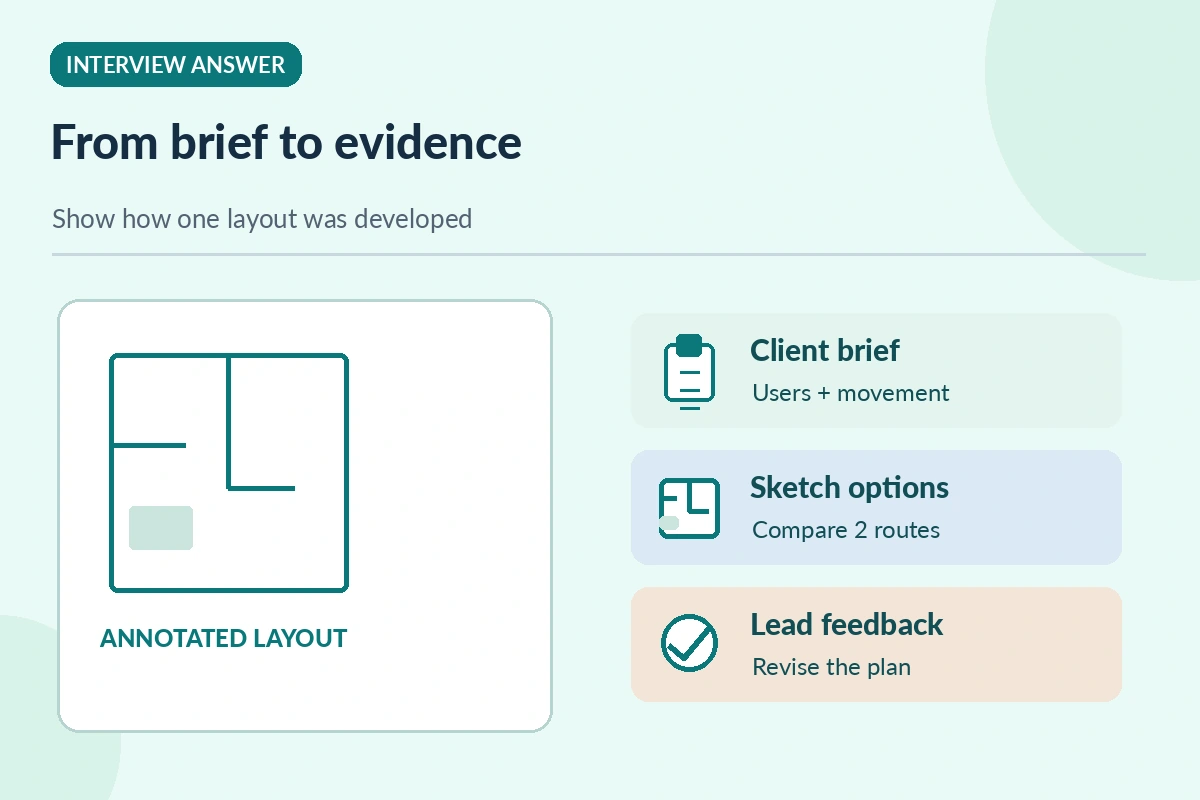
Illustrative answer for a candidate with supervised project work: “I have focused my training on practical room layouts and materials research. In a recent supervised design project, I translated a small-office brief into two annotated layout options and a materials board. I compared how each option affected movement through the room, documented the feedback, and revised the concept for presentation. I’m interested in this studio because the role combines research, clear client communication, and the chance to develop plans with an experienced design team.”
That example is fictional, not a claim of employment. Replace the project, documents, and supervision details with your own facts. You do not need to recite the whole paragraph: speak in natural sentences and allow the interviewer to ask a follow-up. If you have substantial client experience, replace the training reference with your actual title and the kind of project you personally supported.
Choose portfolio evidence without exposing a client
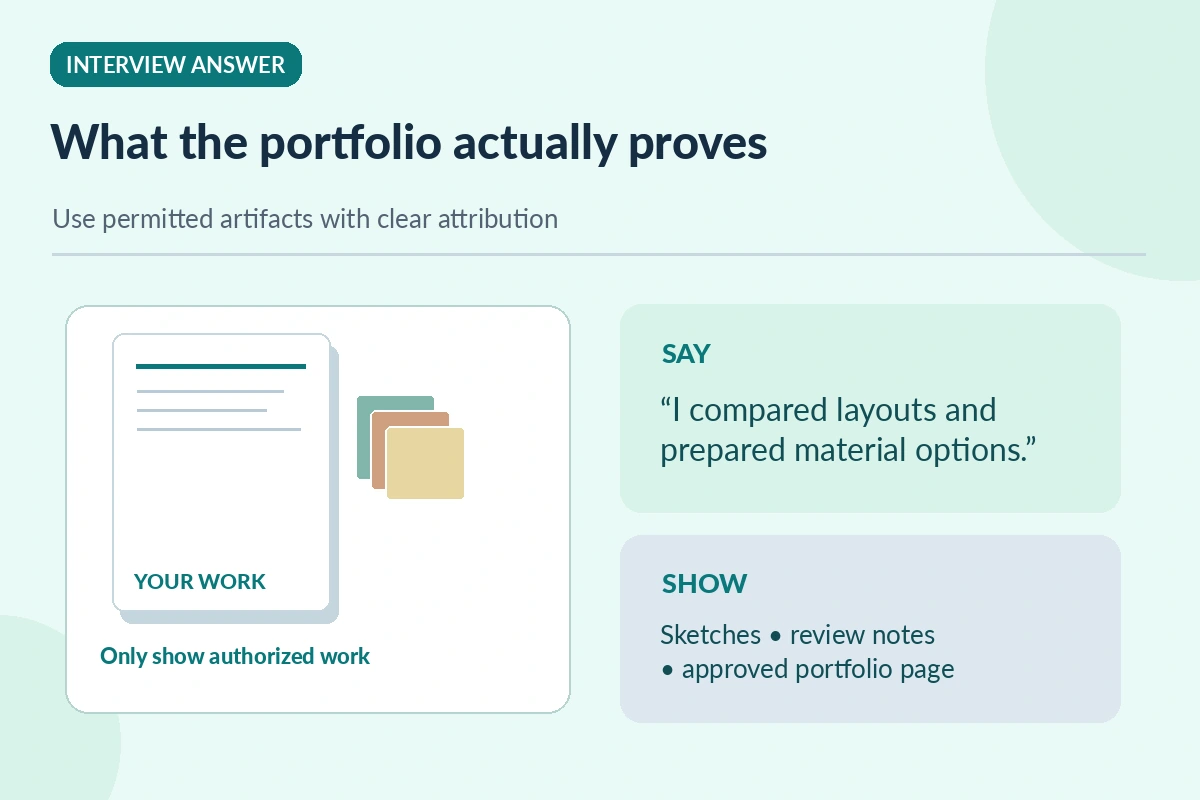
A good interview preview can include an anonymized concept board, a redacted schedule of finishes, or a drawing you have permission to show. Do not upload private plans, addresses, vendor quotes, or photographs of occupied interiors just to make the answer seem impressive. Explain when an item is a student exercise, a proposed concept, or a completed installation; these are not interchangeable statuses.
If portfolio sharing is restricted, describe the workflow in ordinary language and offer to discuss a public or classroom example instead. For collaborative work, label your contribution near the image: “materials comparisons,” “sketch alternatives,” or “presentation cleanup.” Accuracy earns more trust than a polished spread that implies sole authorship of an entire project.
Explain constraints without claiming formal approval
Interior design work involves dimensions, selection trade-offs, users, and practical constraints. You can mention that you checked whether furniture arrangements matched the stated use of the space, but do not say you certified accessibility, structural safety, or code compliance unless that was genuinely within your professional responsibility. In the United States, professional practice and title requirements can differ by state and work type; the interview is not the place to guess about licensure.
When asked how you handled a constraint, use a compact sequence: define the concern, show the option you compared, state who reviewed it, and explain the documented revision. The result may simply be a clearer presentation or a workable proposed layout. You do not need a fictional renovation percentage to demonstrate responsible design thinking.
Match the introduction to the actual studio
A furniture showroom may value product knowledge, customer explanations, and reliable handoffs. A hospitality design team may ask about coordination between drawings, finish schedules, and installation teams. A small residential practice might want comfort with client feedback and revisions. Read the posted responsibilities and pick two relevant details rather than promising you can do everything. A technically oriented role is not automatically the same as a styling role.
For a junior interview, mention the tools you can operate, but name only software and workflows you have used personally. If you used a drawing program for a class exercise, say so. If you maintained a sample library or prepared meeting notes, those tasks can be valuable evidence even when you were not responsible for approving specifications.
Handle the question when you have only student work
Candidates entering the field can focus on an authentic project from coursework, a design challenge, a supervised internship, or a permitted personal project. Briefly identify your process and the feedback cycle. Avoid representing a practice room as an inhabited client site. The interviewer should be able to tell whether a sample was built, proposed, or entirely conceptual.
If you moved into interior design from retail, hospitality, or construction administration, bridge just one relevant skill such as listening to requirements or documenting requests. Then demonstrate what you have learned about design decisions through actual work. An introduction that claims a complete career switch has already been accomplished may invite questions you cannot support.

Practice the opening and prepare for one follow-up
Aim for a focused introduction that can be spoken in roughly 30 to 60 seconds rather than an exhausting chronological account. The Case Western Reserve career center describes such a pitch as audience-specific and career-focused. Rehearse aloud while looking at the job description, then remove qualifications you cannot prove. Pauses and normal phrasing are preferable to a memorized advertisement.
Prepare for the natural follow-up: “Which part of that project was yours?” Have a specific drawing, decision note, or approved public portfolio page available. Before the interview, check that the date, team size, and project stage in your introduction agree with your resume and portfolio. This is a simple quality check, not a requirement to have a perfect design portfolio.
How We Research These Interview Introductions
We use the career-center guidance on short introductions and the occupation or framework references below to distinguish practical job tasks from unauthorized decisions. All interview answers are explicitly illustrative rather than reports from real applicants. Revise names, dates, employer details, and responsibility claims to match your own experience. Sources reviewed on November 10, 2026: BLS occupational profile, Case Western Reserve career center.
Examples are educational, not personal employment evidence or hiring guarantees. We do not claim an affiliate relationship with the cited sources; review JobAsk’s affiliate disclosure and confirm job requirements with the employer.
More Interview Preparation Guides
Mention a style only if it is relevant; a real client problem, evidence of your process, and your role are more useful than a broad personal preference.
Yes. Say it was a student project and describe your own sketches, decisions, feedback, and final project stage accurately.
Summarize the methods and your role without sharing protected drawings or client information; use an authorized alternative where possible.
Only if you actually held that authority. Otherwise name the reviewer or your part of the handoff.
A focused 30- to 60-second introduction is a useful starting point; allow more detail when the interviewer asks for it.