
In a purchasing assistant interview, lead with the steps of a purchasing workflow you actually supported. An honest opening might say, “I have experience organizing supplier information, checking purchase-request details and keeping the buyer updated when quotes or deliveries change.” That is a hypothetical script, not a claim to copy. It gives the interviewer observable actions and avoids presenting an assistant as the person who approved purchasing terms.
Purchasing can involve requisitions, supplier comparisons, purchase orders and contract decisions. O*NET describes many of these tasks for purchasing agents, but assistant duties differ by employer. Your introduction should make clear where you prepared information, where someone else authorized spending, and where you followed up. The worksheet below turns a list of procurement buzzwords into a short, defensible account of your real part in the process.
Name the Purchase-Request Stage You Actually Supported
Start by identifying whether you worked with internal requisitions, supplier quotes, ordering records, delivery updates or invoice discrepancies. These stages involve different levels of authority. A candidate who checked whether a request included a quantity and delivery date should not open with “I managed purchasing decisions.” Try “I reviewed requisition details before passing complete requests to the designated buyer.” That gives the interviewer a specific reason to ask about accuracy and process.
A school project or simulation can also be useful when it is labeled accurately. You might have compared mock supplier offers in a purchasing course without placing any real orders. Explain the exercise, the criteria used and the review step. Do not introduce simulated purchase orders as evidence that you negotiated live agreements. If you are transitioning from inventory or office support, choose the transferable record-checking activity instead of borrowing the title of a purchasing agent.
Show How You Compared Quotes Without Claiming a Win
When speaking about quote comparisons, explain what was on the comparison sheet: unit descriptions, delivery windows, quantities, validity dates or terms that required review. If you merely consolidated offers, “prepared a side-by-side quote summary for the buyer” is accurate. If you actually evaluated vendors under an assigned policy, specify the extent of that evaluation. Avoid “secured the lowest cost” unless you can establish the selected offer, the approved basis and your contribution.
Price may be only one variable in a supplier choice. Materials, lead times, service requirements and purchasing rules can affect an approved selection. O*NET lists evaluating suppliers and preparing purchase orders within purchasing occupations, but an assistant may not have authority to commit funds or modify supplier terms. In an introduction, demonstrate how your comparison helped the authorized decision-maker, not that the decision was yours unless it truly was.
| Purchasing stage | Good support-language | Authority check |
|---|---|---|
| Supplier comparison | Compiled terms in a comparison sheet | Buyer chooses supplier |
| Request review | Checked quantity and due date | Approval may be separate |
| Order preparation | Drafted or entered purchase record | Issuance may need approval |
| Delay follow-up | Logged revised delivery information | Do not promise recovery |

Describe Supplier Updates as a Communication Workflow
A supplier delay can give you an excellent interview example without any dramatic numbers. You may have noticed a changed delivery date, verified the reference number, sent the update to the buyer and documented the response. That is a complete contribution. If you escalated an exception but did not choose a substitute supplier, do not imply that you solved the shortage independently. The decision path below helps separate gathering information, communicating it and approving a revised plan.
Do not disclose confidential pricing, preferred vendors or contract terms in a public portfolio or interview introduction. Explain the categories of information that mattered. A hypothetical line is “I kept order status records current and flagged date changes to the person responsible for approving next steps.” If the interviewer asks about the final outcome, report only what you learned from the record or follow-up, not a fictional savings amount.
Explain Exactly Where Approval Entered the Process
Procurement terminology can blur boundaries. “Prepared a purchase order” may mean populating a draft document; “issued a purchase order” may require a buyer or manager’s authorization. Specify whether you checked, entered, routed, sent or approved the order. If your team had separation of duties, emphasize that you used it correctly. It is better to sound like a careful assistant than to falsely imply the independence of a purchasing manager.
A good opening can incorporate this boundary naturally: “I checked request details, prepared the order record and routed exceptions for approval before any supplier commitment.” Only use it if those were your actual assigned steps. Do not say you negotiated prices, agreed to contract language or authorized payment unless you were permitted to do so. Approval limits also vary between employers, so the interview answer must describe the arrangement you experienced.

Connect a Real Example to the New Purchasing Role
Read the vacancy and highlight one recurring task such as tracking deliveries, comparing quotations, reconciling records or supporting supplier correspondence. Choose an example that shows that task. For a purchasing team with many routine replenishment orders, record accuracy may matter more than an impressive story about negotiations. For a role involving capital equipment, documenting specifications and making sure questions reach technical reviewers may be the relevant part of your experience.
Do not imply that familiarity with spreadsheets equals knowledge of every enterprise purchasing system. Name the tools you used if they are true, and be prepared to describe how you checked the input against source requests. A clear closing sentence is “I’m looking to apply that organized support to a team that values correct orders and documented approval.” This is a statement of fit, not a promise of a cost reduction or a procurement outcome.
Rehearse an Answer That Survives Follow-Up Questions
Try a compact sequence: your current or recent support setting, one quote or order example, how the information was reviewed, and why the target role fits. Time yourself once and remove the history that does not help the interviewer decide whether to explore your abilities. A hypothetical introduction could center on updating an order tracker and following up on missing supplier confirmations. The value is the process you can explain, not how many buzzwords fit into a minute.
Be ready for “Who approved the purchase?”, “What happened when the quote changed?” and “How did you verify the record?” If the answer is “The buyer approved it; I prepared the documentation,” say that. Review your resume for consistency so the title, authority and tools match. An accurate purchasing assistant introduction demonstrates reliable handoffs even when the final commercial decision belonged to someone else.
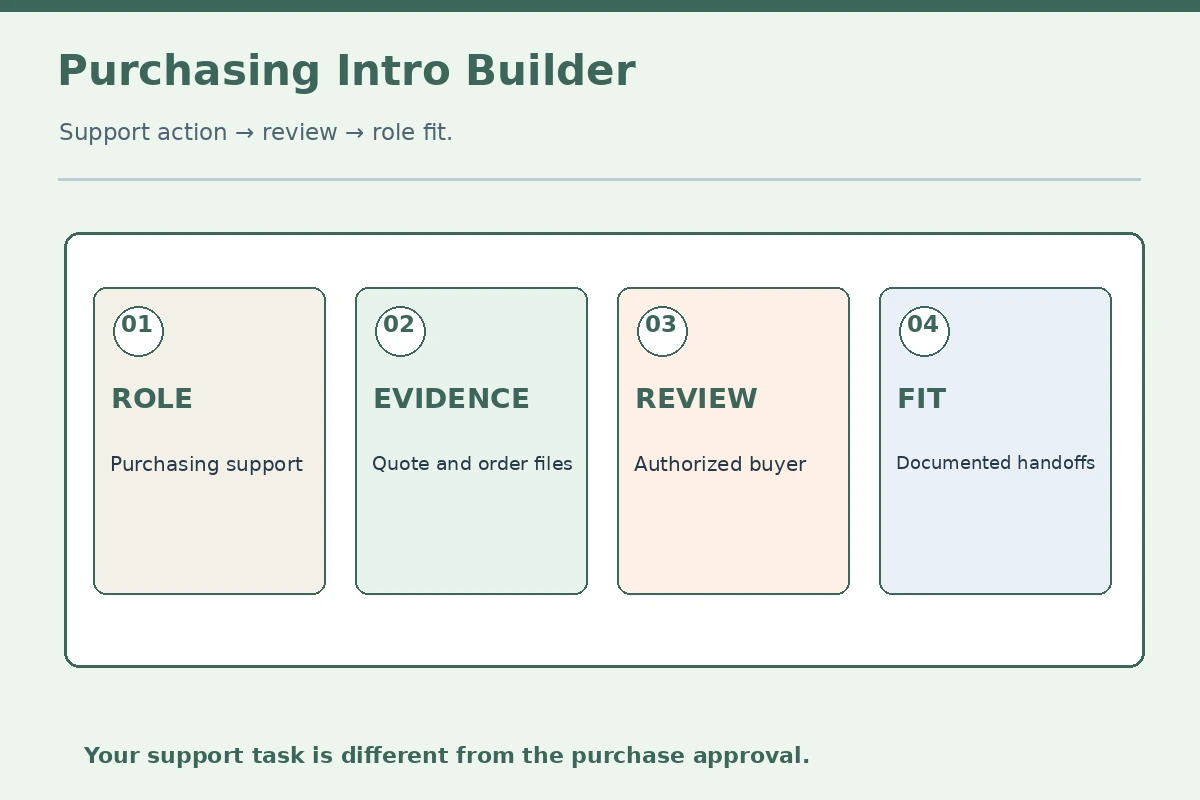
How We Research Professional Interview Introductions
Checked on 2026-11-14: O*NET: Purchasing Agents — O*NET describes purchasing activities such as preparing orders, reviewing requisitions, evaluating suppliers and negotiating where authorized.; OPM: Structured Interview Questions — OPM explains that job-related structured interview prompts should elicit situation or task, action, and result without unrelated claims.; OPM: Structured Interviews — OPM describes structured interviews as assessments of job-related competencies using past behavior or hypothetical situations.. We reviewed the supplied WordPress post-title exports, local recent draft topics and public search results to separate this professional introduction from other JobAsk articles. Sample answers, diagrams and worksheets are hypothetical: confirm all tasks, qualifications, dates and consequences before using them. Occupational descriptions do not determine any individual employer’s duties or licensing rules; use the actual job posting and authorized guidance. No hiring, interview or ATS outcome is promised. We do not assert partnerships with these sources. Read the JobAsk affiliate disclosure.
More Interview Preparation Guides
Only if negotiation was explicitly part of their real authorized work. Otherwise describe quote gathering, clarification or routing proposed terms.
Only with verified attribution and disclosure permission. An assistant can describe preparing information without claiming ownership of the final price.
Label the assignment a simulation or class project, identify the comparison criteria and state what you prepared for review.
Not necessarily. The ordering workflow and authorization limits vary; describe whether you drafted, routed, issued or approved it.
A documented delivery-date change and the buyer notification you personally sent can illustrate communication and record accuracy.