
In a research assistant interview, answer “Tell me about yourself” by describing the research environment you have actually worked in, the methods you supported and how you handled records or checks. Explain what you did yourself and what required a supervisor’s direction. Student projects and volunteer assignments can be useful evidence when labeled accurately. Do not claim to have approved a study, obtained participant consent or interpreted confidential findings unless those activities genuinely fell within your authorized role.
Identify the kind of research the vacancy involves
“Research assistant” can refer to social science surveys, laboratory support, archival projects, public-data analysis and other settings. O*NET describes tasks ranging from data entry and quality checking to preparing tables and helping with research documentation. That list is not permission to claim every task. Read the actual advertisement for required methods, expected documentation and any stated supervision or training requirements before selecting your example.
If the role is based in survey research, an example about questionnaires or coding responses may be helpful. For archival research, accurate source attribution might matter more. For a data-management assistant, file naming, reproducible checks or comparison against a source record could be central. Be specific about your field rather than announcing expertise in all research methods; an interviewer can then ask about the work you really understand.
Choose one method you can describe clearly
Pick a genuine activity such as checking entries against source forms, labeling data files, coding a defined set of records or organizing a literature table. State the method, your assigned responsibility and how you checked its completeness. For instance, you may have compared a sample of spreadsheet entries with an approved coding guide. This description is more credible than claiming you “led the study” when you worked under a graduate student or principal investigator.
Avoid describing participant histories or identifiable responses. If an example involved human subjects, discuss the workflow in general terms and the directions you followed; do not share private consent forms or names. An applicant with no formal research experience can use a class project, provided it is clearly identified as coursework. A classroom survey and a regulated research study are not interchangeable, and the introduction should not blur them.
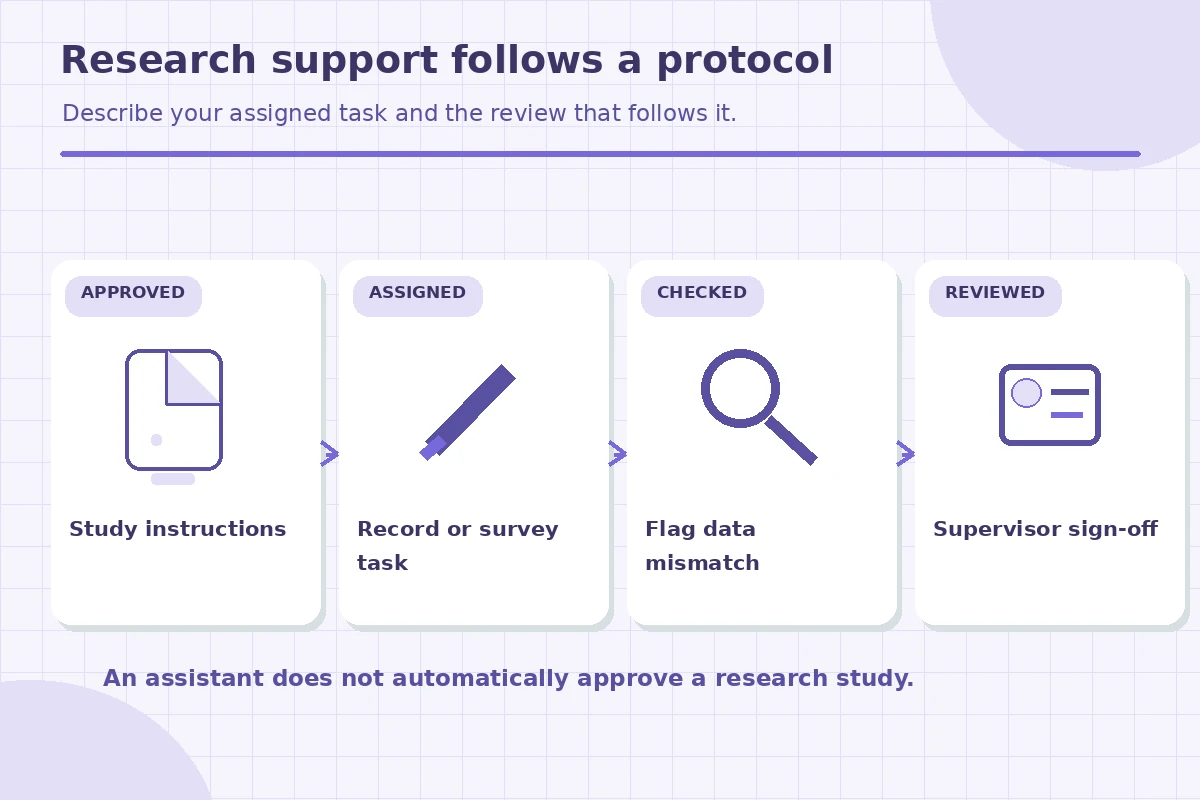
Explain what you did when the information did not match
Research quality often depends on recognizing discrepancies and bringing them to the appropriate person. A simple example might be noticing that two records used different codes, checking the study’s data dictionary and requesting clarification before changing a value. Explain what source you consulted and whose approval applied. Do not imply that you could change study rules, alter participant records or quietly discard an inconvenient observation.
An answer about accuracy should not claim that your dataset was perfect. If an error was corrected, state your actual role in identifying or documenting the issue, and whether a supervisor approved the final change. The purpose is to show a reproducible process and honest uncertainty. The same principle applies when you prepare tables or figures: numbers are only useful when their sources and definitions are understood.
Make teamwork and supervision visible
Researchers rarely work in isolation. An assistant may follow protocols written by an investigator, coordinate with other research staff and document steps for later review. In the introduction, name your place in that workflow: “I entered assigned records, flagged missing fields and prepared a summary for the project lead.” This does not make your contribution smaller; it makes it more precise and demonstrates that you understand review boundaries.
If you worked on an academic team, distinguish a result you personally produced from one belonging to the whole project. “Our team presented a class poster; I prepared the source table” is clear. Do not claim authorship, a publication or ethics-board approval that has not occurred. If a manuscript is under review or a study is still gathering data, keep its status accurate, and do not disclose results your organization has not authorized you to discuss.
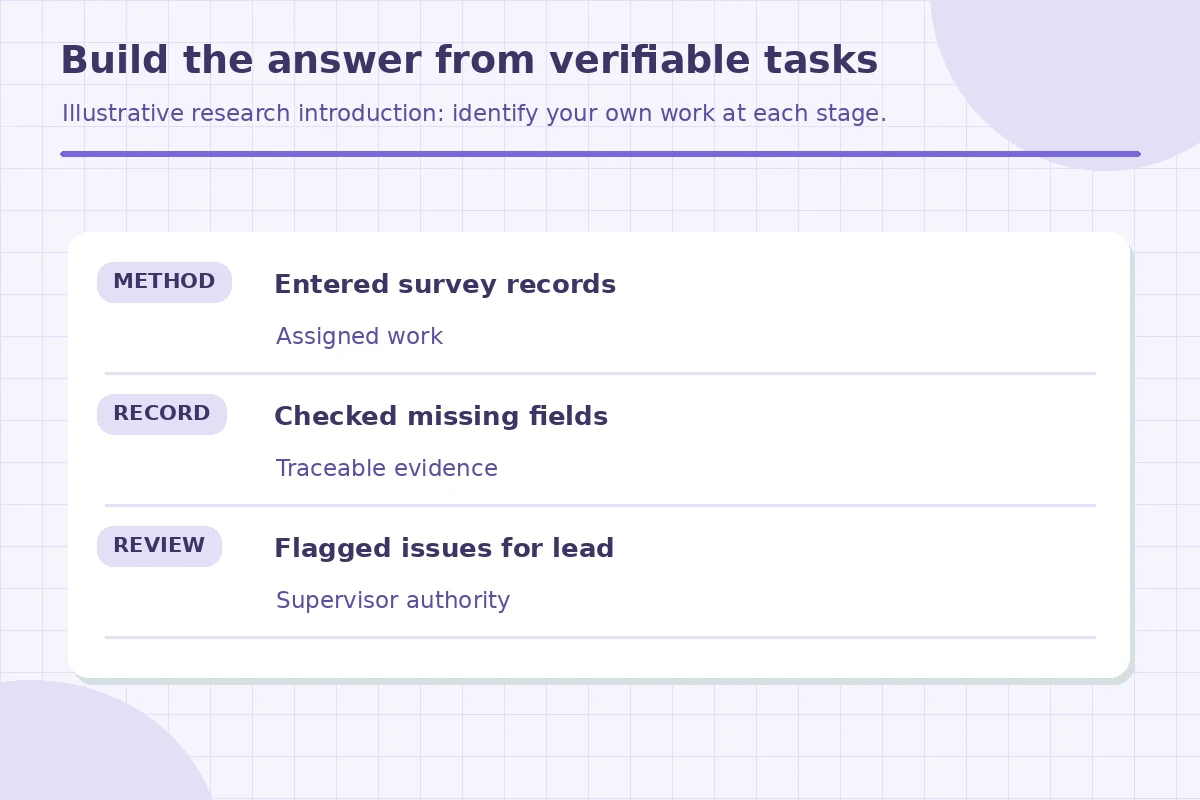
Write a short introduction with an evidence chain
A hypothetical structure is: “My background includes coursework in research methods and an assistant role in a supervised survey project. I helped check entered records against the project guide, recorded discrepancies and prepared a summary for the lead researcher. I am interested in this position because it combines careful documentation with learning stronger data-quality methods.” Change the context and tasks to match your real experience.
If you have more substantial research experience, replace coursework with your verified role and a more relevant method. There is no need to announce every software package. One tool you used competently, paired with a clear explanation of the data task, is more valuable than a string of names. The interview opening is not a full methods presentation; it should motivate a precise follow-up question.
| Task | Credible wording | Boundary |
|---|---|---|
| Data checking | Compared entries with coding guide | Changes reviewed by study lead |
| Survey support | Scheduled participants under instructions | Consent handled only when authorized |
| Report preparation | Prepared tables for supervisor review | Did not claim final study conclusions |
Handle privacy and study permissions carefully
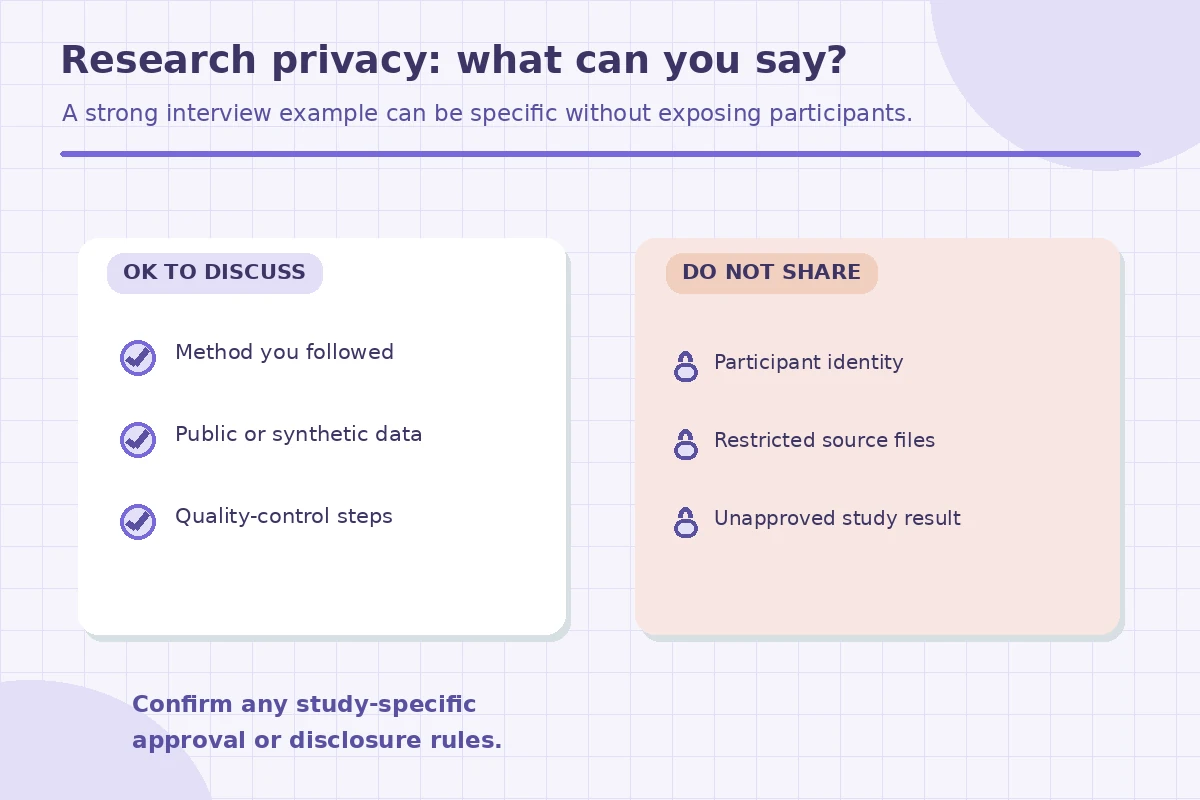
Some research involves participants, sensitive files, controlled environments or procedures that require specific training. You should not imply that a general research assistant title automatically grants permission to recruit participants, obtain consent, access restricted data or approve protocol changes. Tell the interviewer which parts of a workflow you were trained and authorized to perform, and when you escalated a request to the investigator or approved staff.
If a work sample is requested, ask what material may be shown. Publicly available data or a synthetic example may be appropriate, depending on the employer’s instructions. Do not upload restricted research records to an application portal merely to prove experience. A privacy-aware description can still show useful knowledge: coding conventions, document control, review checkpoints and how you tracked outstanding issues.
Practice for the most likely follow-up
After your introduction, a researcher may ask, “How did you check accuracy?” Be prepared to walk through one legitimate, nonconfidential example, including the input, the rule you followed, the flagged issue and the final reviewer. Another question may be, “What would you do if the protocol was unclear?” A responsible answer is to consult the documented procedure and supervisor rather than improvise a new study method.
Practice the answer aloud and remove jargon that obscures your actual task. Review the job requirements again: do they need participant scheduling, literature synthesis, database cleaning or report preparation? Your opening should emphasize only the matching strengths you possess. End with a natural connection to the role and leave room for the interviewer to ask about your method, rather than promising independent authority you have not held.
How We Research and Verify Interview Guidance
JobAsk compared this role-specific question with the user-provided WordPress inventory, original content queue, relevant public search results and US occupational and career guidance on November 7, 2026. The sample responses are hypothetical writing models, not employee testimony or promised hiring outcomes. Follow the employer’s current instructions, describe your own verified experience and see our affiliate disclosure.
Source: cloudfront.careeronestop.org — CareerOneStop recommends researching the job and employer, practicing truthful examples aloud and asking informed questions.
Source: careerservices.fas.harvard.edu — Harvard career guidance describes a brief, job-relevant introduction with background, current strengths and a next-step connection.
Source: www.onetonline.org — O*NET describes social science research assistance in data collection, verification, reporting and participant-related procedures.
More Interview Preparation Guides
Yes. Clearly call it coursework and explain the methods and tasks you completed yourself.
No identifiable or confidential data. Discuss your process and approved responsibilities instead.
Only if you genuinely worked on study design. Collection and study approval are separate responsibilities.
You can still describe legitimate data checks, literature research, reporting or project support without claiming publication.
Use one or two meaningful method details in plain language, saving detailed analysis for follow-up questions.