
A UX design internship cover letter should explain one decision you made because of something you learned about a user task. A wireframe or colorful interface is not, by itself, proof that a design helped anyone. Choose a class project or permitted portfolio case that documents a problem, a method, an observation and a change to the prototype. Describe whether the participants were classmates, volunteers or actual users, and never turn an informal test into a claim of statistically proven business improvement. The goal is an accurate design process story linked to the internship’s work.
Study the team needs before presenting your portfolio
UX internships may emphasize interface layout, usability testing, research synthesis, accessibility, prototyping or collaboration. Read the job description for two central activities and notice whether the employer wants a portfolio link, file or short explanation. Do not assume that every design internship involves conducting independent research with customers. If the role focuses on a design system, a clear account of components and iteration may be better than an interview story. If it focuses on usability, choose observations you can explain without hiding weaknesses.
The BLS describes digital interface designers as people who create and test layouts, interfaces and navigation. That helps identify relevant skills but does not validate any particular portfolio metric. A student designer can show how a prototype changed after feedback without calling it a launched product. Keep the scope close to what you actually designed, tested and documented; do not borrow results from a team project unless you explain your contribution.
Pick an observation that changed a design decision
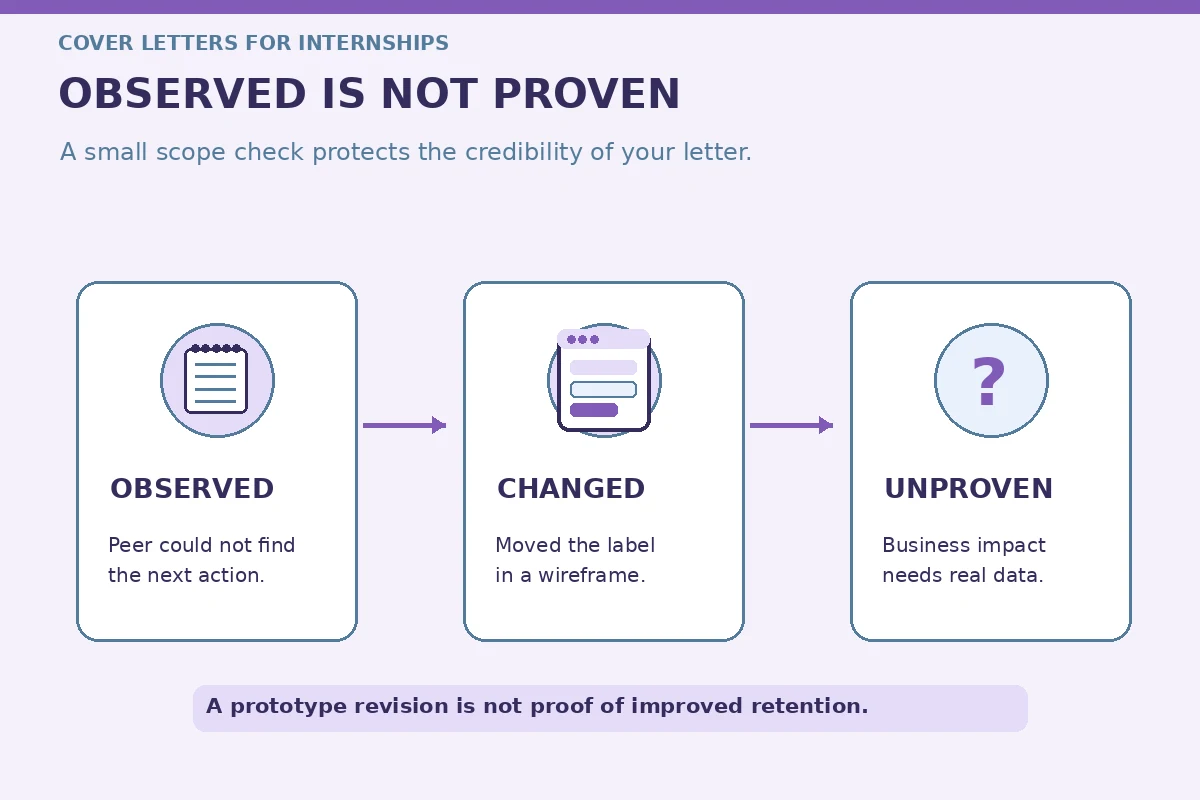
Suppose a class team tested a library reservation prototype with volunteers. Some participants looked for the booking confirmation on the wrong screen. You observed the route they took, wrote down the confusion, and moved the confirmation message in a revised wireframe. You might explain this as an iteration based on a usability observation. You cannot claim that it improved company conversion rates or reduced support costs when no production product or follow-up measurement exists.
Be specific about method without manufacturing sample sizes. Say ‘in a class usability exercise’ or ‘during a permitted peer walkthrough’ when that is accurate. Separate what participants said from what you inferred. ‘Two participants did not notice the confirmation label’ would require real notes confirming two; otherwise state ‘the walkthrough revealed a confusing confirmation step.’ If you have no user testing experience, explain a heuristic review or an annotated design critique honestly rather than inventing research sessions.

Make the evidence paragraph about an actual iteration
The opening should identify the UX internship and an aspect of the team’s work you genuinely understand from the listing or public materials. The middle should take the reader from problem to method to design change. The close can invite the employer to review one relevant, permitted portfolio case. Avoid reciting tool names without saying what design question they helped you answer. A hiring reader benefits from one coherent decision more than from a long list of unrelated screens.
Hypothetical opening: ‘I am applying for the UX Design Intern role because the description emphasizes making everyday workflows easier to understand. In a class project, I learned to test whether people could find a confirmation step rather than assuming the screen was clear because it looked polished.’ Customize the role and employer connection; do not imply the example involved the employer’s product.
Hypothetical evidence and closing: ‘For a library booking prototype, I observed a peer walkthrough and recorded where the confirmation step caused confusion. I revised the wireframe to make the next action easier to locate and documented the rationale in a short case study. I would welcome the opportunity to discuss that process and learn how your team reviews research and iterations. Thank you for considering my application.’ This example claims a design change, not a measured business result.

Distinguish observations, hypotheses, and outcomes
Avoid ‘my redesign increased retention’ when your project ended with static screens. An accurate alternative is ‘I revised the confirmation step after observing that testers had difficulty finding it.’ If you later conducted another permitted test, name what you actually checked, without generalizing beyond that session. A UX cover letter should help reviewers see that you can distinguish a participant’s action from your interpretation and from the effect of a design decision.
Choose one image or portfolio page that supports the story: a before-and-after wireframe with annotations, a clearly labeled flow, or a short findings summary. Do not publish identifying participant quotes, recordings or contact information without consent and authorization. If your work was team-based, say who created the prototype and what changes you were personally responsible for. A well-scoped process narrative can be compelling even without a percentage.
| Unsupported assertion | Defensible design statement |
|---|---|
| Improved user retention | Revised a navigation step after a peer walkthrough. |
| Led customer research | Observed a permitted class test and documented findings. |
| Built a fully accessible app | Checked selected interface labels and noted further review needs. |
Show collaboration and research restraint
An intern may help organize interviews, take notes, prepare prototypes, check patterns or document decisions. It is different from independently directing an organization’s research program. If your class project involved feedback from real people, explain how it was recruited and conducted only to the level that you know and are permitted to disclose. Do not turn an informal class critique into a human-subjects study with implied approvals. When you cite research, note where your evidence ends and what the team would need to validate next.
If an accessibility issue motivated your design, be concrete about what you actually evaluated. Testing a prototype with one screen reader is not proof of full accessibility compliance. Likewise, inspecting colors in a design tool is not a substitute for user testing. An accurate intern-level statement might describe checking navigation labels and documenting questions for further review. This shows curiosity and restraint instead of a promise that you solved a problem you did not measure.
Review the letter alongside the case study
Open the portfolio link in a private browser window to confirm that the case is accessible without a login and contains no sensitive data. Verify that the letter uses the same project name, role, timeline and evidence as the case study. If the portfolio is under an NDA or contains an employer’s restricted material, use an approved redacted description instead. Recruiters cannot assess a broken link, but they also should not receive material you lacked permission to share.
For the final pass, check the real company and position, limit the letter to a readable page, and remove vague statements about ‘user delight’ unless you have specific evidence. Make the strongest research-to-design connection visible before any portfolio link. If the team requests an application form, preview that form to ensure paragraphs and links survive formatting. Your purpose is to communicate a disciplined learning process, not to guarantee a particular hiring outcome.
How We Research and apply this guidance
We checked career-center guidance and the U.S. Bureau of Labor Statistics occupational description on November 9, 2026. University of Pennsylvania Career Services emphasizes tailoring a non-academic letter and illustrating skills with particular examples; UC Berkeley emphasizes linking an application to the specific role and organization. The BLS duties provide occupational context, not proof of what an individual intern may do. All sample people, scenarios and quoted cover-letter passages here are hypothetical. Employer instructions and permission boundaries control any real submission.
Sources and further reading: University of Pennsylvania Career Services. UC Berkeley Career Engagement. U.S. Bureau of Labor Statistics. See our affiliate disclosure. No affiliate relationship is implied by these source citations.
More Resume and Cover Letter Guides
No. A genuine class prototype can demonstrate decisions and iteration when you explain its limited testing context.
No. Label participants accurately, such as classmates or peers, rather than implying external customers.
Only verifiable measures from real tests or products that you have permission to share. Do not infer improvement from a static redesign.
Describe the layouts, component decisions and critiques you actually completed, then connect them to the advertised responsibilities.
Not without appropriate permission and authorization. A sanitized findings summary or redacted case study is usually safer.