
To prepare for a data scientist interview, select two projects you can explain from the original business question through data preparation, baseline, validation, and a decision someone could act on. Practice stating what you did yourself, what teammates owned, and what was uncertain. Interviewers may ask technical questions, but the harder test is often whether you can recognize weak evidence and explain a trade-off without claiming a guaranteed result. This guide turns those expectations into a repeatable preparation plan.
Map the advertised role to actual project evidence
Read the posting for the balance of statistics, programming, experiment design, stakeholder communication, and production work. A data scientist who mainly runs exploratory studies should not rehearse only infrastructure architecture; a position that deploys models calls for operational examples. Create a two-column sheet: required task and project evidence you can genuinely describe. The BLS data scientist profile includes collecting and evaluating data, testing models, and presenting recommendations, but every company assigns those activities differently.
For each skill, name the dataset type without exposing protected records, the tool you actually used, and the output you produced. If your strongest example came from a university assignment, label it as coursework. If model deployment belonged to an engineer, do not present yourself as its owner. An honest limited example is better than a polished story that cannot survive follow-up questions.
Practice the complete data-quality story
Expect a question such as “The dashboard changed overnight; how would you investigate?” Rehearse identifying the data source, time window, definitions, missing values, duplicates, possible leakage, and recent pipeline changes before jumping to a model. Explain what you would inspect first and which assumptions would need confirmation from an analyst or data owner. Separate an observed anomaly from a proven root cause.
A fictional case might show weekend rows missing from an event table after a schema revision. A sensible answer starts with source reconciliation and monitoring logs, not an unsupported conclusion that customer behavior changed. If no logs are available, state what other evidence you would request. Rehearse explaining the check in plain English to a manager who cannot review your code.

Prepare a model-validation walk-through
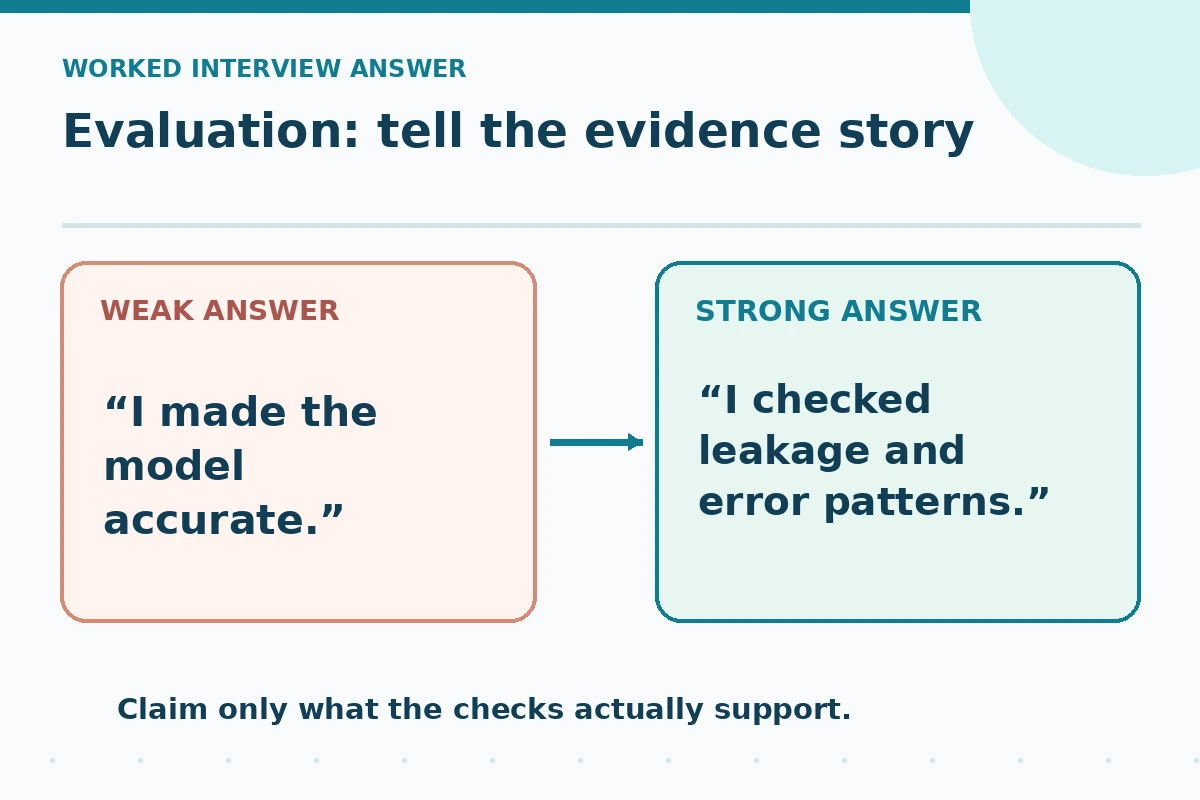
Select one real or clearly labeled practice project and trace the problem to a baseline, features, evaluation split, metric, error analysis, and revisions. Explain why a time-based split might be needed for forecast data and why accuracy alone may miss critical error costs. Do not invent performance improvements or say a metric proved business value unless an actual evaluation supports that claim.
Practice a hard follow-up: “What would make you stop shipping this model?” Your response can mention unstable measurement, leakage, unsuitable training data, poor subgroup behavior, or an unreviewed operational risk. State who was authorized to approve a launch in your actual setting. A course model can demonstrate reasoning even when nobody ever deployed it.
Answer stakeholder questions without hiding uncertainty
A common scenario is that two departments want different answers from the same dataset. Describe how you would clarify the decision, identify the metric definition, surface trade-offs, and document what is known versus inferred. A recommendation should say what evidence would change it. Prepare one example where you revised your conclusion after a peer challenged an assumption; this can be stronger than an exaggerated success story.
Use a 60-second structure: question, evidence, key limitation, proposed action, and review owner. If a stakeholder wanted a causal claim from observational data, explain why you would avoid making one without the appropriate design. Communicating limits is part of professional analysis, not a confession of incompetence.
Rehearse an ethical and reproducible project explanation
Interviewers may ask how you handled sensitive data, protected customer information, or documented a notebook. Prepare to discuss access boundaries, approved environments, code review, and reproducibility without revealing actual private data or security controls. Do not bring a former employer’s dataset, credentials, or internal model weights to an interview. Redacted or synthetic examples can communicate method when the underlying project is confidential.
If a portfolio sample is based on open data, keep a short record of source, license, preprocessing, assumptions, and limitations. If it is fictional, label it hypothetical. Rehearse what you would do when an input is missing or a business stakeholder requests a use outside the project’s approved purpose.
Run a timed mock interview that mixes reasoning and communication
Divide a practice session into a short project introduction, a data debugging scenario, a model trade-off, and a stakeholder explanation. Answer aloud. Pause after each segment and ask whether you stated your own contribution and whether an unfamiliar listener could follow the outcome. The Harvard interviewing guide recommends researching the employer and practicing without memorizing canned answers.
Try one unfamiliar prompt: “A recommendation system looks accurate overall but fails for a small new segment.” Rather than guessing, state the evidence you would request, plausible causes you would investigate, and how you would present uncertainty. Do not invent a percentage gain or claim you can guarantee a fix in a live interview.
Build questions and a final-day checklist
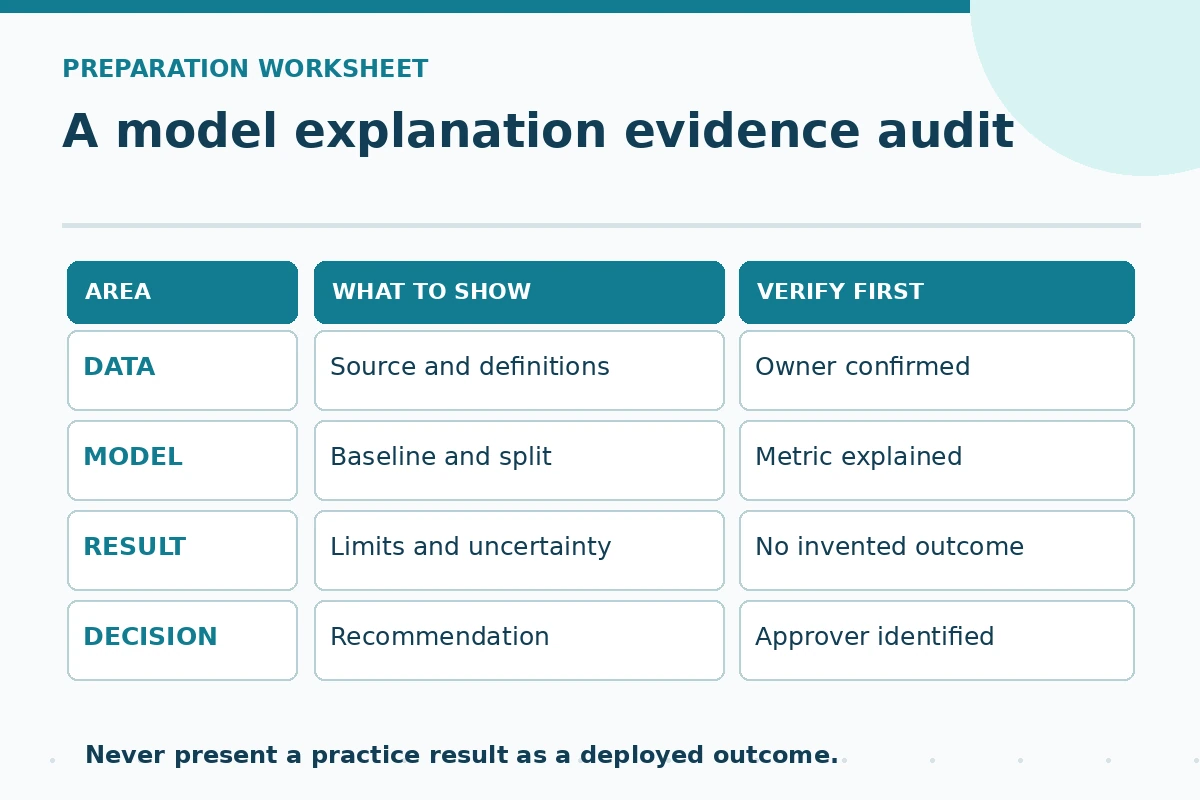
Ask how data ownership is defined, who reviews model evaluation, how success is measured after rollout, and which partners are involved in decisions. Those questions help you judge the role and avoid assuming you would control a deployment you only advise on. Check the actual interview format, whether coding or a case exercise is expected, and which tools may be used. Respect instructions about external assistance.
Before the meeting, test any screen-sharing or notebook setup, print a one-page evidence map, and remove confidential files from the demonstration folder. End with one concise example of how your work supported an informed choice, not an invented return on investment. Keep a written record of questions you could not answer so future practice addresses real gaps.
How We Research Interview Preparation
We reviewed current career-center interview preparation guidance alongside occupational or professional descriptions relevant to this role. Sources: careerservices.fas.harvard.edu — Researching the employer, rehearsing responses, and preparing questions are core interview habits. bls.gov — BLS describes data gathering, model testing, and communicating findings. careerservices.fas.harvard.edu — Harvard explains interview expectations, truthful qualifications, role interest, and informed questions. Examples in this article are illustrative unless explicitly described as real occupational guidance. No invented employer interview requirements, outcome metrics, or approvals should be inferred from these examples.
This guide is independent editorial advice. It is not endorsed by any employer and does not promise hiring results. For the website’s policy, see our affiliate disclosure. Always follow the actual hiring invitation and keep private workplace and customer information out of interview demonstrations.
More Interview Preparation Guides
Know the fundamentals relevant to the posting, but practice explaining the data problem, baseline, validation and why you chose a technique rather than reciting algorithm names.
Label them as course projects, explain the exact dataset and your contribution, and do not claim the model reached production or improved revenue.
Discuss data checks, suitable metrics, error patterns, limitations and the additional evidence needed before changing the approach.
Not without clear authorization. Use redacted, approved or synthetic examples and avoid restricted data, credentials or proprietary code.
Ask about data ownership, evaluation processes, stakeholder partners, deployment responsibilities and how the team learns from model failures.