
A data entry cover letter with no experience should make accuracy observable. Instead of writing that you type quickly or love spreadsheets, describe a real task where you used source information, entered it consistently, checked for errors, and clarified anything you were not authorized to change. A class spreadsheet or volunteer registration project can be valid evidence when you label it honestly. The sample letter and checklists here show how to apply without inventing paid office work, confidential record access, or unsupported accuracy percentages.
Choose an accuracy example from real work or study
O*NET describes data entry keyers as comparing fields with source documents, finding errors, and storing completed records appropriately. For an applicant who has never been hired for data entry, the closest evidence may come from a supervised class exercise, a volunteer mailing list, a club budget, or a student survey. A useful example has a source, the fields entered, a check you performed, and an honest outcome. Do not claim a professional error rate on the basis of a tiny practice sheet.
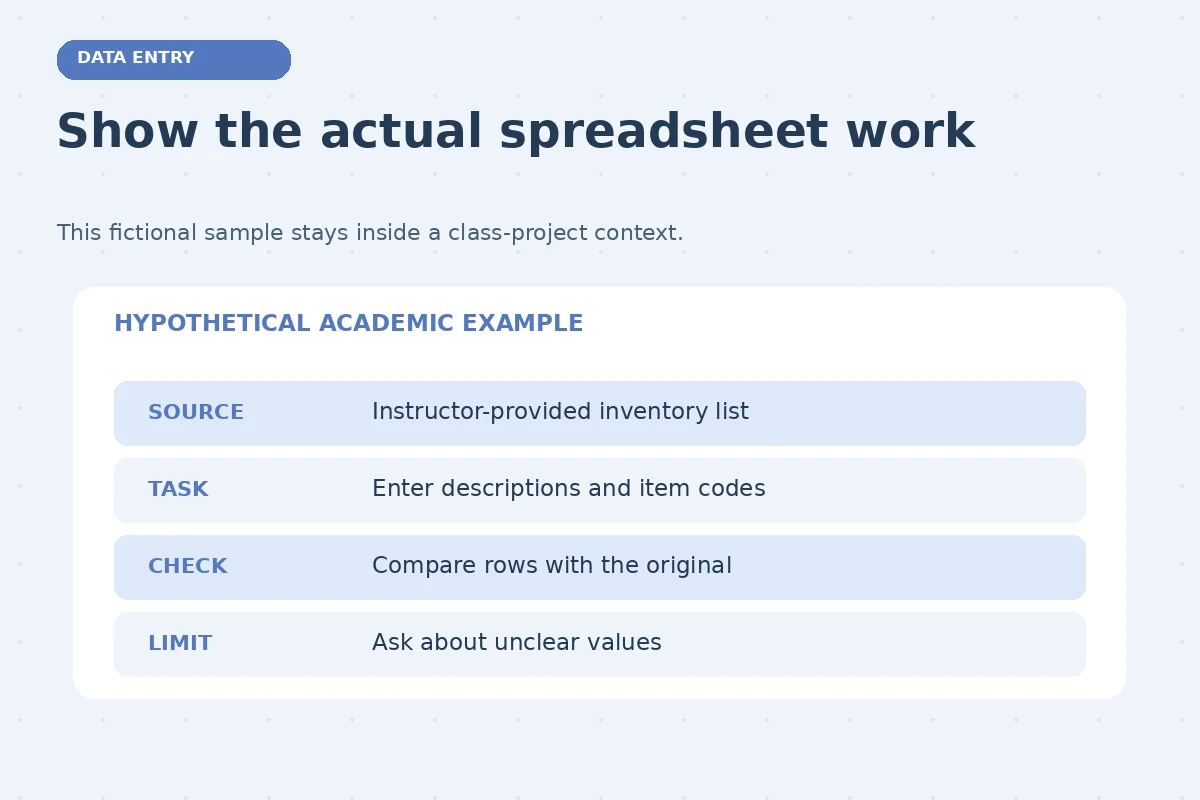
Pick a project you can discuss without revealing private information. You might have transferred fictional inventory items from a printed list into a spreadsheet, checked the item codes, and flagged one illegible entry for your instructor. That is an entry-level process example, not evidence that you processed thousands of financial transactions. Never include names, birthdays, student identifiers, patient data, or copied internal documents in a portfolio without proper authorization.
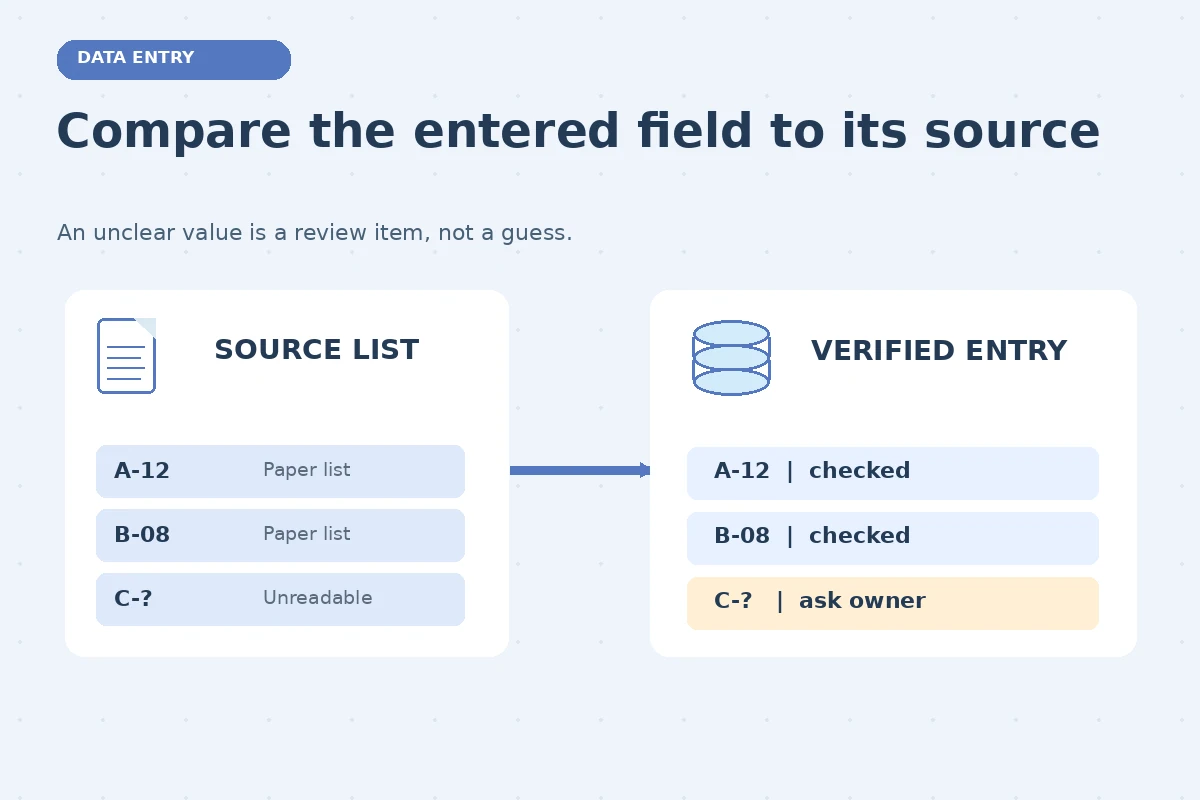
Explain the path from source to saved record
Start with the document that controlled the entry. Was it a course-provided worksheet, a paper attendance list, an approved inventory count, or a volunteer form? State how you kept columns consistent and what you used for validation. A project might involve making sure dates followed one format, checking that required fields were populated, and comparing a sample against the original. Those details are more useful than repeating “detail-oriented” in every sentence.
The error route matters. If a handwritten number was ambiguous, the correct response may have been to ask the record owner, not choose a digit that looked likely. If you corrected a practice spreadsheet yourself, say it was practice. If an authorized supervisor reviewed the entry, distinguish your flag from the final correction. This separates observation, escalation, and completion; it is also a good answer if an interviewer asks what you do when the source and system disagree.
Adapt this hypothetical data entry letter
This sample is fictional. It models a situation a beginner might genuinely have, but you must replace each activity, tool, and outcome with your own evidence.
Dear Hiring Manager, I am applying for the Data Entry Clerk opening posted on your company careers page. I am drawn to the role because it depends on consistent information, accurate transcription, and careful review. Although I have not worked in a paid data entry position, I have practiced checking source records through coursework.
For a classroom inventory project, I entered product descriptions and item codes from a provided paper list into a spreadsheet. I standardized the entry format, compared the finished rows against the source, and brought unclear values to my instructor instead of making assumptions. That experience taught me to document what is verified and what needs a second look. I would welcome training in your approved data handling procedures and systems. Thank you for your consideration; I would be glad to discuss how I approach accurate records. Sincerely, [Your Name]
Edit claims about typing speed and spreadsheet tools
Some postings request a typing test, numerical keypad use, spreadsheet formulas, or a specific database. Only claim a typing rate when you have a measured result from a test you can explain; never insert a fashionable number because a template recommends it. Name spreadsheet tools you actually used and only the functions you can demonstrate. Sorting a table is not the same as building pivot tables, and viewing a database is not maintaining its integrity.
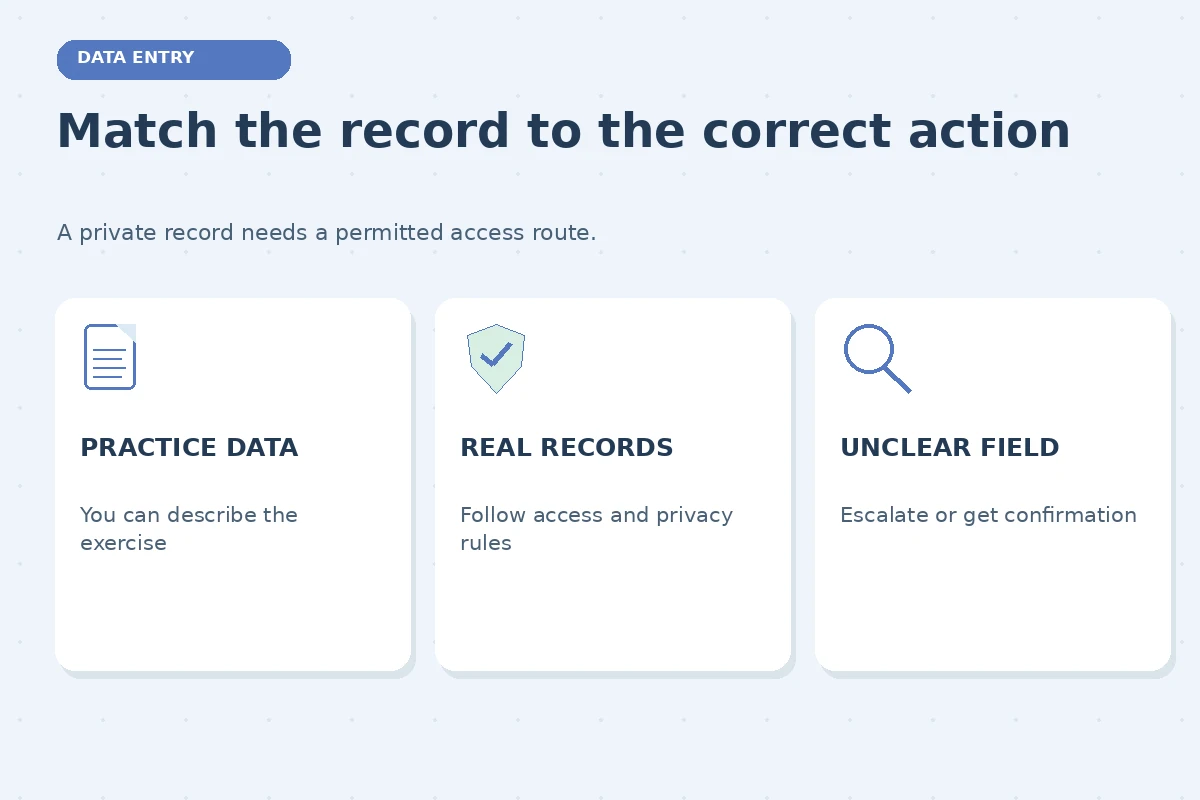
Review the job posting for the type of information involved. Handling invoices, patient records, or payroll data can entail distinct access rules. You can describe respecting school or volunteer privacy expectations, but do not imply HIPAA compliance training or other certifications you have not completed. If the opening involves protected records, make clear that you will follow the employer’s rules and ask for guidance before accessing or altering restricted information.
Avoid common first-job letter mistakes
A weak opening might say, “I am perfect at data entry and never make errors.” That assertion is unverifiable and ignores the real need for review. A better line says you compared entered codes with the source and flagged ambiguous records. Similarly, “I managed a confidential database” is inappropriate if you used a local class spreadsheet with fictional names. The letter should describe the complexity and scale of your actual project without upgrading its status.
Avoid stuffing the letter with software names, generic productivity promises, or claims that an automated system will select you. A short explanation of how you find and route an error is more revealing than an unsupported claim of being the fastest applicant. If you have made a correction yourself, describe the source you checked. If you simply reported the inconsistency, say that. Accuracy includes honest reporting of what you controlled.
Preview the file and verify the employer
Use a clean header that matches your resume, a clear role-specific opening, one concrete evidence paragraph, and a respectful close. The University of Pennsylvania career guide recommends tailoring cover letters to the opportunity and keeping ordinary nonacademic letters on one page. Proofread all dates, names, and the address or subject field. Export to PDF only when the posting accepts PDFs, then open it to confirm the lines and links still work.
Be careful with unfamiliar remote data entry advertisements. The FTC reports that job scams can impersonate recruiters and demand advance payments or information. Verify the vacancy through the organization’s own verified contact channels rather than sending sensitive personal data from an unsolicited message. A legitimate application letter should not include your Social Security number, bank account, or copies of private records. Save the final version so you know exactly what you submitted.
How We Research First-Job Cover Letters
We checked U.S. university career-center guidance on writing targeted cover letters and examined occupation-specific descriptions from U.S. Bureau of Labor Statistics or O*NET, as relevant to this role. Where privacy, credentials, or scam risks matter, we consulted relevant public guidance. We used these sources to check task descriptions and reasonable limits on candidate claims; they do not confirm any particular vacancy. The sample letter is wholly hypothetical, not a report of employment or a promise of hiring outcomes.
Sources reviewed November 13, 2026: careerservices.upenn.edu — University of Pennsylvania recommends matching role requirements to concrete transferable examples rather than generic claims.; www.onetonline.org — O*NET lists compiling, sorting, verifying, entering, comparing, and correcting data or reporting errors for data entry keyers.; consumer.ftc.gov — FTC warns that fake remote job offers may request money or personal information; a candidate should verify suspicious opportunities..
This page offers general U.S. career-document guidance; individual employers may request a different format or credential. Read the JobAsk affiliate disclosure. The navigation links above are informational and do not imply affiliate partnerships, employer endorsements, or an approved job offer.
More Resume and Cover Letter Guides
Describe a genuine classroom or volunteer project using source fields, consistent entry, verification, and follow-up. Label the setting accurately.
Yes, if you actually measured it and can identify the test or context. Avoid a made-up speed or accuracy percentage.
Not automatically. Describe the spreadsheet and tasks you performed without claiming you administered a database system.
Do not share protected or confidential records without explicit authorization. A recreated fictional sample can demonstrate a process without exposing real people.
Verify the position through an independently located employer site or contact and avoid demands for upfront money or sensitive information before proper checks.