
A college minor belongs next to the degree and major it accompanies, not on a separate line that could make it look like a second earned degree. A clear fictional example is “Bachelor of Science in Biology; Minor in Statistics.” Use the university’s official program name and list the minor only when completed or otherwise label its status accurately. A minor can support an application but does not change the degree granted.
Career-center guidance from Southwest Minnesota State University, UC Davis and CUNY treats majors and minors as related education details. The practical task is to make the award easy to understand, then decide whether the minor is worth the space. Focus on specific classes or projects only when they help demonstrate a capability requested in a role.
Start With the Credential the School Actually Awarded
Write the awarding institution and its location, followed by the official award and major. Then add “Minor in…” with the field as recorded by the school. Do not produce two separate degree headings for one bachelor’s degree with a minor. An employer should see that the major and minor are academic fields within a single credential, not independent certifications or licenses.
For a fictional example, “Bachelor of Arts in History | Minor in Data Analytics” communicates one degree with two subjects. Compare that with “Bachelor of Arts in History” and a second, separate “Data Analytics Degree,” which would be misleading if the second qualification does not exist. Check whether your school uses a minor, emphasis, concentration, or certificate; they may have different official meanings.
Choose a Compact and Readable Minor Layout
You can place the minor on the same line as the major or directly below it. Choose whichever makes the name of the school and degree easiest to read. The important points are consistency, an unambiguous “Minor in” label, and space for a graduation or expected date. An unusually long major title may need two lines; do not reduce the font or create a dense symbol-filled row just to keep everything on one line.
For current students, distinguish a declared minor from a completed minor when that difference matters to the hiring decision. A hypothetical “Minor in Economics (in progress)” is clearer than presenting coursework as a finished designation before the university confirms it. If the minor is not on your record, describe relevant classes under coursework instead of claiming a formal minor.
| Education field | Correct label | Avoid |
|---|---|---|
| Credential | Bachelor of Arts / Bachelor of Science | Calling the minor a degree |
| Primary study | Major in the official discipline | Renaming the major |
| Secondary study | Minor in the completed field | Claiming unearned completion |

Decide If the Minor Strengthens This Application
A minor deserves space if it connects to the role’s tasks or explains a combination of skills. A psychology minor might add context to a human-centered research application; an additional language or mathematics field could be useful when duties require it. It is not automatically stronger than paid work, relevant projects or supervised training. Put the most convincing evidence first, especially when your experience section is already substantial.
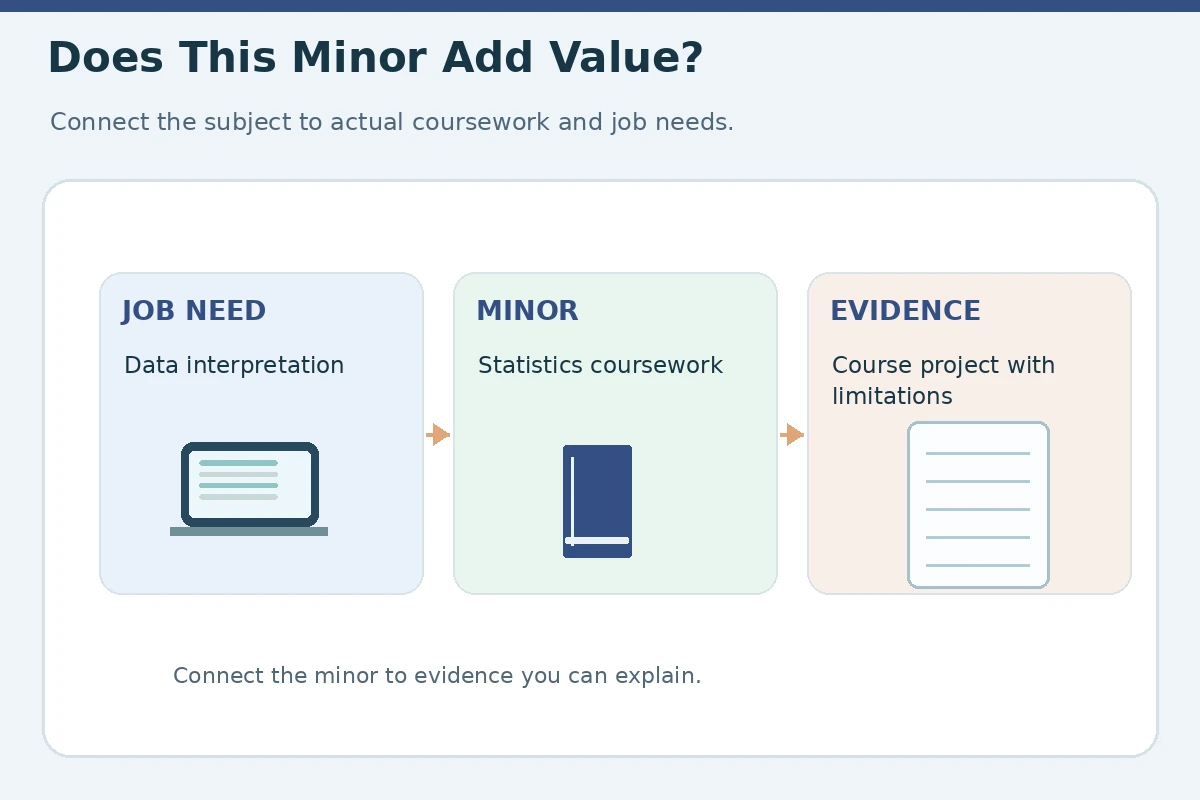
Use the job description as a filter: identify one requirement the minor helps support, then find a real course, project or practical experience that demonstrates it. A minor alone does not prove full professional competence. Avoid asserting fluency, programming mastery or statistical authority because the discipline appears on a transcript. Tell the reader exactly what you studied and applied when such detail is relevant.
Separate a Minor From a Double Major or Certificate
A double major, two awarded degrees, a concentration, a certificate and a minor can all appear near the education section, but they are not synonyms. Confirm the terms used by your registrar or official program record. When a student has one degree with two majors, the label “Double Major” may be appropriate; a minor should remain “Minor.” When someone earned a certificate, the certificate is a separate award only if the school actually issued it.
If you completed elective courses outside your major but did not finish the minor requirements, do not treat the classes as a finished minor. Select relevant course titles or a project instead. If a program is in progress, state the expected status clearly without predicting an award that the institution has not granted. Honesty in short credential labels is particularly important because application forms often ask you to enter each award separately.

Connect the Minor to Proof Instead of Buzzwords
Use a one-line accomplishment only when you can support it: “Analyzed survey data for a statistics course project and presented limitations,” for example, may illustrate the application of a statistics minor. The project statement belongs under Projects when it needs detail; keep the Education entry concise. If a project was completed in a team, identify your specific part rather than suggesting you designed or published everything yourself.
An application to a communications coordinator role might pair a media studies major with a Spanish minor, but it should not promise bilingual professional fluency without a separate assessment of actual skills. The field studied and the skill demonstrated are different claims. Use evidence such as a portfolio, writing sample, classroom deliverable or supervisor-reviewed work only when you are authorized to share it.
Check the Final PDF and Application Form Fields
Review the education entry for school name, official degree, major, minor and date. If a company’s application form has a field for “major” but none for “minor,” keep the degree field accurate and add the minor in an optional note only if allowed. Never enter the minor as an additional degree simply to make it appear in a required dropdown.
Read the saved resume at normal screen width. Make sure the minor visually belongs to the degree and cannot be mistaken for a new credential. Remove a low-relevance minor if it crowds more persuasive work, and expand it when specific job requirements make the subject important. A readable, verifiable entry is more useful than the largest possible inventory of educational terms.
How We Research Resume Education Claims
We checked the referenced career-center and registrar guidance on 2026-11-14: SMSU resume education guidance (Southwest Minnesota State University describes how to display degree, major, minor, school, and completion date.); UC Davis Career Center (UC Davis Career Center lists name of school, degree, major, minor, and optional academic distinctions.); CUNY resume guide (CUNY advises listing school, credential, graduation status, major or minor, and relevant optional academic honors.). We also compared this specific intent with the supplied WordPress title exports, the existing batch inventory and public search results to reduce overlap. Institutional academic terms and policies vary: always verify a credential, date and honor against your own official records. All person, school, program and date examples in this article are hypothetical unless explicitly identified as source policy. Read the JobAsk affiliate disclosure; no paid relationship or approved affiliate program is claimed.
More Resume and Cover Letter Guides
No. Normally it is a secondary academic field associated with one degree, so label it as a minor rather than another awarded degree.
It is optional. Include it when it adds useful context, but prioritize stronger experience or projects if space is limited.
You may describe an officially declared minor in progress when useful, but make the unfinished status explicit and verify the record.
Place it on a second line below the degree and major. Keep formatting legible and clear rather than shrinking the text.
No. A college minor is not proof of a regulated license or professional authorization; state those credentials separately if earned.