
An environmental science internship resume should identify exactly what you observed, recorded, collected with authorization, or checked. A strong entry might describe preparing field forms, labeling approved sample containers, documenting instrument readings, or flagging incomplete notes for a supervisor. It should not claim independent site assessments, regulatory conclusions, laboratory certification, or guaranteed environmental improvements if you were a student assistant working under a project plan.
Environmental monitoring is built on traceable methods and records. EPA quality-assurance guidance explains that field documentation and sample custody help make data interpretable and defensible. An intern may contribute to some steps but not the whole process. The resume examples below are hypothetical. Adapt them only to activities you performed with appropriate training, supervision, and permission to disclose.
Separate Field Observation From Sample Collection
Field work can include attending a site visit, recording a permitted observation, preparing log sheets, assisting with equipment checks, or collecting samples as an authorized team member. These are not equivalent. Write “Observed team sampling procedure and recorded field conditions under direction” if that was your task; do not use “collected environmental samples” unless you personally did so within the team’s approved procedure.
Different sites have different safety rules, access restrictions, and quality plans. Do not imply that all interns can enter hazardous locations or use specialized instruments. You can show readiness by describing your respect for training, personal protective equipment requirements, and the approved role of the field lead. Avoid listing equipment certifications you do not have, and be precise if you only practiced a method on a training bench.
| Internship activity | Honest resume evidence | Claim to avoid |
|---|---|---|
| Field visit | Recorded site conditions on approved forms | Claiming independent site inspection |
| Sample record | Checked IDs and handed discrepancies to field lead | Claiming lab certification |
| Academic analysis | Charted publicly available or simulated data | Inventing measured environmental improvements |
Show Field Notes as a Traceable Work Product
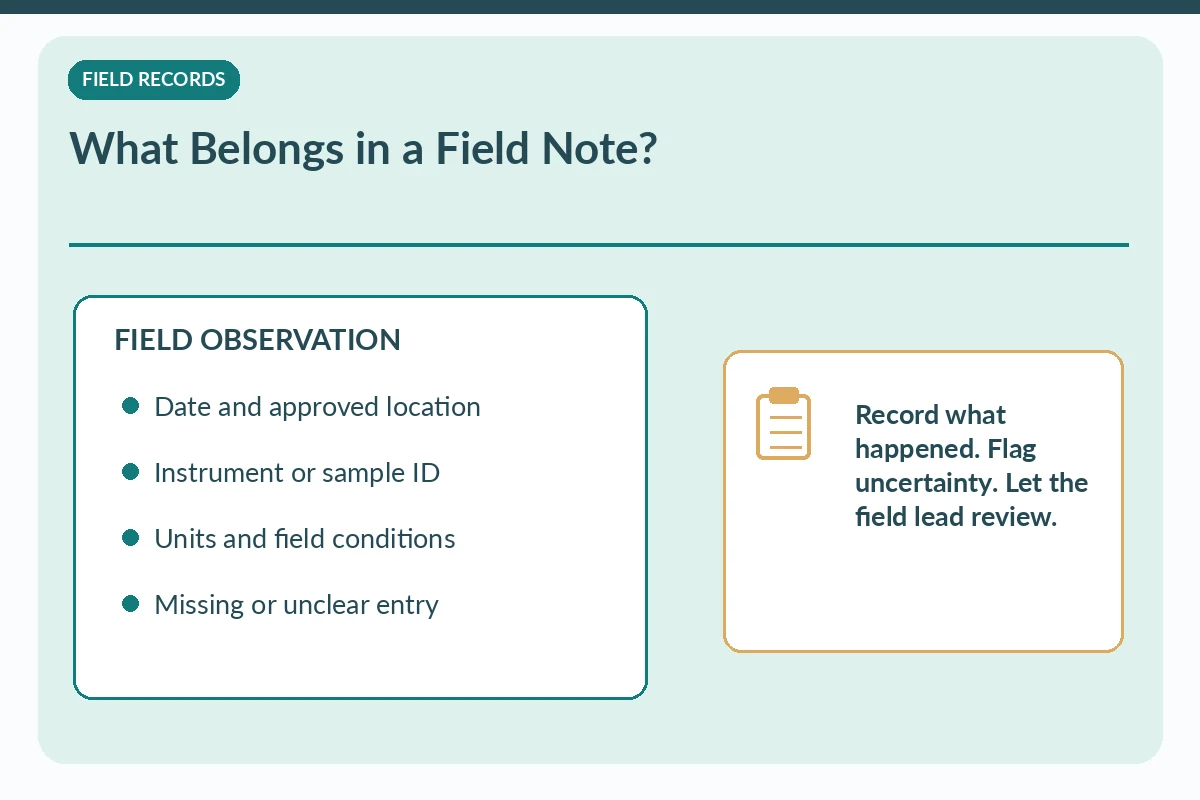
A field note is useful when the next analyst can tell what was observed, where the record belongs, when it was made, and what uncertainty remains. Example, if true: “Recorded approved weather and site-observation fields on standardized field sheets and flagged missing entries during staff review.” This describes documentation rather than claiming to interpret environmental compliance. If the location or project identifier is restricted, use a general descriptor in your public resume.
You may have verified instrument identification, copied readings under direction, or organized worksheets by time and sample code. Explain which quality check you did. A resume does not need to reproduce the worksheet or publish precise site coordinates. It should show a disciplined method: consistent labels, reviewable corrections, and escalation of missing information. Only name a chain-of-custody responsibility if you actually carried out that authorized step.
Clarify Sample Labels, Custody, and Lab Boundaries
Sample custody and field handling are governed by project procedures; do not invent a universal rule about who may sign documentation. A student may have set out approved containers, attached supervisor-provided labels, or cross-checked sample codes. Another student may have observed a designated sampler transfer a container. These responsibilities should be described separately. A hypothetical bullet could say: “Checked approved sample IDs against field log entries and notified the field lead about mismatches.”
Do not confuse tracking a sample with conducting laboratory analysis or validating a final result. If a laboratory handled analytical tests, describe your contribution as documentation or transfer support. Avoid statements such as “certified water quality” or “confirmed regulatory compliance” unless those judgments were genuinely assigned to you and independently verifiable. A truthful handoff shows understanding of the method and the limits of your role.

Describe Data Quality Without Invented Findings
The same discipline applies after field work. You might flag missing values, compare duplicate entries, check units, or make a chart from an authorized public dataset. Say which check you performed: “Reviewed approved measurement tables for missing units and recorded clarification requests for the project analyst.” That is different from “proved the site was safe.” Scientific findings require appropriate methods, interpretation, and review; do not attribute the entire report to a student who prepared an input table.
If your team reported a result, do not automatically claim it as your outcome. Describe the analytical support you provided and let the report’s authorized authorship remain clear. An invented percentage reduction in contamination is not a resume achievement. If you do have a permitted aggregate number, specify whether it is a sample count, a time interval, or a finding, and confirm your supervisor approved public disclosure.
Create a Portfolio Example With Public or Synthetic Data
An internship may give you no public portfolio material because field coordinates, property information, or internal QA records are restricted. That does not prevent you from demonstrating method. Create a fictional field log and simulated sample codes, or analyze a properly identified public dataset. State the source, assumptions, units, and limits; do not let readers mistake invented values for measured pollution or health outcomes.
A relevant course project might involve comparing sample-label consistency, creating a chart with correctly labeled axes, or explaining why missing observations limit a conclusion. Mark the work as Coursework or Independent Practice. Only describe authorized field equipment use as hands-on experience, and never suggest a practice spreadsheet substitutes for specialized training or a required credential.
Verify Site Details and Export a Defensible Resume
Before you send the resume, match title, host organization, dates, field duties, and supervision to your notes. Check whether a site, project, species, location, or sample label is sensitive. Replace exact identifiers with truthful general descriptions when confidentiality requires it. Review any line that uses “managed,” “certified,” “validated,” or “assessed”—those verbs may claim a level of scientific authority you did not hold.
Finally, tailor the order to the opening. Field technician roles may value documented observations and safe procedure; environmental data roles may prioritize unit checks and traceable datasets. Keep the resume scannable, use consistent tense and a readable PDF, and ensure each result can be explained without access to restricted records. Accurate field notes, quality checks, and responsible handoffs are useful professional evidence even when no dramatic environmental outcome is available.

How We Research Internship Resume Examples
Sources checked on 2026-11-15: nepis.epa.gov (EPA quality-assurance guidance describes how field sampling, custody records, and data quality procedures are planned and documented.); career.ucsd.edu (Resume bullet examples should explain methods and individual contributions, including relevant internship or project experience.); careercenter.umich.edu (Resume entries benefit from action verbs, accurate scope, and measurable details only when verified.). We distinguish documented occupational tasks from work a particular intern was actually authorized to perform. All sample sentences above are invented examples; verify your own dates, duties, records, permissions, and outcomes. This informational guide has no verified paid recommendation. See the JobAsk affiliate disclosure for site-wide transparency.
More Resume and Cover Letter Guides
Only when they are verified, permitted to share, and accurately tied to work you personally did.
No. Describe observation separately from hands-on collection carried out under an approved procedure.
Do not post internal or sensitive records without explicit authorization; use a clearly labeled synthetic or public example instead.
Do not claim operating proficiency from observation. State your actual training or supervised use.
Describe the field or data checks you contributed and identify review and final interpretation as team responsibilities.