
A resume education section without a college degree can still be meaningful. List the school credential you earned, then relevant technical courses, apprenticeship education or verified training. Keep each qualification at its actual level: a course is not a diploma, a workshop is not a license and workplace learning is not a degree. This guide helps you decide what to include and how to connect genuine training to jobs that consider experience or nondegree pathways.
A college degree is not required to write a credible education section
If you do not hold a college degree, you can still build a clear Education and Training section from the schooling and courses you actually completed. Start with the highest earned credential, if one exists, then select relevant vocational classes, employer-sponsored learning, apprenticeships or workshops. CareerOneStop explicitly includes technical training and coursework in its education guidance. The key is to show what each item was, who provided it and what you can now do. A resume should not pretend a nondegree training program is a bachelor’s or associate degree. Nor should it hide meaningful work experience behind a long list of classes.
List your high-school credential accurately
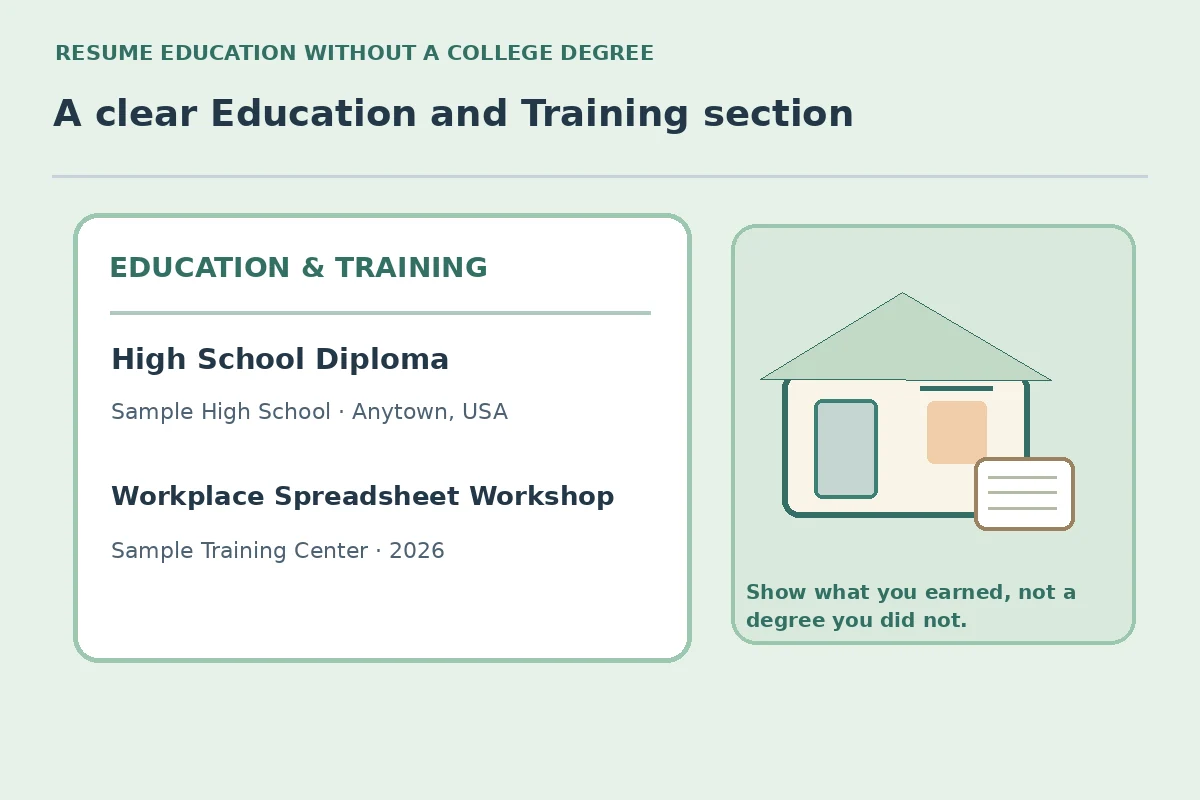
If high school is your highest completed schooling and the role calls for a diploma or equivalent, a concise entry can help: “High School Diploma — Sample High School, Anytown, USA” (hypothetical). If you earned a high-school equivalency rather than a diploma, use the correct credential and jurisdiction. An attended but unfinished high-school program is not the same as graduation. Do not include fabricated awards or GPAs. If you have a long work history and high-school education adds little, the education entry can be short while work accomplishments occupy most of the page.
Differentiate a technical class from an earned program award
A vocational course, workshop, completion certificate and accredited diploma are not interchangeable. If you attended a technical-school bookkeeping class, you can identify the class and provider without asserting that you graduated from the full bookkeeping program. Likewise, an employer-sponsored training session may support a skill but not a separate qualification. Ask what the actual provider’s certificate says; if nothing was awarded, use the word “Course” or “Training.” The final line can be simple, such as “Inventory Records Workshop — Sample Training Center, completed 2026.” Never add “licensed” or “certified” without a valid credential.

Place apprenticeships and supervised learning in the right section
An apprenticeship combines structured learning with practical experience, but its details vary by trade and program. If you are registered in an apprenticeship, describe your actual enrollment and work duties accurately and check which qualification has been completed. A supervised workplace task may belong under Experience, while the formal training program belongs under Education and Training. Do not imply that being an apprentice authorizes independent regulated work. When an employer requires a particular license or journeyman status, compare your current credentials with that requirement instead of assuming time spent training automatically meets it.
Turn ordinary workplace learning into evidence
Perhaps you learned a scheduling system on the job, took a document-control workshop or completed team training. Those details can matter when they connect to a target opening. However, a standalone course line is weaker than a concrete example of using the skill. A hypothetical warehouse applicant could say, “Reviewed delivery scan discrepancies and documented corrections for supervisor review,” if that reflects actual prior work. Do not invent hours trained, vendor certificates or quality results. Your job history can demonstrate reliability and learning even when formal education is limited.
Decide what to put first when you have practical experience
For a first-job applicant, Education and Training may sit near the top because employers need to understand your readiness. For someone with several years of relevant work, keep Work Experience first and put a compact education record later. Do not use a functional resume format to conceal dates when the application explicitly asks for them. A readable document with school, course, provider and status labels is generally easier to check than decorative graphics or unexplained badges. If an application form separates degrees from training, use the correct fields rather than entering a workshop as a college award.
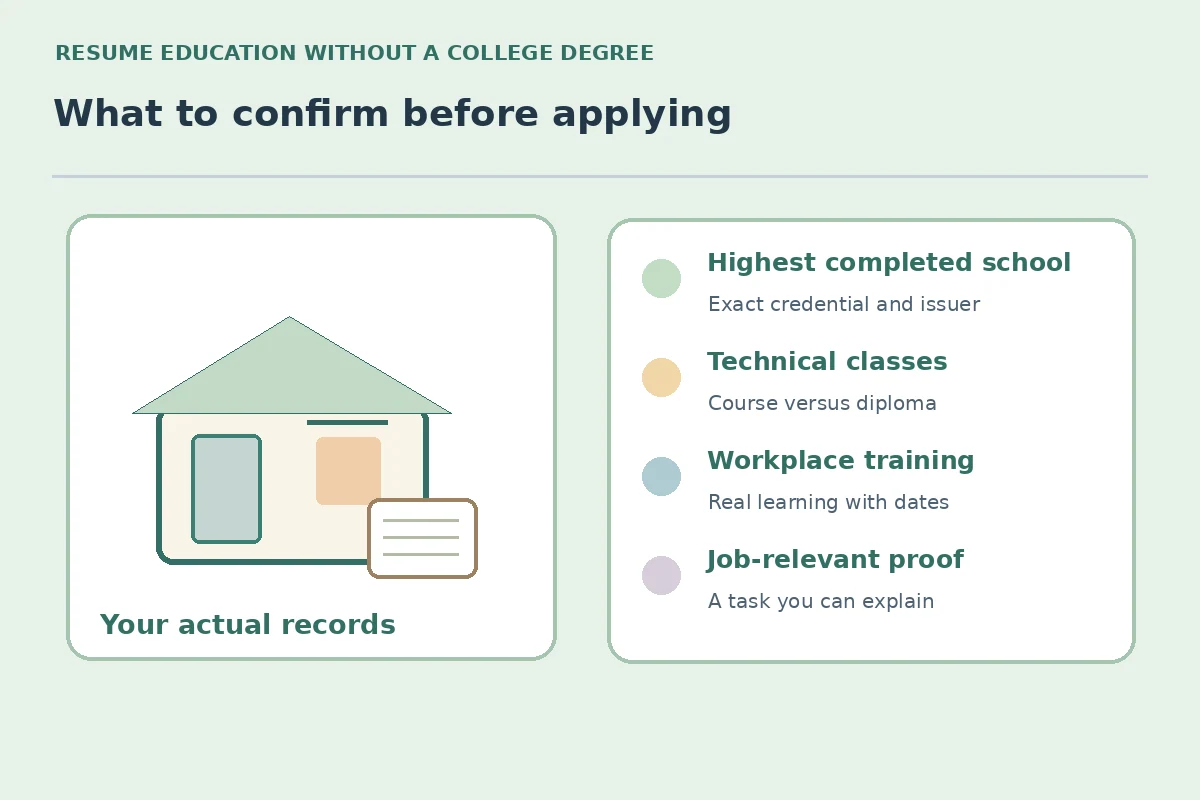
| Item to check | What the resume should show |
|---|---|
| Highest completed school | Exact credential and issuer |
| Technical classes | Course versus diploma |
| Workplace training | Real learning with dates |
| Job-relevant proof | A task you can explain |
Make a sample entry that does not imply graduation
An unsafe hypothetical example is “Associate Degree in Office Administration — not completed.” The wording risks confusion because the award was never earned. A clearer alternative, when true, is “Office Administration coursework, Sample Community College; 18 credits completed; no degree awarded.” If the person has no college coursework, use school and completed training instead: “High School Diploma, Sample High School; Workplace Spreadsheet Workshop, Sample Training Center, completed 2026.” Use only the credits and dates shown on real records. Never insert a sample number into your actual resume unless verified.
Address postings that require a college credential
Read whether the employer lists a degree as required, preferred or one possible combination of education and experience. These categories have different implications. If the role or licensing body legally requires a degree, your unrelated workshop cannot replace it. If an employer considers equivalent experience, provide evidence of specific tasks you have performed and ask how the employer evaluates qualifications. Avoid false checkboxes in application forms. You can still target roles that explicitly welcome nondegree training or provide paid onboarding instead of trying to make one class look like formal graduation.
Proofread terminology and keep records available
Verify the name of each school and training provider, whether you completed the program and which document was issued. In your private notes, save actual course transcripts, apprenticeship paperwork and certificates for later verification. Do not attach identity documents or transcripts to unsolicited messages. Delete irrelevant training from the final resume when it distracts from stronger work evidence. Keep the exported PDF readable and consistent with any online application form. A short, accurate section often communicates more than a long, inflated qualification list.
How We Research Education and Credential Guidance
JobAsk checked these education, career-service and occupational sources on November 17, 2026: CareerOneStop explains how to list education, training, awards and study in progress without misrepresenting a degree. CareerOneStop outlines evidence for education without a degree, short courses, significant awards and completed credits. UC Davis recommends distinguishing education from workshops, training and coursework, including incomplete programs. We compared guidance on education records with the distinctions that an applicant must verify with a real provider, school or regulator. Requirements vary by employer and jurisdiction; a cited educational resource is not proof that a particular applicant has a credential. All example schools, award names, documents and people in this article are hypothetical and are not evidence of a real award, employer endorsement or employment outcome. We do not promise hiring, testing results or acceptance by an applicant tracking system. There is no claimed paid partnership in this article. Read our affiliate disclosure for relationship transparency.
More Resume and Cover Letter Guides
List the high-school credential you actually earned and relevant vocational, workplace or apprenticeship training with accurate completion status.
Yes. Describe it as coursework or training, identify the provider and do not imply the full program award was earned.
Use Education and Training for formal learning and Work Experience for tasks you actually performed; both may be appropriate without duplication.
Read whether it is required or preferred. Do not claim equivalence where the employer or regulator requires an actual degree.
Often, especially when more recent relevant education or work experience makes it unnecessary. Follow the employer’s specific application instructions.