
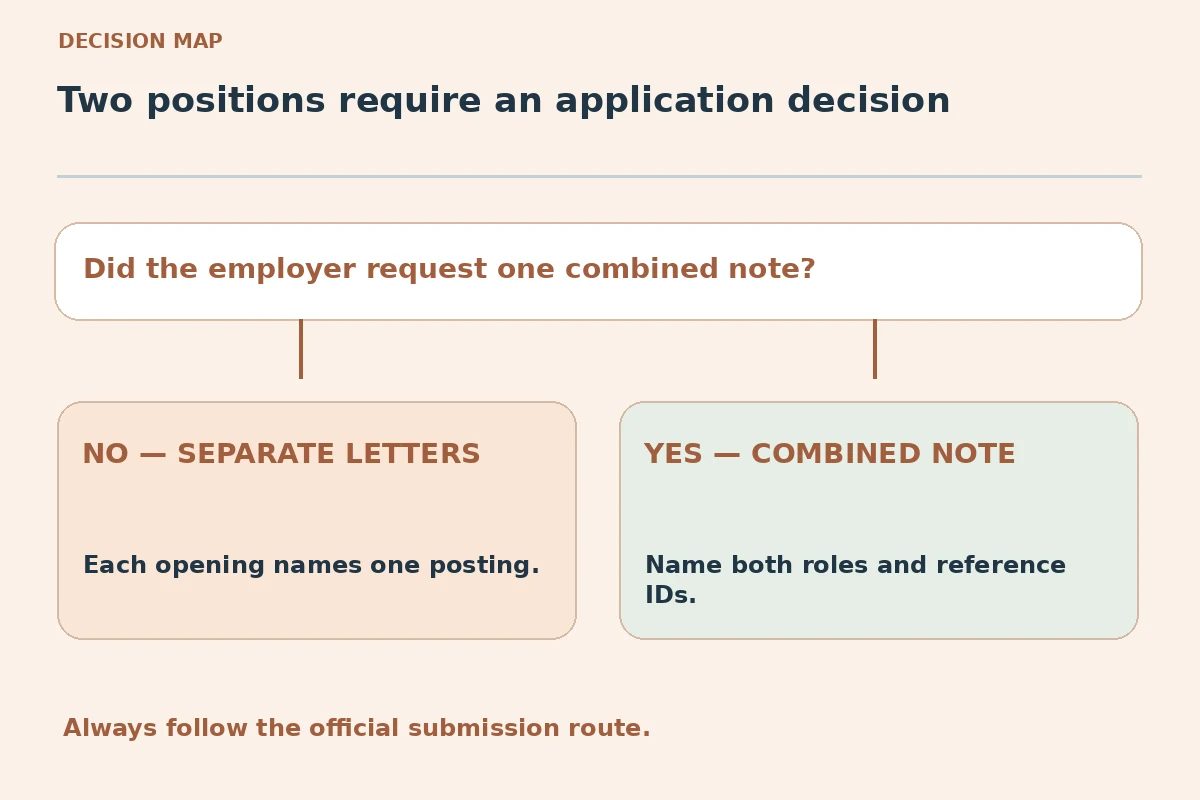
When you want two jobs at the same company, the safest cover-letter opening usually names one specific vacancy at a time. Write a distinct first paragraph for each posting and match each to its real duties. A generic ‘I am interested in any available position’ hides the requirements you could meet. If an employer or recruiter explicitly invites one combined message for two roles, identify both titles and any reference numbers in that note. The decision depends on the submission instructions, not on an assumption that one letter will automatically route to several hiring teams.
Compare the two postings before writing either letter
Collect the actual descriptions for both jobs and make a small side-by-side table. Include title, requisition number, location, required credentials, central tasks and submission route. Similar titles may have different ownership, schedules or technical requirements. For example, an Inventory Clerk may maintain receiving logs while a Scheduling Assistant coordinates calendar updates; the same applicant might have evidence for both, but the first sentences should not be identical. Mark requirements you genuinely meet and those that you do not. Do not assume the employer will consider a candidate for every vacancy because one application was submitted. Check each posting’s separate deadline and required attachments.
Default to separate role-specific introductions
The University of Michigan Engineering career center explicitly discourages a generic cover letter for several positions. For ordinary applications to two advertised openings, prepare two letters, each naming the exact role and explaining one relevant experience. You can reuse true background facts but not the central fit claim without checking whether it makes sense for both roles. Use the employer’s own application system for each posting unless directed otherwise. The purpose is not to flood a company with messages; it is to let each hiring team see the most relevant evidence quickly. Keep the records separate, especially when the roles have different requisition numbers.
Write a different evidence sentence for each role
For an inventory-oriented posting, lead with a documented example of counts, receiving logs or exception notes. For an office scheduling posting, lead with calendar coordination, handoffs or visitor communication. If the same internship involved both tasks, state the correct task in the appropriate version and avoid implying you held two different job titles. The opening can be compact: one sentence naming the role and one sentence about the best example. Save the fuller context for later paragraphs. A broad assertion of ‘strong organizational skills’ is less informative than a real workflow you can describe, even if that workflow was part of an entry-level position.
Know the exception for an employer-approved combined note
Sometimes a recruiter has already reviewed your profile and explicitly asks for a single message covering two openings. In that case, a short combined introduction may be appropriate: name both exact roles or requisitions, identify one shared skill supported by evidence and ask how separate applications should be recorded if necessary. Do not choose a combined submission on your own when two individual applications are required. If the recruiter says they will route your profile internally, keep a record of that instruction without inventing an application confirmation. The final method should match the actual employer process, not an online template’s assumption about hiring administration.
Avoid an opening that sounds indifferent to the work
A weak illustrative introduction says, ‘I will do anything at your organization and am qualified for every open position.’ A more useful one says, ‘I am applying for the Inventory Clerk vacancy, Req 411. My receiving-log experience fits the position’s record-checking responsibilities.’ This example is hypothetical and uses invented role numbers solely to illustrate formatting, not a real vacancy. A separate Scheduling Assistant letter might reference calendar change tracking instead. A clear target does not mean you cannot consider another job later; it tells the reader which opening you are addressing now and why the evidence is credible.

Check when two jobs have different eligibility rules
An employer can have separate physical, licensing, shift, education or location requirements for superficially similar openings. Do not copy a claim about work authorization, credentials or availability from one application to another unless it is true for both. If a job requires a professional license, one relevant class is not equivalent to the credential. Where a job describes financial approvals or patient-facing work, clarify the duties you have actually performed versus those handled by qualified staff. Even if you could perform some tasks in both roles, use the first paragraph to highlight only verified experience. Keep the opening truthful and let the employer evaluate eligibility from the complete application.
| Check | Evidence needed |
|---|---|
| Vacancy A | Title and requirements |
| Vacancy B | Different role requirements |
| Submission | One or two permitted routes |
| Proof | Match each role accurately |
Use a simple role-to-evidence worksheet
Create four columns for your own use: exact vacancy, important requirement, your example, and where the example appears in the letter. If two jobs share a requirement, check whether one example really demonstrates it in both contexts. For instance, accurate data entry may support inventory records and administrative scheduling, but the employer may also expect different systems and communication. Do not turn a single classroom exercise into a statement of production-level expertise. The worksheet should reveal when the applicant has no good example, in which case that claim should not be forced into the introduction. The graphic below shows how to keep two applications distinct while maintaining factual consistency.

Track separate submissions and recruiter instructions
Keep the final letters, resumes, application IDs, posting URLs and submission receipts for each role. If the company portal allows only one active application or a recruiter asks you to prioritize a position, follow its actual rules and record the choice. Do not repeatedly apply through alternative accounts to bypass a restriction. Review each first paragraph for an accidental reference to the other role or department before submitting. A short, relevant introduction makes later communication easier because you can quote the exact vacancy being discussed. No particular choice guarantees the hiring team will read a letter or invite you to interview.
How We Research Cover Letter Opening Advice
JobAsk checked the following original government or university guidance on November 17, 2026: University of Michigan Engineering Career Resource Center discourages sending a single generic letter for multiple positions. University of Illinois advises a customized opening naming the role and relevant qualification, instead of mass-produced cover-letter introductions. University of Michigan advises naming the role and motivation in the first paragraph, using authentic evidence from work or academic experiences, and using a professional salutation. CareerOneStop recommends a position-specific first paragraph and permits an email-body cover letter when the employer requests an emailed resume. We compared the actual cover-letter and role requirements described in these sources with the distinct first-paragraph problem addressed here; neither the illustrations nor sample wording represents a real vacancy, applicant outcome, school, or employer communication. For every sample, verify the specific job posting, eligibility rules, contact details, document format, and genuine personal qualifications. Where a source describes a typical process, the actual employer instructions take priority. We do not guarantee interviews, ATS outcomes, licensing, employment offers or responses to messages. For potential commercial relationships, read our affiliate disclosure.
More Resume and Cover Letter Guides
Separate role-specific letters are usually clearer when you submit two applications. Follow the employer’s process; use a combined note only if it expressly invites one.
Yes. Name each exact title and use the evidence relevant to its requirements, even if the employer is the same.
Still check separate job descriptions, IDs and qualifications. A small difference in duties can change which experience is most useful to lead with.
That is usually too vague for an advertised vacancy. Identify a realistic target role and the qualifications you actually have.
State the two titles and their requisition IDs, explain the common relevant skill briefly, and follow the recruiter’s requested format.