
For an advertised PhD-level research position, open with the exact appointment and a narrow statement about how your verified methods or publications connect to the team’s stated work. The first paragraph should not try to retell a thesis or imply you led a principal investigator’s entire project. Academic employers may ask for a CV, research statement, teaching statement or other documents separately, so read the specific instructions before deciding what belongs in the letter. A useful research opening makes three facts easy to find: the role, the relevant work you personally performed, and the fit that can be checked from the vacancy description.
Locate the precise research appointment and requirements
The wording ‘research position’ can describe a funded postdoctoral fellowship, staff research associate, laboratory scientist or term-limited project appointment with different responsibilities. Start by identifying the employer’s actual title, department, supervisor or research unit, and whether the posting emphasizes methods, teaching or administration. Do not assume a PhD alone satisfies every eligibility requirement. A letter for a staff research role may need to foreground operational project skills; a faculty search may evaluate a research agenda. University of Chicago career resources emphasize tailoring academic materials to the hiring institution and role. Use the advertisement as the organizing document rather than a generic application letter found online.
Lead with a verified method or scholarly contribution
Choose one skill the employer describes and connect it to a task you completed. For example, archival coding, experiment setup, survey design or analysis of a reproducible public dataset may demonstrate a relevant method if you actually used it. Distinguish collecting data from designing a study, implementing a protocol from approving it, and participating in publication preparation from being an author. If a paper is accepted, in revision or only submitted, use the accurate status. Do not invent a publication, grant, peer-review decision or dataset access. The opening can be effective with one truthful method-and-contribution sentence; elaborate project context belongs in a later paragraph or research statement.
Connect your work to the lab without inventing collaboration
Review the job posting and the organization’s official information to identify a specific connection, such as a documented method, research question or type of evidence. A good fit statement says why your actual workflow would help with the advertised tasks. It does not claim that the hiring team has selected your application or that you have access to unpublished results. Avoid casual praise about revolutionary discoveries. If the lab publishes a public description of a project, you may refer to it accurately, but do not speculate about budgets, staffing or confidential partners. Fit is a reasoned comparison of published requirements and experience, not a promise of a future result.
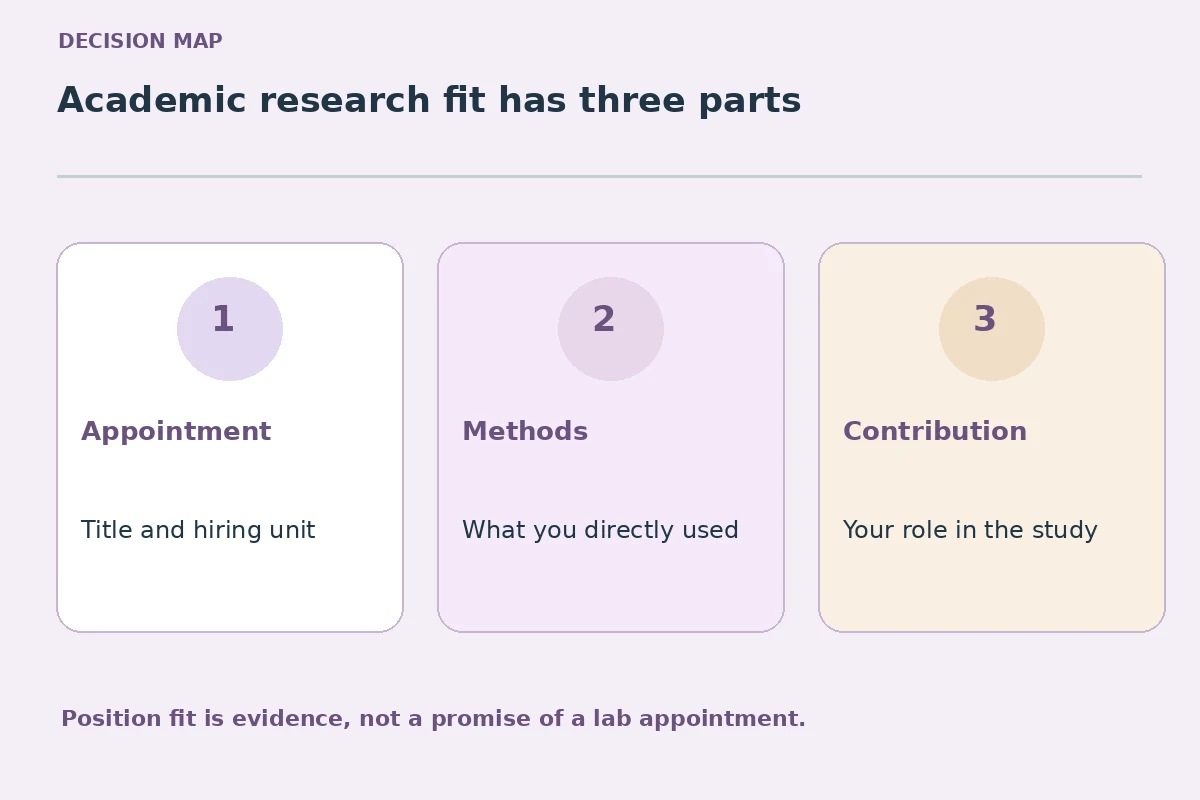
Give your research role the correct level of authority
Academic work is collaborative, and research governance matters. You may have cleaned files, prepared instruments, followed an approved protocol, maintained version history, or supported a literature review; the supervisor may have designed the study or authorized participant contact. State the distinction. If you were a teaching assistant, do not describe student support as being the instructor of record. If your work involved sensitive participants or licensed procedures, do not present it as independent authority without evidence. A clear research cover letter demonstrates judgment by crediting coauthors, advisors and project leads where appropriate. The first paragraph need not name them all, but it should avoid transferring their decisions into your achievements.
Keep the opening distinct from the research statement
Academic applications can request both a cover letter and a separate research statement. The letter should explain why this particular appointment is relevant and introduce one or two fit claims; the statement can explore a research agenda, methods, collaborations and future projects in greater depth. Follow the employer’s requested document set and length limits. Some academic letters are longer than conventional business letters, especially for faculty roles, so an arbitrary one-page rule is not universal. University guidance describes different emphases for research-led and teaching-led institutions. Your opening serves as a map for the reader, not a substitute for evidence and citations in the remaining materials.
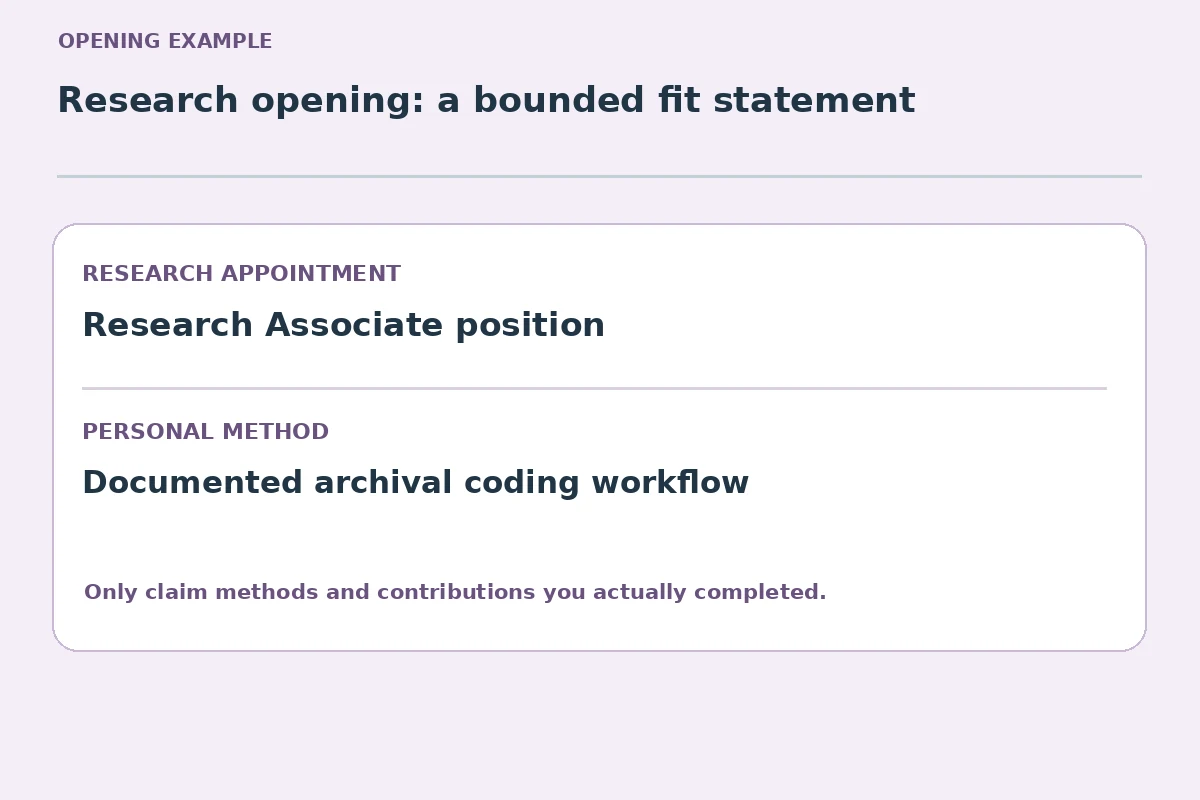
Rewrite a grandiose opening as a bounded claim
Weak illustrative opening: ‘My groundbreaking doctoral research proves I am an expert in every relevant method and will transform your lab.’ A better hypothetical version is: ‘I am applying for the advertised Research Associate position. My doctoral project involved an archival coding workflow with reproducible notes, which relates to your posting’s emphasis on documented research methods.’ This example does not assert a real job opening or grant. It limits the claim to work the candidate can explain. If the candidate did not personally create the coding approach, change the wording to reflect a support role. Precision about contributions is stronger than unsupported claims of exceptional impact.
| Check | Evidence needed |
|---|---|
| Appointment | Title and hiring unit |
| Methods | What you directly used |
| Contribution | Your role in the study |
| Materials | CV or statements requested |
Prepare supporting materials with matching facts
Check that the CV, publications list, portfolio, and statements use the same institution names, job titles, project dates and authorship status. If the application requires a writing sample, choose permitted work and remove private data. A paper draft is not automatically a published article. If a laboratory method required supervision, do not omit the supervision in the letter while noting it elsewhere. Keep research themes understandable to a mixed search committee when relevant; jargon alone does not show fit. If you mention technical tools, be prepared to describe a task, input, quality check and limitation. Maintain a version of the opening for each application and confirm no previous institution’s name remains.
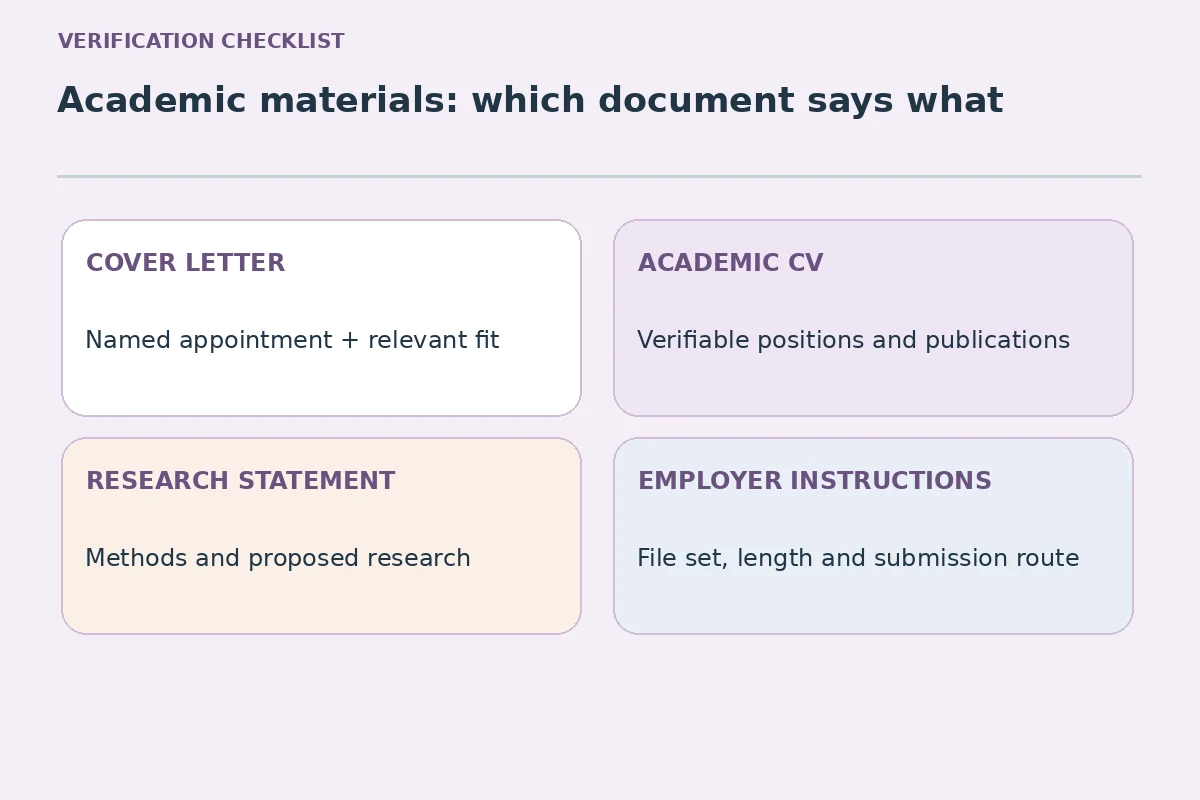
Finish with the employer’s actual submission route
Academic postings may require a faculty portal, centralized HR system, direct email or multiple referee submissions. The first paragraph cannot compensate for an incomplete application. Check whether the requested position is current, what documents are required and how letters are submitted. Where the employer specifies a research statement, teaching statement or transcript, attach only what the instructions allow. Do not email sensitive materials to an unofficial address. Track the posting identifier, application date, submitted file versions and confirmation receipt. A strong opening helps the search committee understand your fit, but it does not guarantee an interview, funding decision or appointment.
How We Research Cover Letter Opening Advice
JobAsk checked the following original government or university guidance on November 17, 2026: UChicagoGRAD explains that academic letters should emphasize documented research and teaching fit and reflect the institution and specific advertisement. University of Michigan describes how academic-search cover letters can connect research and teaching interests to the role and other application statements. University of Michigan advises naming the role and motivation in the first paragraph, using authentic evidence from work or academic experiences, and using a professional salutation. University of Illinois advises a customized opening naming the role and relevant qualification, instead of mass-produced cover-letter introductions. We compared the actual cover-letter and role requirements described in these sources with the distinct first-paragraph problem addressed here; neither the illustrations nor sample wording represents a real vacancy, applicant outcome, school, or employer communication. For every sample, verify the specific job posting, eligibility rules, contact details, document format, and genuine personal qualifications. Where a source describes a typical process, the actual employer instructions take priority. We do not guarantee interviews, ATS outcomes, licensing, employment offers or responses to messages. For potential commercial relationships, read our affiliate disclosure.
More Resume and Cover Letter Guides
Usually begin with the precise appointment and direct relevance. Mention a paper when it is actually yours and directly supports the fit you claim.
Not necessarily. The posting may request a CV, research statement, teaching statement or other files separately; follow its instructions.
Explain the project context and identify what you personally did, rather than claiming the principal investigator’s direction, approvals or publications as your own.
Name a comparable method you have used and explain the transferable parts. Do not claim expertise or independent lab authorization you do not have.
Revise the position name, project relevance and evidenced fit for each appointment. Generic mass-produced claims seldom answer a specific research advertisement.