
Quick answer. Before accepting, ask about any term that could change your decision: responsibilities, work location, schedule, expected start date, reporting line or unclear written conditions. Thank the recruiter, ask numbered factual questions and request a reply before your decision deadline. Keep the message separate from a formal acceptance.
Identify the Questions That Actually Affect Your Decision
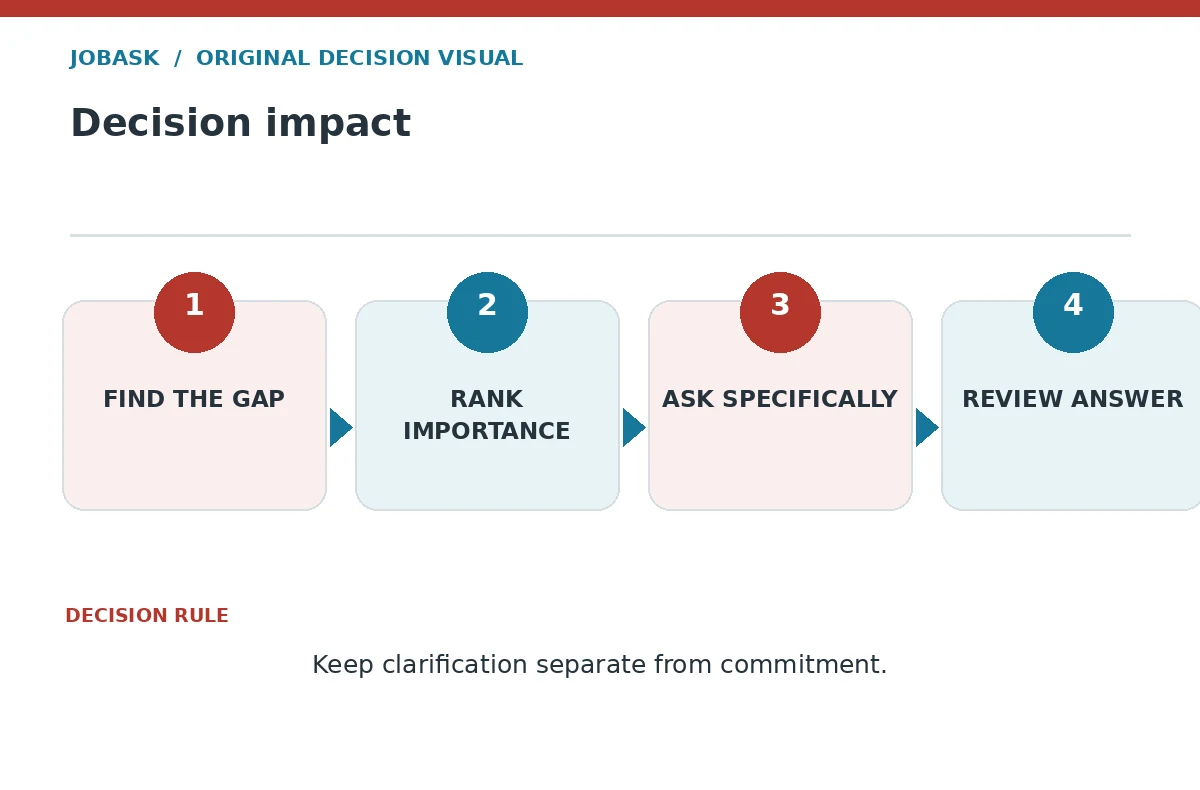
Begin by reading the written offer alongside what was said during interviews. Highlight only differences and important gaps. Perhaps the offer says “hybrid” without naming required office days, or gives a start date before you could finish a previously agreed commitment. Those are concrete clarifications. By contrast, questions about optional office snacks or the entire five-year technology roadmap usually do not need to delay a decision. Group your unknowns by decision impact rather than by how quickly they occur to you. For the basics, see our guide: What to Say When You Receive a Job Offer Without Accepting Yet.
Make three columns: fact not supplied, why it matters and who can answer. For example: “Expected on-site days; commute planning; recruiting coordinator.” This format prevents a vague “I have a lot of questions” email. Berkeley’s evaluation guidance recommends reading the offer carefully; Michigan advises reviewing the role and overall work conditions before deciding. Neither prescribes a magic number of questions. Ask as many as needed, but present only the ones relevant to the present decision.
Check Duties, Reporting Lines, and Daily Work
Job titles often cover different duties across employers. If the offer names a role but not its core responsibilities, request the official description or a summary of the team’s priorities. Confirm whether you would supervise anyone, cover a rotating shift or travel on a regular basis if those expectations could affect your decision. Do not invent a role expansion because an interviewer mentioned “potential growth.” Ask what belongs to the starting position and what might be discussed later.
Useful phrasing: “Could you confirm whether weekend coverage is part of the regular schedule or only an occasional assignment?” This offers two factual alternatives that a recruiter can answer. If the company says a manager will clarify after acceptance, evaluate whether the remaining uncertainty is acceptable to you. A written explanation may be more dependable than an offhand conversation, particularly if your decision depends on those hours or travel arrangements.
Clarify Location, Schedule, and Start Logistics
Ask what “remote,” “hybrid,” “flexible” or “field-based” means for this team instead of imposing your own interpretation. Does the role require a defined office location, regular travel or a particular time zone? Does the proposed start date account for any known onboarding requirements? These are logistics, not demands for special treatment. Do not assume you can work across jurisdictions or that equipment will be shipped before a written policy confirms it.
A hypothetical candidate could write: “The document lists Denver as the location; in the interview we discussed two remote days each week. Would you confirm the regular schedule for this position?” This example is fictional and contains no claim about an actual employer. If you already know the schedule and only want a personal accommodation or a change, that is a different conversation and may require a tailored request, not a routine factual clarification.
Distinguish Clarification From a New Proposal
A clarification asks what an existing document means: “Does the listed start date assume onboarding is complete?” A negotiation proposes a change: “Could we consider a later start date?” The distinction matters because the recipient may need different authority to answer each. If you want to discuss pay or contract language, prepare specific questions and use reliable guidance appropriate to your situation. This article does not provide salary comparisons, a negotiation script or legal interpretations.
Do not send an acceptance sentence followed by “but only if” unless you genuinely intend to propose a conditional arrangement and understand its implications. It can create uncertainty about whether you have committed at all. Instead write: “Before I make my decision, could you clarify…” and wait for the answer. Berkeley and Michigan encourage candidates to address open terms before deciding, while emphasizing that employers differ in what they can change or clarify.

Send One Focused Email Before the Deadline
Original hypothetical email: “Subject: Operations Coordinator Offer — Two Questions. Hi [Name], Thank you for the written offer. I am very interested in the position and am reviewing the details before responding. Could you confirm (1) the expected weekly office schedule and (2) whether the start date of [date] remains the planned date after onboarding? I can send my decision by [agreed date] once I have those details. Thank you for your help. Best, [Name].” None of these names or arrangements represent a real vacancy. Our guide “After Accepting a Job Offer” covers a practical checklist before day one.
If the recruiter already provided a response deadline, use it accurately; do not imply an extension was granted when you merely asked for one. Keep the subject line recognizable and preserve the original thread when appropriate. If the recruiter needs time to investigate an answer, politely ask whether the decision deadline can also move. A longer question list may call for a scheduled phone conversation, followed by a brief written confirmation of any resolved facts.
| Question priority | Recommended action |
|---|---|
| Decision-critical | Ask the recruiter before accepting |
| Helpful but nonessential | Clarify if time permits; assess uncertainty |
| Preference or requested change | Separate into a proposal or negotiation |
| Already confirmed in writing | Record it; avoid asking a duplicate question |
Evaluate the Replies With a Decision Matrix
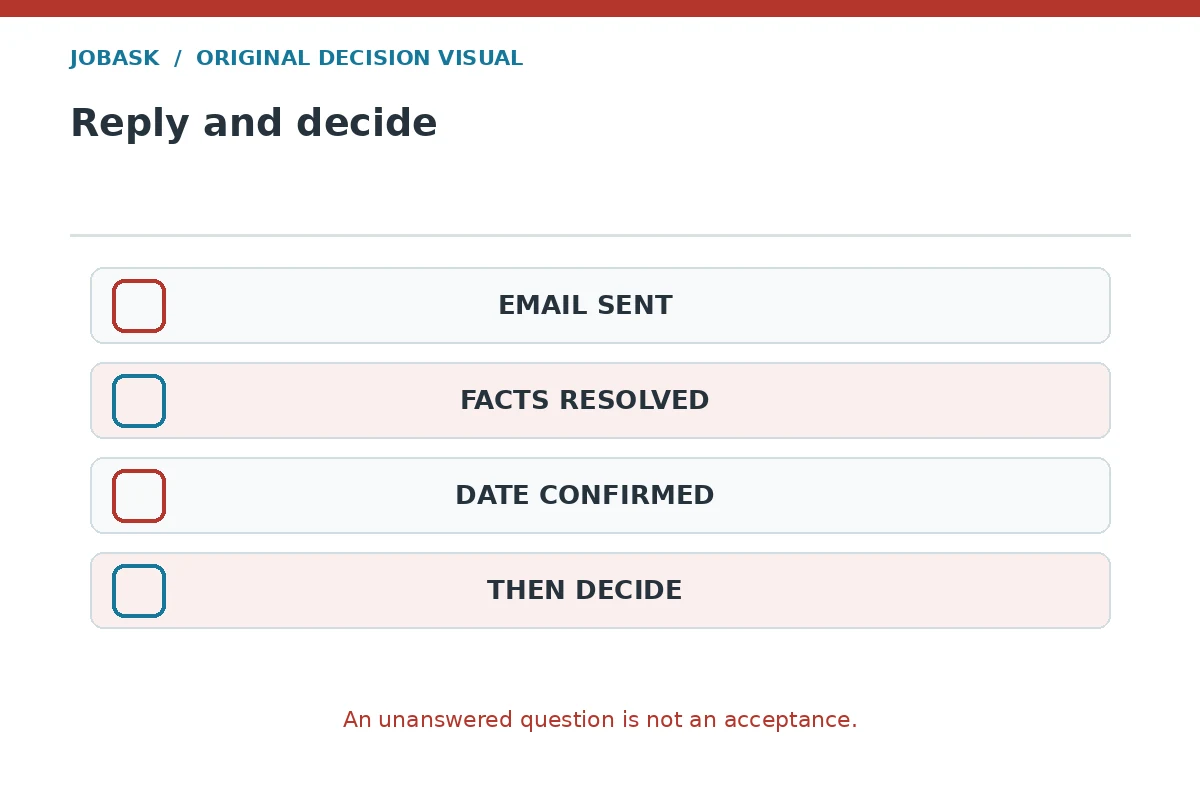
When answers arrive, record each one beside its source and whether the issue is resolved. A recruiter may say a schedule is “usually flexible” while the written policy specifies set office days. Ask what rule applies to the actual role. Mark each item green for resolved, amber for acceptable uncertainty, or red for a material issue that remains unanswered. These labels are a private decision aid, not a scoring system employers use.
If an unresolved term is important enough to affect your choice, do not force the decision into a yes merely because the deadline feels close. Ask for a reasonable extension before it expires, or make an informed decision with the information you have. The NACE guidance on offers favors enough information for thoughtful decisions rather than one universal calendar rule. Neither an unanswered question nor a request for time guarantees that an employer will extend its offer.
Keep Security and Privacy in the Conversation
You may be asked to provide administrative details during onboarding, but do not treat a vague job offer as authorization to share bank credentials or pay a fee. The FTC documents fake recruiters who impersonate employers and hurry candidates toward payment or personal-data collection. Verify the sender through an independently found company contact, especially if the request arrived unexpectedly or moved from professional email to private messaging.
Limit the email to information that is relevant to the role and that you are comfortable sharing. You need not explain private family or medical circumstances simply to ask about a schedule. If the offer contains complex legal provisions or restrictive terms you do not understand, seek qualified advice for your jurisdiction rather than assuming a general online guide resolves them. This article is about asking clear pre-acceptance questions, not interpreting contracts. Our walkthrough on how to accept an internship offer and verify the next steps sets out each step.
How We Research This Job Offer Decision
We cross-checked university job-offer evaluation lists and NACE guidance to select decision-critical questions. The matrix distinguishes existing facts from proposals; all example emails and workplace terms are fabricated solely as illustrative scenarios.
Sources and Editorial Transparency for This Guide
Source pages checked October 20, 2026: www.career.berkeley.edu — source 1; careercenter.umich.edu — source 2; www.naceweb.org — source 3; consumer.ftc.gov — source 4. We link to these resources so readers can check the original guidance. This is general career communication guidance, not individual legal, financial or employment advice. For disclosures see the JobAsk affiliate disclosure. We have not claimed any affiliate approval for resources linked here.
Related Workplace Guides
- How to Respond to a Job Offer With Questions Before Accepting
- Thank-You Email After Accepting a Job Offer: What to Say Next
- Before Accepting a Job Offer: Compare the Terms That Matter to You
- What to Do After Accepting a Job Offer: Your Pre-Start Checklist
- How to Decline a Job Offer by Email Before You Accept It
No. Focused, polite questions about material details help you decide responsibly and reduce misunderstandings.
Yes. Ask the employer to confirm the actual schedule, location and any regular travel requirements.
Not if the unanswered details may change your decision. Send a clarification request first, then make a separate acceptance.
Follow up and request a specific extension before the deadline; do not assume silence means the deadline moved.
A request to explain an existing term is a clarification; asking to change a term is a separate negotiation that may need further research.