
In a customer service interview, choose one job-related strength you can prove and one genuine weakness you are actively improving. A useful answer pairs a specific task with what you personally did, what changed, and the part someone else authorized or completed. For this role, a possible strength is active listening and accurate follow-up; a possible development area is waiting too long before escalating an exception. These are ideas to test against your own experience, not traits to claim automatically.
The examples below are hypothetical, not stories you should memorize as your own. First compare the employer’s posting with your actual responsibilities. Choose a real a complete contact note and authorized handoff or describe its method safely; keep refunds, account changes, private customer information confidential or within authorized decision-making. Interviewers may ask what happened after your action, so prepare the answer in a way you can defend without private data or invented numbers.
Choose a strength that leads to a clear next step
Customer service strengths are not just friendliness or patience. BLS describes handling questions, orders, complaints, contact records and referrals to supervisors; different industries assign different powers to representatives. Pick a strength that turns a customer’s request into an accurate record and authorized action. Active listening, calm explanation and follow-up can work well if you have an example.
Distinguish empathy from a promise you cannot make. A representative may acknowledge a customer’s frustration and explain the available process without committing to a refund or policy exception. Interviewers learn more from how you obtained the right information and set expectations than from a claim that everyone left happy.
Turn an interaction into a credible strength story
Describe one real request, your questions, what you recorded, the options within policy, and the final communication. A hypothetical example is a delivery discrepancy where the representative verified the order, summarized the issue, checked the standard resolution, and involved a supervisor for an unusual adjustment. The result can be a correctly routed case and an informed customer rather than a guaranteed positive review.
If your example came from retail rather than a call center, say so. Do not claim that you improved satisfaction scores unless you know the actual measurement, population and your part in the result. Protect customer names, account numbers and private details when telling the story.

Use escalation timing as an honest improvement area
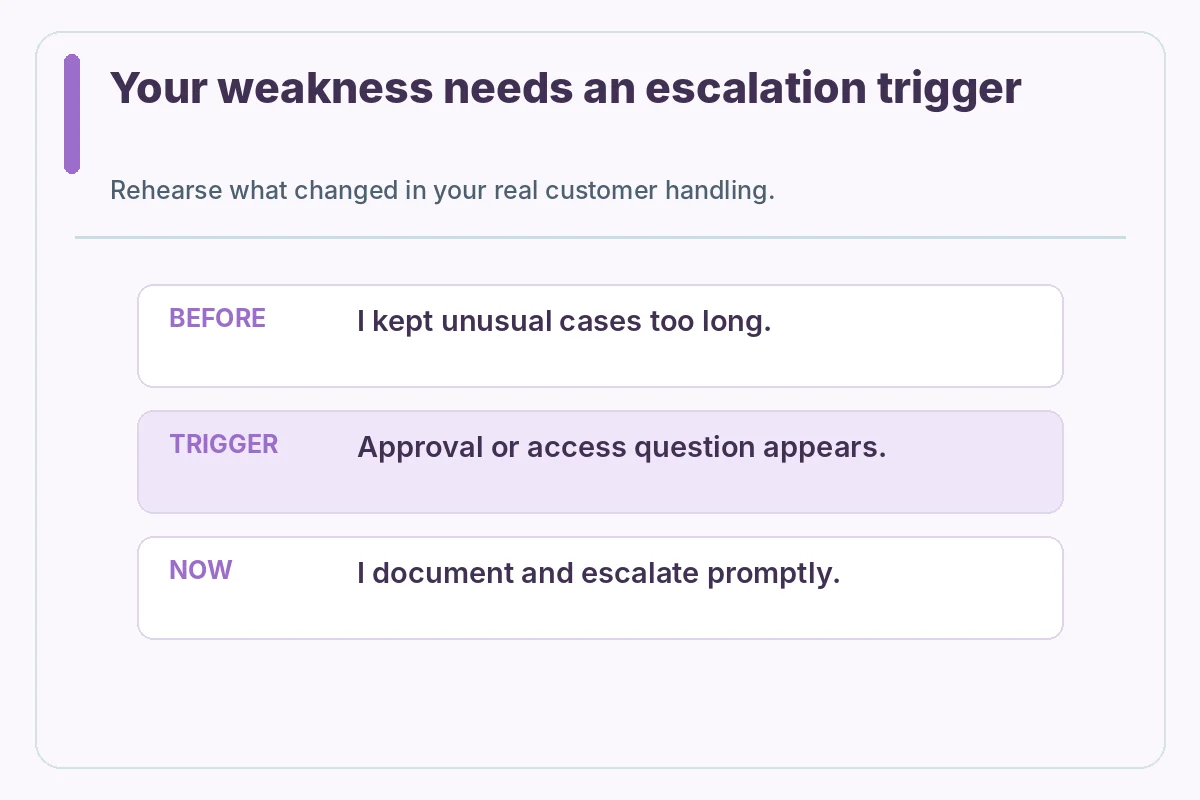
A workable weakness might be trying to solve every unusual case alone instead of requesting help when the issue exceeded your authority. Describe when you recognized the problem, what delay or confusion occurred, and what trigger you now use. For instance, you might escalate sooner when a request requires a manager’s approval, a safety decision or an account access change.
Do not present unauthorized refunds, identity verification shortcuts or casual handling of protected records as acceptable mistakes. If your improvement process includes a supervisor or security team, say who is responsible. “I now know when to ask” is weaker than explaining the explicit boundary you check before acting.
Keep empathy, resolution, and approval in separate boxes
Your answer can show that you listened carefully while still being clear that another team resolved the issue. An escalation is not a failure if it was timely and properly documented. Use precise verbs: clarified, recorded, explained, routed, monitored, or confirmed. Do not change them to “approved” or “fixed” unless you personally had that responsibility.
If a customer was upset by a policy, explain how you communicated the available choices without blaming the policy or inventing an exception. A good interview answer also names what you did after handing off a case, such as checking the promised update through an approved channel.

Prove your contact documentation process safely
You could describe how a contact record captures the request, relevant verification performed, action taken, owner, and next contact time. A synthetic example is useful for explaining consistency without exposing real records. Do not reproduce screenshots from a live customer system, including even apparently harmless partial identifiers, unless permission and privacy controls are clear.
Tell the interviewer how you avoid making assumptions about facts the customer has not confirmed. A note that states “customer reports incorrect item” is more reliable than asserting that the warehouse made a mistake before it has been investigated. Clear notes help later team members without overstating certainty.
Adapt answers to phone, chat, and in-person channels
The channel changes the evidence. In phone support you may need to summarize a call and confirm next steps verbally. In chat you must write concise and accurate updates. At a counter you may manage a queue while maintaining discretion. Choose an example from the channel you know and explain what would need training in another channel.
Do not claim you can manage multiple concurrent chats just because you handled many in-person customers. A truthful transfer is that you have practiced prioritization and clear communication, while recognizing the platform-specific workflow and data handling standards you would need to learn.
Prepare the paired answers without a forced happy ending
For a strength, begin with a phrase such as “I clarify the real request before selecting a next step,” then give your own example. For a weakness, describe a real earlier pattern, the safeguard you adopted, and a modest verified improvement if one exists. Not every case ends with a thrilled customer or a perfect score; timely explanation and correct escalation are legitimate outcomes.
Record the exact part of the interaction you owned. If the support team resolved it after your handoff, your contribution may have been collecting the right facts and setting a reasonable update expectation. Avoid speaking as if you alone achieved the entire team’s result.
Ask how quality and escalation are measured
Good follow-up questions include who can authorize exceptions, how unresolved cases change hands, what information a contact note must capture, and how new representatives receive coaching. These questions help you decide whether your strengths fit the team’s real workflow. They also make your improvement plan concrete: you can learn the organization’s specific triggers rather than assuming all help desks use the same policy.
Use a practice card with request, verification, allowed action, escalation and follow-up. If your proposed answer skips one of those elements, revise the story. The aim is to show trustworthy service, not to promise unlimited discretion.
An Example Answer You Must Adapt to Your Own Experience
Hypothetical example: A customer described a delivery mismatch. I repeated the order details to confirm I understood, documented the issue, and explained that a supervisor needed to approve a nonstandard adjustment. I then checked that the customer received the promised update. This is a made-up situation to illustrate a responsible answer. Use your own real situation, responsibilities, limits and result when speaking to an employer. If you never did the action, do not borrow the example as your work history.
Before the interview, write two short drafts: a strength story centered on active listening and accurate follow-up and a weakness story centered on waiting too long before escalating an exception. For each, mark the specific action, the available evidence, who else participated and any result you can confirm. Read each aloud. Replace jargon with clear verbs, and remove any number you cannot substantiate. An honest limitation with a real change in method is better than an untested claim of perfection.
How We Research and Verify This Guide
We compared job-relevant interview guidance with occupational descriptions and current search results on November 2, 2026. The U.S. Office of Personnel Management explains how interview questions can be tied to job competencies and how situation, action and result fit a behavioral example. Occupational references describe common tasks, not mandatory duties for every employer. The scenarios in this article are fictional, not verified candidate outcomes, hiring predictions or guaranteed interview scripts. The website’s relationship policy is available in our affiliate disclosure.
OPM Structured Interview Guidance: OPM explains job-related interview questions and the Situation/Task, Action, Result answer structure. Source reviewed November 2, 2026; always verify the particular job posting and employer procedure.
Official Occupational Reference: BLS describes customer communication, contact records, complaints and supervisor referral. Source reviewed November 2, 2026; always verify the particular job posting and employer procedure.
OPM Structured Interview Guidance: OPM explains structured interviews and assessment of job-related competencies. Source reviewed November 2, 2026; always verify the particular job posting and employer procedure.
More Interview Preparation Guides
Yes when paired with a specific example of understanding a request, explaining next steps, and acting within policy.
Discussing delayed escalation can work if it was a real growth area and you can explain the trigger and process you now follow.
State what you handled, who owned the decision and how you completed the handoff. Do not claim another person’s resolution.
Only if the metric is real, can be explained, and relates to your actual work. Do not invent scores.
No. Use minimal anonymous facts or a clearly labeled hypothetical scenario instead of identifying information.