
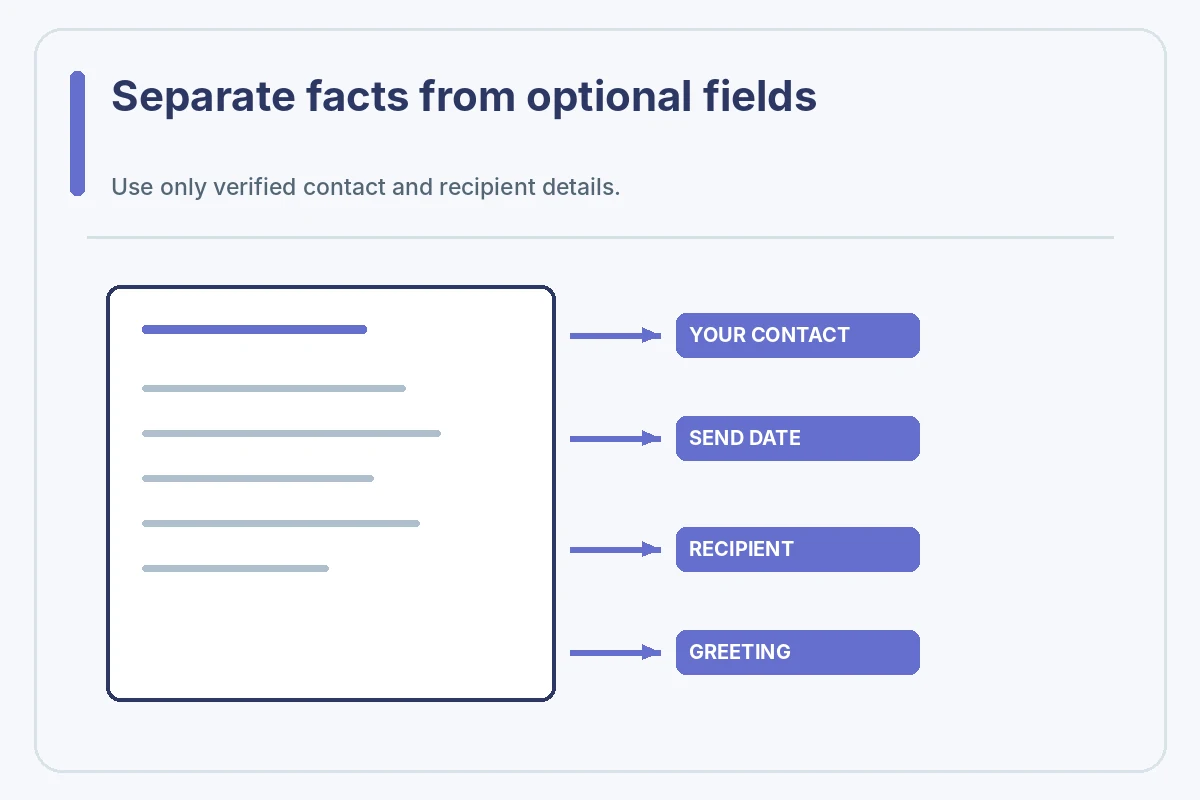
In a cover letter attachment, place your name and reliable contact details in a simple header, followed by the actual date and recipient information if it is available and relevant. For a cover letter pasted into an online application box, the portal may already capture those details; the greeting and message may be enough. Never invent a contact person, mailing address or job reference to make a template look complete.
The header is a routing aid, not a biography. Use the same name spelling and working contact methods as the resume and application form. If the employer gives a required format, use it even if a career-center sample shows a different address block. This guide focuses on verifying header fields, not rewriting the whole body of the letter.
Build the applicant contact line
A practical header might contain your full professional name, email address and one phone number you can answer. Add your city or a relevant portfolio link only when useful. You do not automatically need a full home street address in a digital application; consider what the employer requests and whether location matters for an on-site role.
Check every character by opening a saved draft rather than trusting autocomplete. An incorrect email or an inaccessible portfolio link defeats the purpose of a tidy header. If your email display name differs from the name on your resume, make the identity consistent where possible. Avoid inserting personal ID numbers, birth dates or other sensitive details that the application does not request.
Use a real submission date
For a traditional letter, use the date on which you are sending or submitting that version. Do not leave a sample date from a template or set a future date unless the letter will genuinely be submitted then. A straightforward month-day-year form is easy for a US reader to interpret.
A date is contextual information, not a guarantee that the application reaches an employer on that day. An applicant who drafts on Monday but submits on Thursday can update the date for the Thursday version. Keep a saved copy of what you submitted so later edits do not make your own record misleading.
Only include recipient information you can check
If a recruiter or hiring manager is named in the actual posting, copy their name and title carefully. If the posting identifies only a department, you may use an appropriate department label. When no recipient address is provided, do not scrape an unrelated office address and call it the hiring address.
For a printed letter mailed to a specified address, a full employer block may be appropriate. In many digital PDFs, a shorter verified recipient block can be more useful than a fictional mailing location. Dartmouth illustrates formal business-letter blocks; CareerOneStop also shows conventional header examples, but neither removes the need to follow the specific posting.
Handle an unknown name professionally
When the decision-maker is not known, use a neutral relevant greeting such as “Dear Hiring Manager” or “Dear Search Committee.” Do not guess an honorific, gender, department or personal connection. The goal is to address an appropriate reader respectfully without implying research that did not occur.
If the posting lists a contact person for accessibility questions rather than hiring, that does not automatically make them the addressee for your letter. Ask whether there is a verified hiring contact only when feasible, and otherwise use a neutral greeting. A correctly targeted letter with honest evidence matters more than an invented name.

Decide what the application channel needs
A PDF attachment often benefits from a visible applicant header and date because the document may be downloaded separately. An email message already has sender information and timestamp; a redundant postal block can make the main message harder to reach. A form text box may request only a short statement and provide contact fields elsewhere.
For a hypothetical portal asking for “cover letter text, 2,000 characters,” copy the greeting, selected paragraphs and closing rather than the full page header. If instructions specifically ask for an address or requisition number within the text, include the verified requested item. The channel decides formatting; it does not change the requirement to tell the truth.
Use a small verification table before sending
Compare the letter with the application: applicant name, role title, employer name, location if mentioned, date and contact method should agree. Verify whether the contact named in the header is still at the organization and associated with the position. Do not assume a company office address from search results belongs to this vacancy.
An illustration can contain sample placeholders such as “Your verified email” and “Recipient, if known,” but remove them from the actual submission. A placeholder left in the final PDF is a more concrete error than a less decorative header. Avoid copying someone else’s contact details from a public letter example.

Keep the header accessible after export
Use normal document text, a readable font and simple alignment instead of an image containing your name. The final exported PDF should show selectable contact details when possible. This makes it easier to proofread and less likely that a conversion will distort the email address or a link.
Open the PDF and scan the first 20% of the page for misspellings, cut-off lines and unexpected gaps. Then compare the applicant contact details against the resume one more time. If an employer requires the whole letter inside its own template, adapt your information there instead of sending a conflicting extra block.
Worked Example: A Draft You Must Personalize
Hypothetical sample only: “Taylor Morgan | your real email | your real phone”; “November [submission day], [year]”; “Hiring Committee, Example Organization”; “Dear Hiring Committee:”. Each bracketed item is an instruction, not information to leave in the document. For an online form with separate identity fields, the candidate might begin at the greeting.
Treat this example as a demonstration only. Do not copy fictional employment, names, credentials, results or contact information into a real application. Recheck each detail against your records and the employer posting. When a system does not show a submission receipt, do not claim that a saved document was delivered.
Verify This Letter in Its Actual Submission Format
Before sending, reread the headline question: cover letter header and date. Verify that the visible letter matches the employer and role, the claims describe things you actually did, the document or text is readable in the target channel, and no sample placeholders remain. A practical check has four steps: compare the posting, open the exact submission file, inspect its content or preview, and record the actual submitted status. Do not treat this guide as a promise of a recruiter response.
When you adapt the letter for another employer, repeat the check from the beginning. Employer-specific instructions outrank generic examples, and digital portals may behave differently. A clear application is valuable because it communicates your experience faithfully, not because a particular font, file name, software or page layout is universally approved.
How We Research This Guide
We compared first-party career-center cover-letter guidance, Microsoft Word documentation where relevant, and the JobAsk topic inventory on November 2, 2026. The guidance describes practical formatting options rather than mandatory US-wide hiring rules; real job postings and submission platforms take priority. Examples and names are fictional, not verified candidate outcomes. Read our affiliate disclosure.
Career guidance source: CareerOneStop describes the purpose and usual sections of a concise, tailored cover letter. Reviewed November 2, 2026.
Career guidance source: Dartmouth career center explains letter layout, spacing and recipient blocks. Reviewed November 2, 2026.
Career guidance source: University of Nebraska–Lincoln explains printed-letter section order and adapting a cover letter to an application text box. Reviewed November 2, 2026.
Career guidance source: UC Berkeley advises aligning cover-letter font, contact header and layout with a resume. Reviewed November 2, 2026.
More Resume and Cover Letter Guides
Not automatically for a digital cover letter. Include what the posting asks for and what is relevant to location eligibility.
Use the date you submit that version, unless a specific process gives different instructions.
Use a neutral, appropriate greeting rather than guessing a name or title.
Only when that is the actual appropriate recipient address. Do not assume headquarters receives a particular application.
Only as needed or requested. When the form already captures it, the message can be more compact.