
What this skill should look like in a resume
Presentation skills on a resume should describe the information you presented, to whom, and what you were responsible for after the session. “Excellent presenter” is difficult to test; “prepared a project update and presented open decisions to the class team” shows a real activity. Presentation work may include research, organizing a message, building legible slides, answering questions, recording feedback, or handing decisions back to an owner. Choose the parts you actually performed and avoid inventing audience numbers, positive feedback, or business impact.
Separate presenting from designing slides
Creating a deck, speaking to an audience, facilitating discussion, and recommending a decision are different activities. A candidate may have built a slideshow but not delivered it; another may have spoken from approved materials without deciding what content was released. The resume should make that distinction explicit. If you mainly prepared visuals, mention content organization, charts, or accessibility checks. If you delivered, mention who attended and the purpose when verifiable. Do not claim stakeholder persuasion merely because the presentation occurred.
Name the audience and the question they needed answered
An audience of classmates needs a different explanation than an internal support team, customer group, or manager. Describe the setting without turning it into a fake achievement. A student may have explained findings to a course panel; a team coordinator may have reviewed a project timeline with colleagues. Identify whether the goal was to teach a process, share status, compare options, or ask for feedback. This helps a hiring manager see the communication skill behind the event rather than a generic “communication” tag.
Show the preparation work that improved clarity
Useful preparation includes checking data against original sources, writing an outline, selecting examples, removing crowded slides, arranging visuals for readability, and rehearsing key explanations. Pick the actions you genuinely completed. If the presentation contained a numerical chart, name the data verification step before claiming analysis. If a colleague supplied the conclusions, credit your role in assembling the materials. Prepared slides can be meaningful evidence, but they do not automatically prove that the candidate led the meeting or persuaded anyone.

Distinguish giving an update from owning a decision
Many workplace presentations serve a decision-maker who retains approval. A staff member may present schedule risks and possible options while a supervisor chooses the final date. A researcher may summarize a study without approving the next experiment. This boundary is worth preserving in a resume. A truthful line such as “Presented project milestones and unresolved issues for team review” communicates clear reporting, and it avoids implying that the employee approved scope, funding, or safety-critical changes.
Rewrite weak presentation claims using a concrete event
Illustrative example: “Strong PowerPoint and leadership skills” is too broad. If true, a better statement is “Designed and delivered a short training presentation explaining the new request log to volunteer coordinators; recorded questions for organizer follow-up.” The bullet names the audience, the material, the format, and the next action. If you built but did not deliver the deck, change “delivered” to “prepared.” If questions were answered by another person, do not claim you resolved them. Adapt only the pieces you can verify.
Decide when a portfolio presentation helps
A published or independently created presentation can support a claim if the target position values communication. Career centers recommend portfolios and work samples, but employers do not automatically need a public slide deck. Check for confidential charts, client logos, named participants, unpublished work, and materials you lack permission to disclose. When a real deck cannot be shared, build a new, fictional demonstration and label it accordingly. A private employer presentation should not be converted into a public work sample simply because it looks impressive.
Keep numbers and feedback proportional to evidence
Do not invent an audience size, satisfaction score, training completion rate, or decision outcome. If your program tracked an actual attendee count and sharing it is permitted, it may add context. If a team used a presentation to plan its next step, describe only the part you know. You can still write a good bullet without metrics: what information was prepared, how it was presented, and who reviewed it. Outcomes such as “clarified open actions” should be tied to recorded follow-up, not assumed from silence.
Choose placement based on the intended role
For training, education, consulting, sales, and coordination roles, a presentation bullet may belong in Work Experience. For a recent graduate, an academic project can carry the evidence if labeled as coursework. In a separate skills section, “Presentation design” or “Public speaking” may be useful only when supported elsewhere. Put PowerPoint or Google Slides under tools if the software itself matters, and keep the activity under the relevant role. This preserves the difference between application proficiency and interpersonal delivery.

Check accessibility and purpose before claiming expertise
A well-made slide deck needs readable text, meaningful labels, and visual choices suited to the audience. If you actually checked contrast, added descriptions, simplified visuals, or provided supporting notes, those actions may be worth mentioning. Do not claim formal accessibility compliance merely because a deck used large font. For a role requiring specialized public presentations, learn the employer’s rules and approvals. Your resume should show an honest example and leave space to explain the audience questions in an interview.
Adapt the example to your own verifiable history
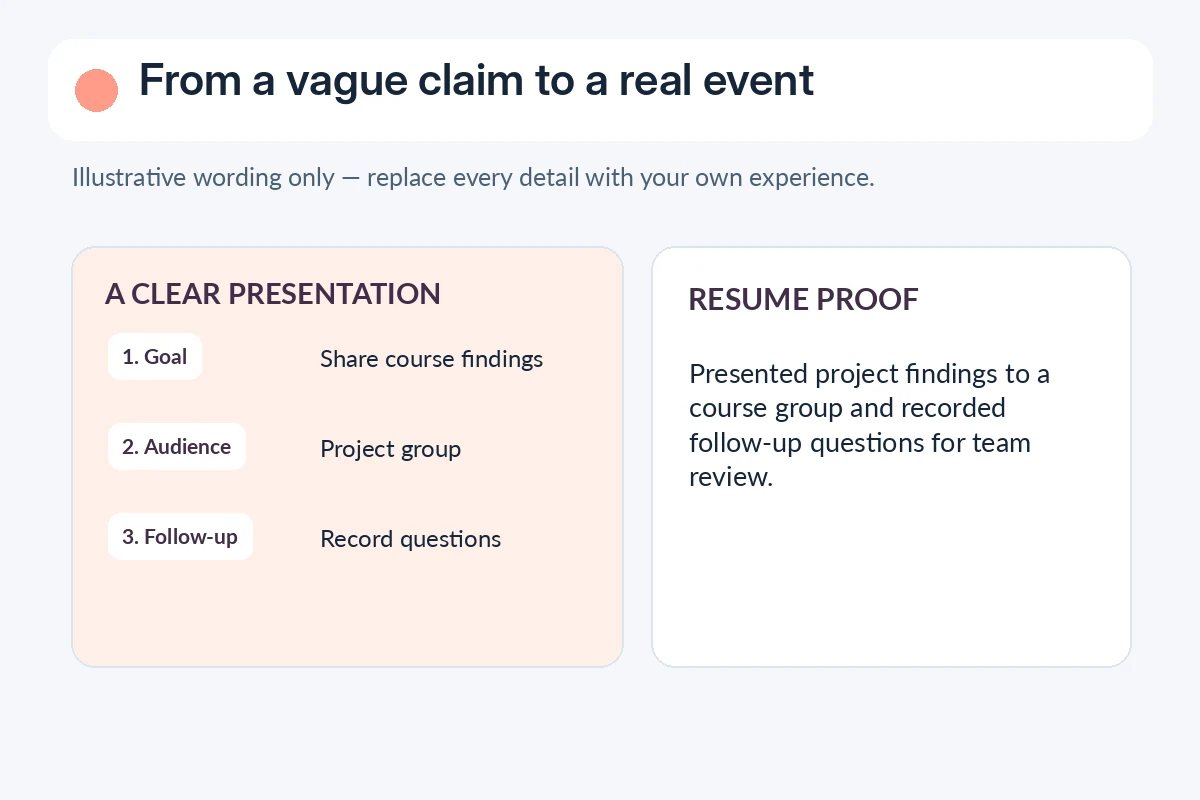
The before-and-after example in this guide is hypothetical and is not an achievement you should paste as your own. Weak version: “Excellent public speaker who inspires stakeholders.” Possible revision when true: “Presented project findings to a course group and recorded follow-up questions for team review.” Replace the setting, verbs, and tools with your actual work; remove anything you cannot explain in an interview. If you participated in a team, distinguish your contribution from a coworker’s decision and never infer a numerical result that was not measured. Use the skill only when it is relevant to the vacancy.
How We Research These Resume Skill Examples
We compared the job-search intent with previous JobAsk resume subjects, used the primary and university sources below to check how work skills should be evidenced, and made the examples deliberately hypothetical. Skill terminology does not guarantee a particular hiring or applicant-tracking-system outcome. Your responsibilities, authorization, and source records determine which claims belong on your own resume.
Sources reviewed 2026-11-03: UC Davis advises describing significant presentations and the audience when relevant. UCLA models translating presentation tasks, tools, audience, and results into accurate accomplishment bullets. UMBC lists speech outlines and evidence of public speaking as potential portfolio artifacts. Editorial and relationship disclosure: affiliate disclosure. No partner recommendation or guaranteed hiring result is implied.
More Resume and Cover Letter Guides
Only when both are supported. Tool proficiency and delivering a message to an audience are separate skills.
Yes if you label it as an academic project and identify your own preparation and delivery responsibilities.
No. Include a number only when it is accurate, relevant, and appropriate to share.
Only with permission and after removing protected information; an original demonstration may be safer.
Use “prepared,” “designed,” or “organized,” not “presented,” and describe your actual contribution.